Broadband
Tata Trusts, Google India and Intel team up to launch Internet Saathi

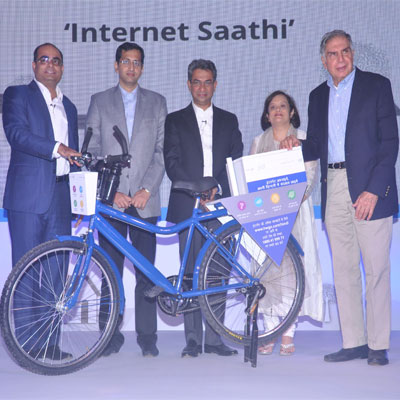
MUMBAI: The definition of philanthropy is changing with time. In a philanthropic move and in keeping with the ‘Digital India’ campaign started by Prime Minister Narendra Modi, business giant Tata Trusts and digital ruler Google India have tied up to launch a special programme called ‘Internet Saathi’ to empower women and their communities in rural India by enabling them to use internet and benefit from it in their daily lives.
The joint initiative is aimed at bridging the technology gender divide, which currently puts women in rural India at further risk of getting marginalized in the society as the world around them benefits from going online. The ‘Internet Saathi’ initiative adds on to the ‘Digital India’ vision of the country. The launch event was also attended by Tata Trusts chairman Ratan Tata.
The initiative will provide basic training on the usage and benefits of internet for women through specially designed internet cycle carts which will be used to visit areas in villages which women can easily access and also learn more from the internet.
Built on the back of a cycle, the cart is modeled on India’s traditional distribution system that is used to carry everything right from ice-creams to industrial supplies. The operator or the ‘Internet Saathi’ keen to train the women, would be akin to the village postman who was the single point contact for the village with the outside world both in terms of information as well as communication. Tata Trusts, with its vast field based ecosystem, will manage the on-ground rollout with its partners whereas Google will invest in providing the internet-enabled carts and the training content.
Google South East Asia and India VP and managing director Rajan Anandan said, “While women are making rapid progress on adoption of internet in urban areas, women in rural India are being left behind. Today only 12 per cent of internet users in rural India are women. We need to come together to address this challenge and empower women in rural India through training and programmes that can truly transform their lives. We are delighted to partner with the most respected and well known Tata Trusts who have years of experience in managing programmes of this scale. By combining our strengths, I am confident that we can achieve great results and overcome the challenges of providing easy access and digital education to women in rural India.”
“Tata Trusts strongly believes that innovative use of technology should be at the core of all its interventions that are undertaken for the benefit of the communities. Internet connectivity has become a fundamental need in any society and improves literacy and access to information that is instrumental for socio-economic development. We are glad that this joint initiative with Google will reach out to the rural communities, especially women in our country and we are confident that it will contribute towards their empowerment and also self-sustenance,” Tata Trusts executive trustee R Venkataramanan.
Speaking to Indiantelevision.com, Google country marketing director India Sandeep Menon asserted, “With this initiative we will educate and empower women of rural India about internet and take them a step closer to entrepreneurship which will enable them to be self dependent. The next set of internet users will be totally different as majority of them will come from the rural part so it’s very important to make them aware about internet.”
The initiative will also be supported by Intel who has been a long term partner of Google India’s Helping Women Get Online initiative. “We believe that the vision of Digital India will empower every Indian citizen with equal opportunities irrespective of cast, creed and gender. At Intel, we believe that skill development and innovation are imperative for realizing the Digital India vision and we are very proud to collaborate with Google and Tata Trusts on the ‘Helping Women Get Online’ initiative especially as we celebrate the Digital India Week,” said Intel vice president SMG, managing director- South Asia Debjani Ghosh.
The initiative will kick off from Gujarat, Rajasthan and Jharkhand and will be rolled out across the country eventually reaching out to over 4500 villages and 5 lakh women and rural communities across rural India over the next eighteen months. The internet cart would be available in the village for a minimum of two days every week for over a period of four to six months. It will create awareness and also try to ensure that adequate training is provided to use the devices till women are confident of using them independently. Once the cart has completed the training in a cluster of three villages, it will be moved to the adjoining cluster for completion of a similar cycle. The training of women, and the community at large would be ensured by involving SHG federations / local NGO members as trainers.
Google’s helping women get online is an initiative to create awareness about the benefits of internet amongst 50 million women in India. Under this initiative, Google conducts various outreach and educational programmes. The programme includes an awareness module, coupled with hands-on training modules aimed at teaching women how to use the internet, including via mobile devices. Since the launch of this initiative, Google has directly trained over 1.5 million women on the basics of the internet.






