Digital
NITES urges govt to mandate WFH for IT sector amid fuel saving push
IT employees’ union cites PM Modi’s appeal, seeks mandatory remote work advisory



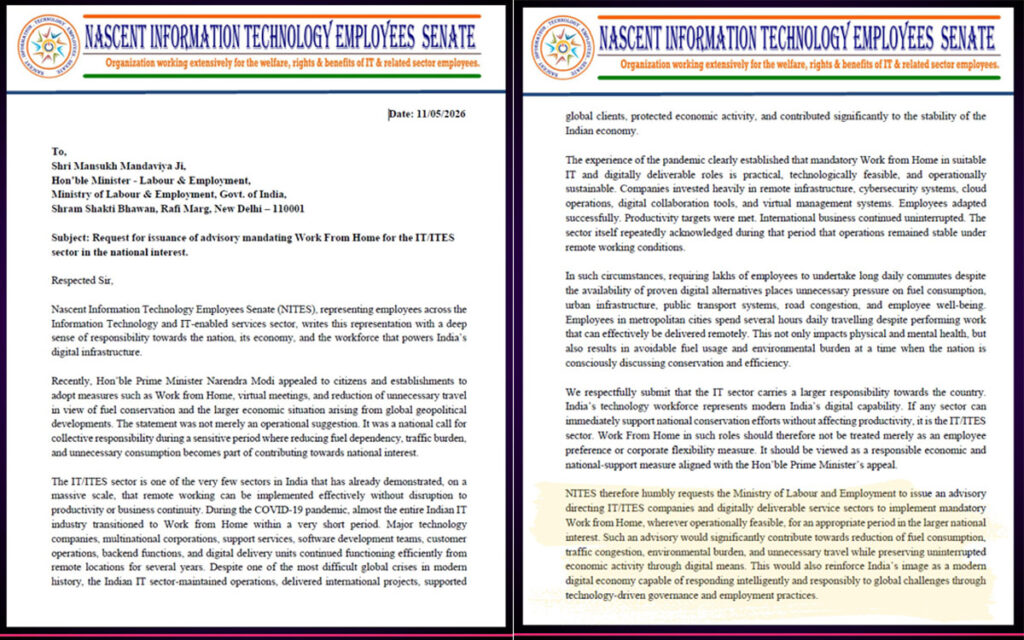
MUMBAI: As conversations around fuel conservation and economic caution grow louder, Nascent Information Technology Employees Senate, better known as NITES, has formally urged the Centre to issue a mandatory work-from-home advisory for India’s IT and IT-enabled services sector.
In a detailed representation addressed to Mansukh Mandaviya, the employee union said the IT industry is uniquely positioned to support the government’s broader call for fuel conservation and reduced travel without affecting productivity or business continuity.
The appeal comes shortly after Narendra Modi urged citizens and organisations to adopt more restrained lifestyle practices, including reduced fuel usage, virtual meetings and avoiding unnecessary travel amid global geopolitical uncertainty and rising energy concerns.
NITES argued that the Indian IT sector had already demonstrated during the Covid-19 pandemic that large-scale remote working was both operationally viable and economically sustainable.
The letter, signed by Harpreet Singh Saluja, stated that forcing lakhs of employees to commute daily despite proven digital alternatives was placing avoidable pressure on fuel consumption, traffic congestion, public transport and employee well-being.
The union said the IT sector “carries a larger responsibility towards the country” and described work-from-home not merely as a flexibility measure, but as a “responsible economic and national-support measure”.
NITES has increasingly emerged as one of the more vocal employee unions within India’s tech industry, frequently taking up issues related to layoffs, onboarding delays, workplace policies and employee welfare. Over the past year, the union has written to authorities over alleged onboarding delays at Infosys and Wipro, concerns around bench policies at Tata Consultancy Services, and workplace compliance matters.
The development is likely to reopen the larger debate around hybrid work, employee flexibility and corporate productivity, especially as India’s tech industry balances economic caution with return-to-office mandates.