Fiction
Sudhir Sharma’s journey: From facts to fiction

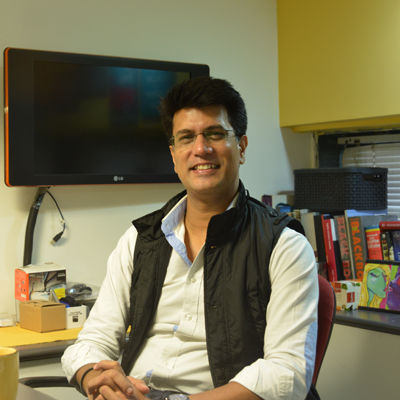
MUMBAI: A fearless producer, who has brought a change in the television industry with his out-of-the-box thinking. He is someone, who doesn’t believe in following the herd which is busy minting four-five shows at a time, but is satisfied doing one at a time. A firm believer of hard work and determination towards his art, he is one of those producers who strive to bring about a change in society through the powerful medium – television.
We are talking about the owner of Sunshine Productions, Sudhir Sharma who has seen a meteoric rise in the television industry. The husband-wife duo of Sudhir and Seema Sharma have come a long way in providing viewers with niche shows on television like Miley Jab Hum Tum and 12/24 Karol Bagh. The two have dabbled in direction and scripting, apart from production as well.
From news to fiction

It was at a very young age (standard six to be precise) that Sharma became certain of making his career in either television or films. He started his career with Rajat Sharma in the news and current affairs section of Zee TV, which was the first private channel to produce news pieces, in 1992. He also directed the famous show, Janta Ki Aadalat and many other projects on Star Plus.
After spending almost six years in directing news programmes, he then shifted to Mumbai in 1997. This was the time when he decided to work on fiction series. It was this drive which gave birth to Sunshine Productions in 1998.
Starting a production house poses challenges, and Sharma too had his share. Surprisingly, the biggest challenge came from his news and current affairs background, as people got a little wary about his capability to handle fiction series.
Sharma recalls the time he has spent with Ebrahim Alkazi, a famous theatre personality, in the national capital while he was working on news related projects. He believes the time he spent with him, gave him the exposure and the understanding of what is needed to create a fiction!
Under his banner, Sunshine Productions, he began with directing ad films and music videos. From 1999 to 2005, the production house was known for creating packaging and promos.
Initially, he focused mainly on making TV promos for all the top shows of Hindi general entertainment channels (GECs) Star Plus, Zee TV and Sony. Right from Jassi Jaisi Koi Nai to KBC, the production house was known for creating launch campaigns.
It was in 2005, that the company finally got into producing shows. Flooded with offers to direct shows, Sharma was somewhere not comfortable in only directing a TV daily. He was confident that he could have a better hold on a project rather than just direct it. “The offers that came in, was a sign that we were doing something right. It was from 2005 that I seriously started thinking about fiction content,” says Sharma.
The production house is always cautious of not falling into the category of someone who is rolling out shows simultaneously. “I mean this. There are no pretences and I am not being diplomatic about it. We are very sure that we want to do selective work. We do not want to do four-five shows at a time,” states Sharma.
He is not apprehensive about the P&L of the company. “I am just conscious about the quality of work that we do because we love making and watching our each and every project. We do not do anything which is focused purely from the business perspective. I feel business will grow automatically, if I am confident and happy in what I am doing. That is the only challenge we have taken for ourselves,” explains Sharma.
For him restraining from doing many shows is a difficult task, considering the high demand for good content, directors and producers. Also, with the advent of new channels, the greed for doing more soaps is very tough to resist, at times.
When he started the production house, he was never short of good resources. He had a mini creative team – right from the DOPs to assistants, writers and creative directors – that had directed projects for the company during its initial years. “Then, they used to write promos and design logos for various programmes. So in that case, the mini creative team was already in place,” informs Sharma, who considers himself lucky to have found them.
One area, which posed challenge, was having a dedicated casting department. “Initially, I used to do the casting on my own, until three years back when Reema came on-board as casting agent and started doing a fabulous job.”
Behind the scenes
Sharma believes in working with the same writers again. Apart from the permanent employees, many professionals are also hired, as and when required for a project.
The husband and wife duo have different qualities but work as a team. Seema, who is a graphic designer, is completely engrossed in content while he takes care of the strategy.
Ideas come from either the core team or members. “Many a times, it also happens that, broadcasters give us a rough sketch. For 12/24 Karol Bagh, producer Sukesh Motwani called me and said he wanted to make a show on the Delhi middle class. Just one thought/peg is required.”
 |
Once a basic outline is created, a lot of writers come-in and pitch their ideas, out of which one is selected. Casting, he says, is the trickiest job and 50 per cent of a show’s success depends on it.
He believes that ideas can float from anywhere; from a newspaper article to a poster at railway platform. He shares that at times, writers come up with their own ideas which is quite laudable. For example, the idea for Na Bole Tum Na Maine Kuch Kaha, which ran for two seasons, came from the writer, Venita Coelho, herself. Sharmas took the lead and gave it a specific direction.
He goes on to say that the research on how to tap the viewer, (mostly) provided by broadcaster is not on his priority list. Sharma believes in doing his own research. So for Bawre, which is currently on-air on Life OK and is based in Lucknow, he went to the city and stayed there for a month to understand the culture, taste and behaviour of the people. “There I met a lot of people, did my research, shot a number of short videos and read a lot of material,” he informs. For him creative product comes from the gut and from his own conviction.
Sunshine has clicked with the youth as well through shows like Paanch, It’s Complicated, The Buddy Project on Channel V. While every genre excites him, there are certain areas which are his strengths like youth, love etc.
Dailies are here to stay!
He believes that though bi-weeklies have an advantage, the importance of dailies, which cost Rs 6-8 lakh per episode, and Indian soaps will never die. “For makers, the main concern is how to attract the audience and understand what they like and don’t like. In terms of format, daily soaps will never die in India because of the different viewing pattern here. It will not turn into a UK or a US market overnight.”
He goes on to say that earlier even mediocre shows would run for two to three years but not anymore. “This doesn’t mean that everyone will get into bi-weeklies or mini-short series. It involves a completely different science,” he opines. Finite series is a different grammar of content. “Bi-weeklies are a different type of genre which Indian audience is not exposed to so frequently. Worldwide it is a big phenomena and a big hit.”
It was 15-16 years ago, when fiction content had just started to develop. “In these 15 years, whatever content one got was put on television and viewers watched it happily without complaining. Those days are gone now. People have become choosy and demanding. They have more channels to watch and hence better quality content is needed. They will go to anyone who offers better content.”
The next step for Sharma is trying more bi-weeklies and mini-series. So is that the new trend the industry is moving towards? He quickly says, “It is very pre-mature to comment on this. But, from a content perspective, what a bi-weekly or a mini-series does is, it gives you better content and a tight script. Paanch was appreciated because of the kind of budget it had and the kind of quality it delivered.”
“Feedback should not turn into a screenplay”
Sharma has always found support from the broadcasters. For him, creative freedom is a must, and he has never faced any issues in that area. “But at the same time, producers also have to understand that the channels are investing a lot of money and time into it. If we understand that part then things are easy,” opines Sharma.
He further goes on to say that broadcasters have a lot of research and data which producers may not have. “Problem is when broadcasters start dictating the script and the feedback ends up turning into a screenplay. I hate that. Yes, strategy is their forte. It is always a collaborative effort between the makers and the broadcasters.”
Sharma agrees that there is pressure always to deliver numbers, but that for him is justified. “I feel there is nothing wrong in it. This is no charity that anyone is doing. We are in a professional environment and I don’t feel anything is wrong if the channel is putting pressure,” laughs Sharma.
But just because the efforts don’t translate into good ratings, changing the storyline doesn’t work. “One needs to be patient with the medium.” Sharma is of the view that the storyline should be changed only if the audience is unable to relate to the story.
Surprisingly, apart from the main office, the company has a 16-20 edit set up where all the post-production and edit work happens.
He broadly defines his three different set-ups. One is the back office where all the meetings take place between the writers and the casting happens. Second, is the post production set-up where one entire set of editors sit 24X7 in various shifts. These include editors, junior editors, post production operations team and creative team. Third, is where the shoot happens. Apart from the set, an office is located at Filmcity. On a daily or weekly basis, all of them meet to decide how to take things to the next level. At Sunshine, the core team consists of 50-60 people.
He recalls the moment when for his first project he needed huge funding. After that, Sharma says he hasn’t faced many issues. The initial hiccup was also because he came from a different background than other existing professionals.
By the end of this year, the company plans to delve into producing feature films.
Sunshine won the prestigious Indian Telly Awards (2010), for being The Most Promising Producers/ Production House and in 2012 won The Best Youth Show Award for ‘The Buddy Project’.







Fiction
Banijay merges with All3Media in $6.65 billion deal
Marco Bassetti will lead the combined company as CEO
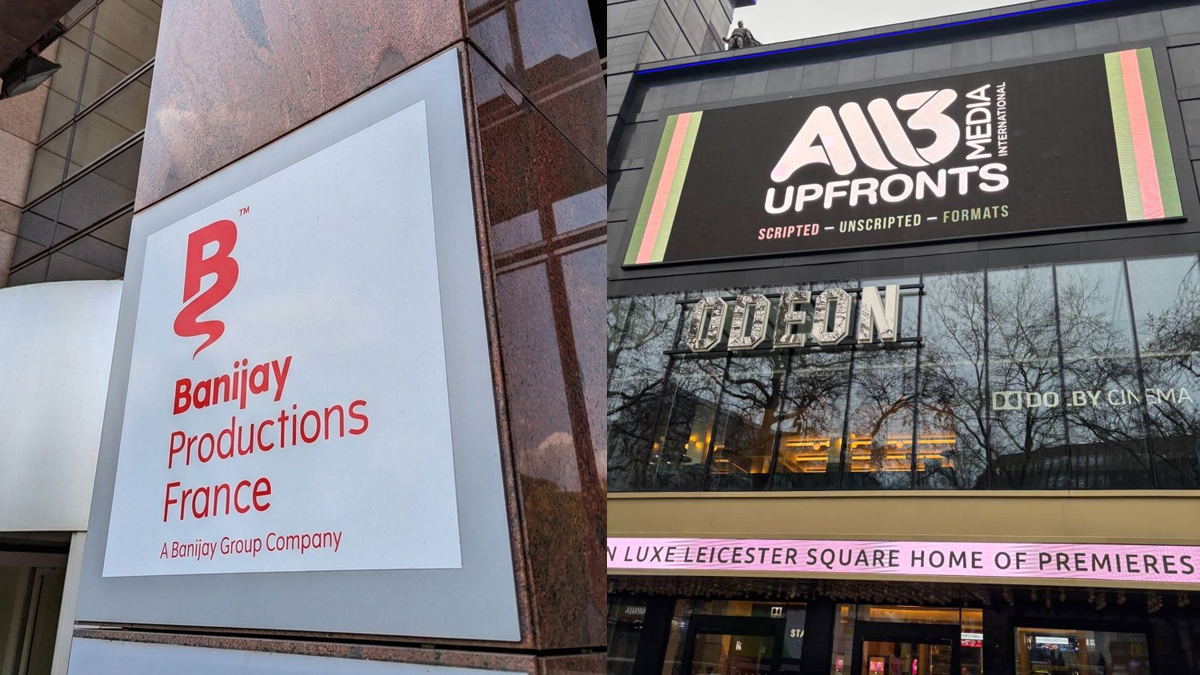
PARIS: Six years after acquiring Endemol Shine at the height of the pandemic, Banijay has struck again. The European production heavyweight is merging with All3Media in a deal that will create a television titan with $6.65 billion in revenue and redraw the contours of a fast-consolidating market.
The combined company will trade under the Banijay name and be owned 50 per cent each by Banijay Group and RedBird IMI, which acquired All3Media in 2024. The transaction is expected to close by autumn, subject to regulatory approvals.
Banijay Entertainment CEO Marco Bassetti, will take the top job at the enlarged group. All3Media CEO Jane Turton becomes deputy CEO. RedBird IMI CEO Jeff Zucker will serve as chairman.
The logic is scale. Broadcasters are commissioning less, streamers are tightening budgets and global buyers are fewer but bigger. Against that backdrop, heft matters. The merged entity will generate roughly $6.65 billion in revenues based on 2024 figures, giving it sharper elbows in rights negotiations and deeper pockets for franchise-building.
“Entrepreneurialism, ambition and creativity” remain core to Banijay’s DNA, Bassetti said, flagging plans to invest more heavily in new intellectual property, live events and emerging platforms. Turton struck a similarly bullish note, pointing to All3Media’s journey from a 2003 start-up to a global supplier of hit formats and high-end drama.
Between them, the two groups control a formidable slate. Banijay’s catalogue spans MasterChef, Big Brother, Survivor, Black Mirror, Peaky Blinders and Deal or No Deal. All3Media’s labels include Studio Lambert, producer of The Traitors and Squid Game: The Challenge; Two Brothers, behind The Tourist; and Neal Street, currently producing the forthcoming Beatles biopics directed by Sam Mendes for Sony.
The back catalogue is equally muscular. Banijay Rights holds some 220,000 hours, while All3Media International adds around 35,000 hours, forming one of the industry’s largest libraries.
Banijay, controlled by French entrepreneur Stéphane Courbit and listed in Amsterdam, counts more than 130 production companies across 25 territories. All3Media operates over 40 labels, with strong positions in the UK, US and Germany. The enlarged group will also lean into live entertainment, building on Banijay’s Balich Wonder Studio, which produced the opening ceremony of the Milan-Cortina Winter Olympics, and the Independents.
The deal marks a shift in tone. As recently as October, Bassetti suggested that mergers and acquisitions were not a priority. But the drumbeat of consolidation has grown louder. Mediawan has moved for Peter Chernin’s North Road. David Ellison’s Paramount has agreed to a $110 billion takeover of Warner Bros, with plans to combine HBO Max and Paramount plus. ITV has explored selling its media and entertainment arm to Comcast-owned Sky, though talks have reportedly slowed.






