News Broadcasting
Star News asserts it is real No. 2; claims lead position among affluent males

MUMBAI: The scrap for pole position in the Hindi news channel space may still be a while away with Aaj Tak the clear leader, but where the action is right now is for the Number 2 slot.
In clear riposte to NDTV India stating to Indiantelevision.com recently that it was now the Number 2, chief rival Star News has issued a counter. A company release asserts that it is in fact the number two channel among the the key C&S, 25+, male, SEC ABC demographic, in the Hindi speaking markets.
Going one further, it states that among SEC A males 25+ it is ahead even of Aaj Tak (data for six main metros, including Delhi and Mumbai).
The data refers to the latest TAM figures for the week ending 10 January 2004 and average channel shares for the past four weeks.
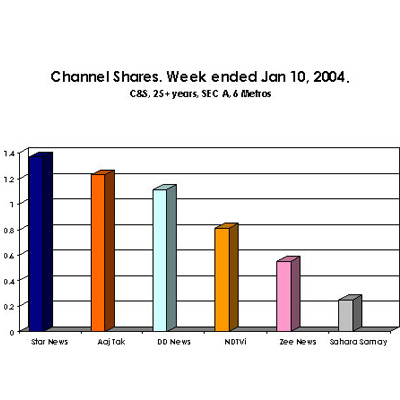
Backing up its claim to being the favourite news channel for the upmarket adult male, the release quotes channel shares for the week 4 – 10 January 2004 in C&S, 25+ years, SEC A, 6 metros that show it ranks first with 1.37, followed by Aaj Tak 1.23, DD News 1.11 and NDTV India coming in a lowly fourth with 0.81
Jan 4 – 10 4 week avg
Aaj Tak 2.9 3.04
Star News 1.34 1.37
NDTV India Hindi 1.28 1.36
Zee News 1.14 1.23
DD News 0.88 0.92
Sahara Samay 0.49 0.60
(TG: Male 25+, SEC ABC – Hindi Speaking Markets)
Commenting on the performance, president & CEO of Star News Ravina Raj Kohli is quoted in the release as saying, “The latest figures reaffirm that Star News is one of the fastest growing Hindi news channels and the most preferred channel among urban viewers in SEC A homes across six metros. This is a tremendous achievement for a young news channel.”
Two channels both claiming the Number 2 position? Indiantelevision.com asked TAM to do a run through the data that had been supplied and this is what the reply was – both seemed okay but there might be some slight differences as to the Hindi-speaking markets covered in the two sets of data that have been issued.
Further, NDTV’s data was for the period between 7 December 2003 and 3 January 2004 while Star News is more recent and covers a four-week period up to the week ending 10 January. NDTV’s data had three time bands covered – all day (24 hours), evening prime (6 pm to midnight) and morning prime (6 am to 9 am). Star News did no time band break ups and the data represents absolute channel shares (all day) over four weeks.
What this seems to indicate is that, as of now, the two channels are running virtually neck-and-neck. It may well be the coming general elections that delivers a clear verdict on the Number 2. But for the moment it looks like a “hung result”.






News Broadcasting
News18 India launches Command Centre war explainer with Arya
New show shifts from debates to decoding global conflicts and impacts

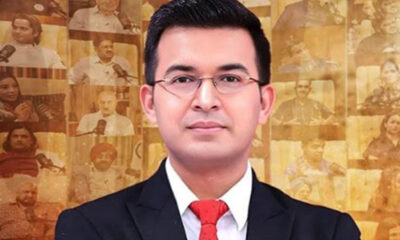
MUMBAI: News18 India has rolled out a new war-focused programme, Command Centre, featuring Gaurav Arya, as it looks to offer viewers a sharper, more grounded take on global conflicts amid rising tensions in West Asia.
Positioned as an “insider war room”, the show moves away from conventional panel debates and instead focuses on explaining military developments, decoding strategy and connecting global events to their everyday impact, from fuel prices to economic shifts.
The format leans heavily on visuals and data. The studio has been designed like a command hub, complete with large LED war maps, real-time graphics and an alert system to track developments as they unfold.
At the centre of it all is Arya, who brings his military background to simplify complex war strategies for viewers. His signature line, “Seedhi baat samjhiye”, anchors the show’s promise of clarity over noise.
News18 India managing editor Jyoti Kamal said, “Command Centre, featuring Major Gaurav Arya is designed to deliver accurate insights and a clear perspective on how evolving conflicts impact everyday life, from household budgets to national security. With expert voices analysing every development in real time, the show goes beyond headlines to decode what’s happening now, what it means, and what could come next.”
Echoing the intent, Gaurav Arya added, “In times of war, confusion is the biggest threat. With News18 India’s Command Centre, we are bringing viewers inside the war room, decoding strategies, tracking every escalation, and explaining, in the simplest terms, what it means for India and for every household. Seedhi baat samjhiye, this is where you understand not just what is happening, but what happens next.”
The weekday show will air in the afternoon slot and will also feature Gaurav Shukla, adding to its editorial depth.
With its mix of analysis, visuals and a clear focus on impact, the show reflects a broader shift in news consumption. Viewers are no longer just watching events unfold, they are looking to understand what those events mean for them.






