iWorld
Screenwriters, broadcasters, and digital freedom: ISC’2016

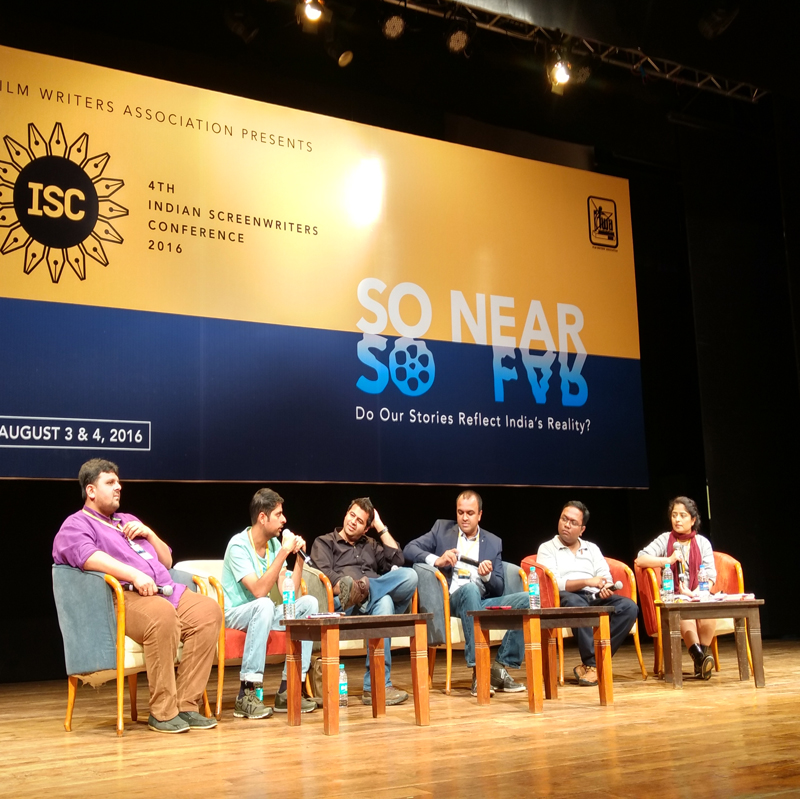
MUMBAI: What do we really mean by digital media? When did it start? Why did it start? If you too are concerned about these questions and wanted a detailed insight, the Fourth Indian Screenwiters’ Conference 2016’s session on ‘The Digital Explosion’ was the place to get all your answers. Held last week, it saw writers, producers, film makers, broadcasters get together to discuss the issues plaguing the writing community today.
The panelists included ‘newcomers’ such as the screenwriter of Masaan, standup comedian and National award winning lyricist Varun Grover, The Viral Fever (TVF) creative director Biswapati Sarkar and Y-Films senior manager Nikhil Taneja, with 16 years experience across broadcast media Youtube India operations head content Satya Raghvan and Mukta Arts strategy vice president and Whistling Woods International business development vice-president Chaitanya Chinchlikar.
Session moderator and FWA activist and Malamal Weekly and Bhool Bhulaiyya screenwriter Manisha Grover set the ball rolling by asking when did digital writing really start in the Indian context and what sparked it off.
“We initiated the web series Jay Hind when the internet was in its early stages here but it has grown so rapidly that now we have vanished, says Grover. Jay Hind was a popular Indian stand-up comedy show made exclusively for the internet platform and was launched in 2009.
Grover recalls the day when he pitched the show to NDTV Imagine. “In those time there were only two comedy shows – Movers and Shakers and Aisi Taisi Democracy – which were also written by me. The broadcasters were very excited about the script. We made the pilot and they loved it and sent it to their focus group. The focus group didn’t like our host as they couldn’t relate to him. The channel asked us to shoot the pilot again with a different host. But it was my arrogance that didn’t allow me to do what the broadcaster wanted me to do.”
Other writers on the panel to narrated how rejection by broadcasters led them to move on to digital. A move that turned out to be a boon for them as it allowed their ideas to come to fruition as completed episodes for the web.
“My seniors were pitching a show for which I wrote a few episodes,” recollected Biswapati. “We went to MTV and after reading the script, they said the content is too intelligent for Indian audiences. We didn’t understand what they meant but i guess our timing was better at that time because YouTube was growing and it slightly became easy to make the series. For me digital is not a ‘also’ medium.”
In the digital world, Youtube is pioneer, which has given a creative platform to many writers, was the consensus of the panel. “I think the big conclusion that we have drawn that digital Youtube is a ‘writers’ first’ platform. It’s probably the only medium where the writer can dictate the entire product that will come out,” added Raghvan.
Raghvan went on to explain that in the Youtube ecosystem the web series revolution was sparked off over a year and half ago and the biggest series we saw was Permanent Roommates season one which is a TVF product. The latter has also produced some formats but Permanent Roommates was the first finite story. “Till now we have seen 40 series on the platform in different shapes and sizes not only in Hindi but also in Tamil,and Telugu,” revealed Raghvan. “We are also waiting for some Marathi productions this year and people are working on it. We will also start doing this in Bengali in couple of months.”
Till 2014, in India some 150 million internet connection were there that too from the big metros. Between 2014 -2015 we saw a lot of growth in south India, expounded Raghvan.
“We are doing shows for a certain kind of audience that is there on the internet. The question that arises is what what can we give to them on the internet that they can’t find on television and in films. Digital is mostly about good writing,” adds Taneja.
The panel concluded that writers need to hone the fine art of writing for digital, as in the future, it is going to emerge as the medium and not as an “also” medium.