I&B Ministry
RS Prasad voices need for media policy

NEW DELHI: Information and broadcasting (I&B) minister Ravi Shankar Prasad today said, the government would soon formulate a comprehensive media policy after having wide-ranging consultations with the media stakeholders. That included editors, media houses, broadcasters, working journalists, media critics, small and medium newspaper representatives, non-government organizations and state governments.
Inaugurating a two-day seminar on media policy at the Indian Institute of Mass Communication – just before attending a Group of Ministers (GoM) meeting on convergence issues of regulation – Prasad said that technology has completely changed the media environment today.
He said, no government can stop the march of technology – it can only delay it, and even the delay “would be disastrous”.

According to Prasad, in the past four years, the I&B ministry has taken a number of initiatives like revision of policies on foreign direct investment (FDI) in print (both news and non-news), syndication arrangements, uplinking guidelines, DTH, CAS, community radio and FM privatization and so on.
But, he said, all these initiatives have been “reactive, rather than prospective”. He said, “The reach of technology is overpowering, altering all boundaries of relationships but we must juxtapose our policies with these technological changes. The government wants to come out with a National Media Policy looking at the media scene 10 or 20 years ahead.”
Prasad said the fast emerging situation has posed certain very important questions like creation of monopolies, cross-media restrictions and survival of small and medium newspapers.
“Globalisation, no doubt, is important and we cannot but be a part of it. But the face of globalisation has to be humanized,” Prasad said.
Referring to content in the media ,the minister said that the multiplication of media and proliferation of television channels has necessitated the need of an independent regulator for broadcasting sector.
But, he made it clear that the government has no role in this and has no intention to control the media. He said, the best course would be self-regulation but regretted that all his pleas to implement that in relation with objectionable ads on liquor and tobacco on TV channels, have fallen flat. This has strengthened the view to have a regulator, he pointed out.
Prasad said, it has to be seen whether the regulator would be under the proposed Convergence Commission or a separate broadcasting regulator. In this regard, Prasad said, though he is all for the freedom of press and creativity, the rights of the recipient – the viewer or the reader – also cannot be ignored.
The issue is to find out a way to juxtapose self-regulation with the over-powering commercialization, Prasad said, continuing that the great divide among the stakeholders in the broadcasting sector only highlights the need for an independent regulator that can help bridge this divide.
The minister also appealed to the media to lend its support to the economic reforms and said there is no escape but to carry out internal economic reforms.
The need is to educate the people about the benefits of reforms and enlist their support.
The I&B ministry’s secretary Pawan Chopra gave an overview of the three sectors of information, broadcasting and film and explained the recent polices initiatives of the government.
The two-day seminar would have five sessions and would review the existing elements of Media Policy – the available framework, need for having a Comprehensive Media Policy’, elicit the opinion of stakeholders across the spectrum and formulate policy recommendations and broad strategies for future deliberations.
The seminar is the first in the series of such events proposed to be held in all parts of the country to generate a nationwide debate and evolve a consensus before drafting the National Media Policy. Those invited to participate include the CEOs of media houses, senior editors and journalists, media critics, press institutions and organizations, non-governmental organisations, political representatives, members of Parliament, advertising experts, economists and broadcasters.
Participating in the discussion, the government’s principal information officer Sahab Singh said that new ideas must be developed and more positive measures must be taken to shake up the ad-hocism in policies and the prevailing inertia.
The responsibility of evolving a media policy, which is workable and progressive, also rest as much with the media as with the government, he said. He felt that the mature Indian press will shoulder this responsibility in having a document to guide in the media domain in the
form of a National Media Policy.







I&B Ministry
India tightens anti-piracy law, blocks sites and Telegram channels
New rules bring jail terms, fines and faster takedowns of illegal content
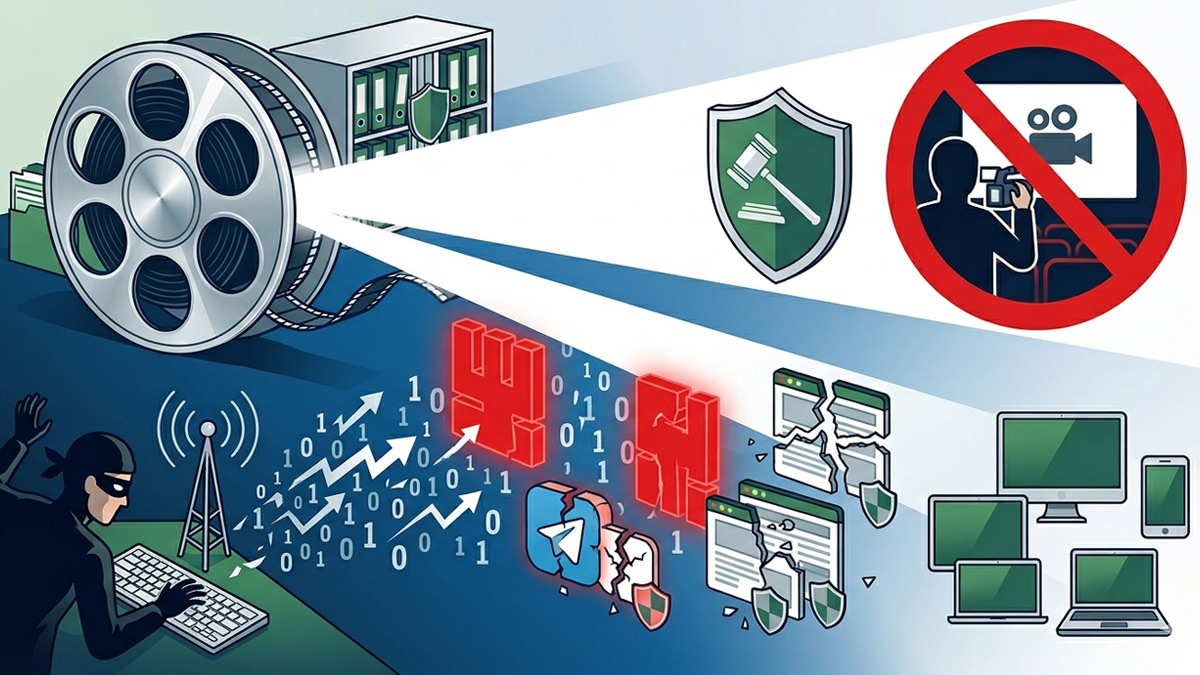
NEW DELHI: The Government of India has stepped up its fight against film piracy, invoking stricter provisions under the Cinematograph Amendment Act 2023 to crack down on unauthorised recording and distribution.
The law now imposes tougher penalties, including jail terms ranging from three months to three years and fines starting at Rs. 3 lakh, which can go up to 5 per cent of a film’s production cost. The provisions target both illegal recording in cinemas and unauthorised online transmission.
In a fresh enforcement push, authorities have notified the Telegram platform to act against piracy, leading to the identification of 3,142 channels allegedly distributing copyrighted content without permission. In parallel, access to around 800 piracy websites has been blocked through internet service providers.
The action has been taken under the Information Technology Act 2000, which empowers the government to direct intermediaries to remove unlawful content. The framework is further reinforced by the Information Technology Rules 2021, requiring platforms to act swiftly when notified of violations.
An institutional mechanism is also in place, allowing copyright holders and authorised representatives to file complaints through designated nodal officers. Once verified, these complaints trigger takedown notices to intermediaries for disabling access to infringing content.
The update was shared in Parliament by Government of India minister of state information and broadcasting l murugan in response to a query from Parimal Nathwani.
The government’s latest move signals a sharper, more coordinated approach to tackling piracy across both physical and digital channels. For the film industry, it is a step towards protecting revenues, while for viewers, it reinforces the shift towards legitimate content consumption.