News Broadcasting
Roy vows to resist political pressure in news coverage


MUMBAI / NEW DELHI: “Experienced journalists, not news readers is what we offer!”
Thus, Dr Prannoy Roy sought to differentiate his soon-to-be-launched channels from the rest of an ever-growing pack, in a 14-city press conference connected live via V-sat. The assembled media from across the country was given a first glimpse and feel of the two channels that are set to begin beaming into Indian homes from 2 pm on Monday, 14 April – NDTV India and NDTV 24×7.
Dr Roy stressed the channels’ core strength was the quality of the journalistic team behind the project. Putting forth what the channels represented, Dr Roy said the tag line for NDTV 24×7 – “Experience and truth first” and NDTV India – “Khabar wohi jo such dikaye (news should always seek to reveal the truth)”, stressed on that theme.

Dr Roy had to answer some tough questioning, especially on NDTV’s coverage of Gujarat, both at the time of the riots as well as during the recently held elections where he was accused of clear bias. Dr Roy stoutly defended the editorial stances that the channel had taken on Gujarat, adding that his channels would continue to report as it saw fit and would not buckle under political pressure.
It must also be handed to Dr Roy that he can charm his way out of any situation. “News is not entertainment as it’s a serious profession,” he said, probably with his tongue firmly in cheek. The barb appeared to be directed principally at old associate turned rival Star News though he would not be drawn into a comment as to who his main competitor was. “We are not a dumb channel for dumb people,” Dr Roy added for good measure.
Is NDTV also in the business of breaking news and going in for sensationalism? “We believe in showing the truth without any sensationalism and we will continue to do so. Without bowing under any pressure,” Dr Roy said as pens and pencils flew across notepads to take notes.
And how unfortunate that what would have been the only Indian media company to be embedded with the coalition forces in Iraq, could not do so as NDTV channels were not on air. In hindsight though, probably, NDTV would thank God as not being on air saved it from the cheer-leading that most Western embedded journos did for the Allied forces – a point that was noticed elsewhere in the world and did not go down very well with non-US and UK media and viewers.
Some of the technical advantages, NDTV says it has to offer, are as follows: as reported earlier on indiantelevision.com, NDTV has its own helicopter. Additionally, through an exclusive arrangement with Deccan Aviation, NDTV will have access to nine other helicopters and two planes in different cities.
NDTV is also employing “opt-out technology” that will allow viewers in one city to watch local programming while the rest of the country is watching the national news schedule, claims Dr Roy. “To begin with, Mumbai would have its own Marathi programme every evening,” said Dr Roy.
And following the lead provided by Star India, Mumbai is getting prominence in the scheme of things. “Mumbai will be the national news hub for the network,” says Dr Roy.
Dr Roy sought to highlight the brand equity the network possessed when he declared that advertisers had committed ad spends of over Rs 100 million even before the launch of the channel.
That Dr Roy is a shrewd businessman as also a good TV personality can be gauged from the fact that he went in for a live press conference covering 14 cities. Q&As back and forth from different cities, including “smaller centres” like Lucknow, Jaipur, Ahmedabad and Hyderabad, not only was a first of its kind in the industry, but also saved him money on separate press conferences across the country.
Though Dr Roy also felt that journalists should only ask questions and not answer them, the broadcasting icon, as a the press release described him, is adept at avoiding tricky queries.
Take, for example, a poser to him by indiantelevision.com at the Delhi studio, from where the whole exercise was being anchored, “How much of investment has gone into the two channels? What would be the size of the media campaign for the two news channels? What are the financial details for the tie-up with Deccan Aviation for the choppers for fast news gathering?”. The stock reply that journalists got – expectedly – no figures because of non-disclosure agreement.
Yes, what Dr Roy did admit was as part of the media campaign, NDTV would also use hoardings, apart from cross channel promos on One Alliance channels.
Oh, yes, the journalists were also informed that both the NDTV channels are fully Indian owned and that NDTV is a debt-free company? Nothing more nothing less.
Asked whether Murdoch’s arrival on the scene at Hughes Electronics (see indiantelevision.com headline Murdoch seals $6.6 billion deal for Hughes Electronics) would affect in some way, the transmission of the two NDTV channels from PAS 10, Roy rolled his eyes and then in his ever-charming way said, “That seems a bit far fetched.. we don’t foresee any problems. Anyway, PanAm Sat functions more as an independent organisation.”
The two proposed channels from NDTV would be on PAS 10 satellite that is already used by the Sony channels, Discovery, Animal Planet and BBC, amongst other broadcasters.




News Broadcasting
News18 India launches Command Centre war explainer with Arya
New show shifts from debates to decoding global conflicts and impacts
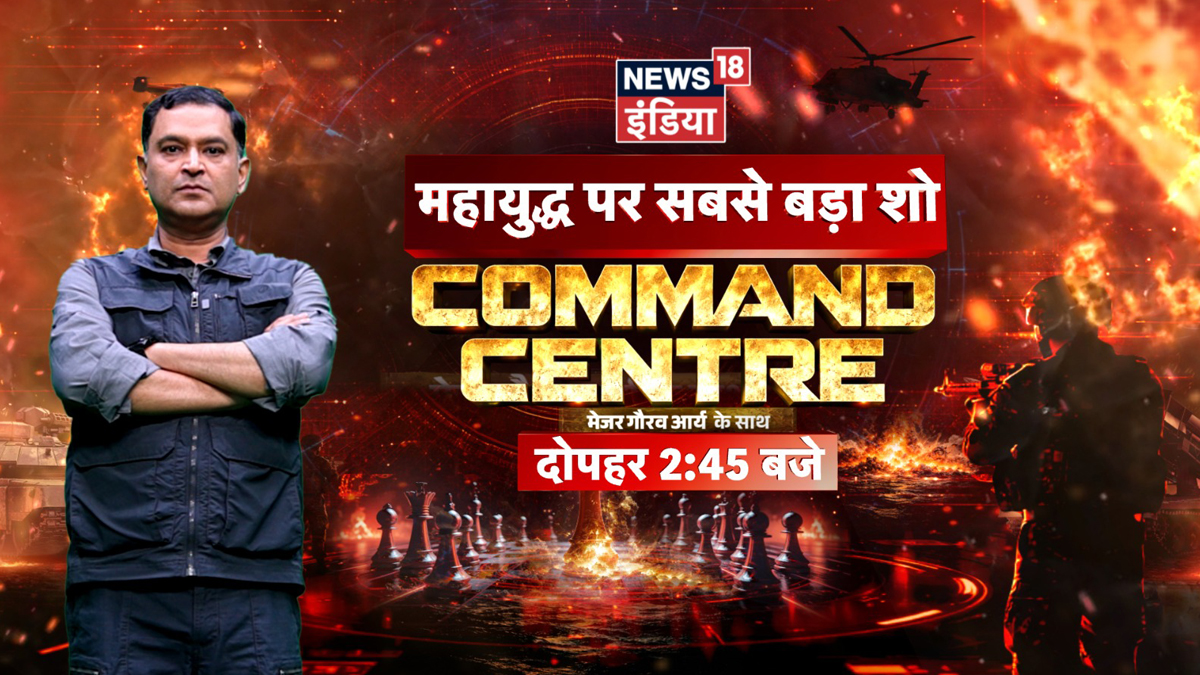
MUMBAI: News18 India has rolled out a new war-focused programme, Command Centre, featuring Gaurav Arya, as it looks to offer viewers a sharper, more grounded take on global conflicts amid rising tensions in West Asia.
Positioned as an “insider war room”, the show moves away from conventional panel debates and instead focuses on explaining military developments, decoding strategy and connecting global events to their everyday impact, from fuel prices to economic shifts.
The format leans heavily on visuals and data. The studio has been designed like a command hub, complete with large LED war maps, real-time graphics and an alert system to track developments as they unfold.
At the centre of it all is Arya, who brings his military background to simplify complex war strategies for viewers. His signature line, “Seedhi baat samjhiye”, anchors the show’s promise of clarity over noise.
News18 India managing editor Jyoti Kamal said, “Command Centre, featuring Major Gaurav Arya is designed to deliver accurate insights and a clear perspective on how evolving conflicts impact everyday life, from household budgets to national security. With expert voices analysing every development in real time, the show goes beyond headlines to decode what’s happening now, what it means, and what could come next.”
Echoing the intent, Gaurav Arya added, “In times of war, confusion is the biggest threat. With News18 India’s Command Centre, we are bringing viewers inside the war room, decoding strategies, tracking every escalation, and explaining, in the simplest terms, what it means for India and for every household. Seedhi baat samjhiye, this is where you understand not just what is happening, but what happens next.”
The weekday show will air in the afternoon slot and will also feature Gaurav Shukla, adding to its editorial depth.
With its mix of analysis, visuals and a clear focus on impact, the show reflects a broader shift in news consumption. Viewers are no longer just watching events unfold, they are looking to understand what those events mean for them.






