I&B Ministry
Right time for India-centric global news channel: Smriti Irani

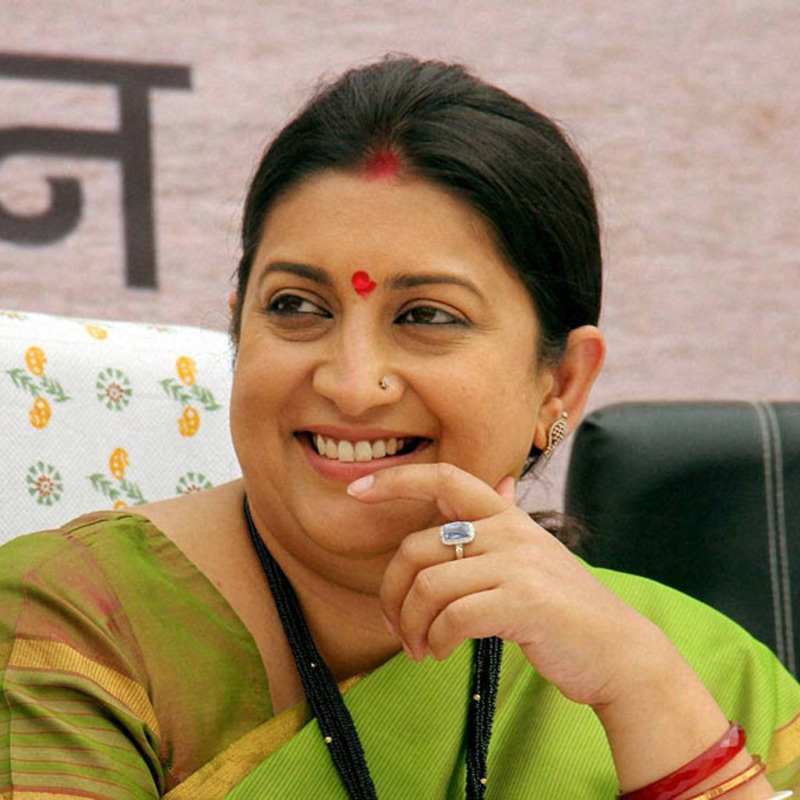
MUMBAI: Information and broadcasting (I&B) minister Smriti Irani is ready to take India abroad. The minister has said it is the right time for the state-owned broadcaster to launch a news channel focused on India for the international market, although she added that no decision has been taken yet.
In an interview with the Hindustan Times, Irani added that Doordarshan’s (DD) quality of content had to improve significantly for it to compete with private news and general entertainment channels but added that Prasar Bharati (DD’s parent body) had the kind of infrastructure and reach that could not be matched by private broadcasters.
According to Irani, the big priorities for the I&B ministry are to minimise the interference of the government, but because I&B is a sensitive area, there are many regulations that need to be reviewed. “I need to increase the efficiency of how we work, because this is the first time in the history of the I&B ministry that we have eight zones specially set up (as communication hubs for the government). Zone-wise, state-wise, our communication has to be strengthened. My third big focus is on communication in local and regional languages,” she said hoping that the CEO of Prasar Bharati can make some big-bang changes.

“The data needs to be democratised—that data cannot have only have a few masters. It is this data that helps fund channels and programmes. It is this data that drives what the viewer consumes. Advertising decisions are based on this data. The kind of programmes produced is based on this data. If the data is opaque, it leaves many questions unanswered,” she said during the interview.
But Irani is not in the habit of casting aspersions at random. “The facts at hand are simply that we do not have details on many aspects related to ratings agency BARC (Broadcast Audience Research Council), and when BARC gives us that information I can make a more informed decision. As things stand, there’s very little understanding of BARC in the public domain,” she said.
She said that there have to be more voices from regional media and language-based media houses — editors, creators. “On budget day, when DD was the only channel with the finance minister and ministry officials, we saw a 582 per cent growth in viewership,” she added.
On the talks of expanding the reach of DD News to over 100 countries, she said, “If we do something like this, we will also have to involve the Ministry of External Affairs, but there is no decision on this. Yes, the timing is right to do something like this, and the market also seems to be ready.”
She brushed away claims that the department controls advertising. “That’s a misconception. Government departments and ministries decide how much they want to spend and where they want to spend it. We just become the channel for implementing it. To say I&B decides who spends what and where is an anomaly,” she pointed out.
Also read:
MIB mulls broadcast of DD News to 100 countries
Doordarshan’s R-Day broadcast notches up record TV viewership







I&B Ministry
CBFC speeds up film certification; average approval time cut to 22 days
Over 71,900 films cleared in five years as digital system shortens approval timelines

MUMBAI: The Central Board of Film Certification (CBFC) has significantly reduced the time taken to certify films, with the average approval timeline now down to 22 working days for feature films and just three days for short films.
Operating under the Ministry of Information and Broadcasting, the statutory body certifies films for public exhibition in line with the Cinematograph Act, 1952 and the Cinematograph (Certification) Rules, 2024. The rules prescribe a maximum certification period of 48 working days, though the adoption of the Online Certification System has sharply accelerated the process.
Over the past five years, from 2020-21 to 2024-25, the board certified a total of 71,963 films across formats. Of these, the majority fell under the U category with 41,817 titles, followed by UA with 28,268 films and A with 1,878 films. No films were certified under the S category during the period.
Film approvals have also steadily risen in recent years. The CBFC cleared 8,299 films in 2020-21, a figure that peaked at 18,070 in 2022-23 before settling at 15,444 films in 2024-25. During the same period, 11,064 films were certified with cuts or modifications.
Despite the high volume of certifications, outright refusals remain rare. Only three films were denied certification over the last five years, with one refusal recorded in 2022-23 and two in 2024-25.
The board may recommend cuts or modifications if a film violates statutory parameters relating to the sovereignty and integrity of India, security of the state, friendly relations with foreign states, public order, decency or morality, defamation, contempt of court or incitement to an offence.
Filmmakers can challenge CBFC decisions in court. Data shows that such disputes remain limited but have seen some fluctuation. Between 2021 and 2025, a total of 21 certification decisions were challenged before High Courts, with the number rising to 10 cases in 2025.
Responding to a question in the Rajya Sabha, minister of state for information and broadcasting L. Murugan shared the data. The question was raised by Mallikarjun Kharge.
With faster timelines and a largely digital workflow, the certification process appears to be moving at a far brisker pace, signalling a shift towards quicker clearances for India’s growing film output.