iWorld
Rajnish Lall: Ad man to OTT content maker

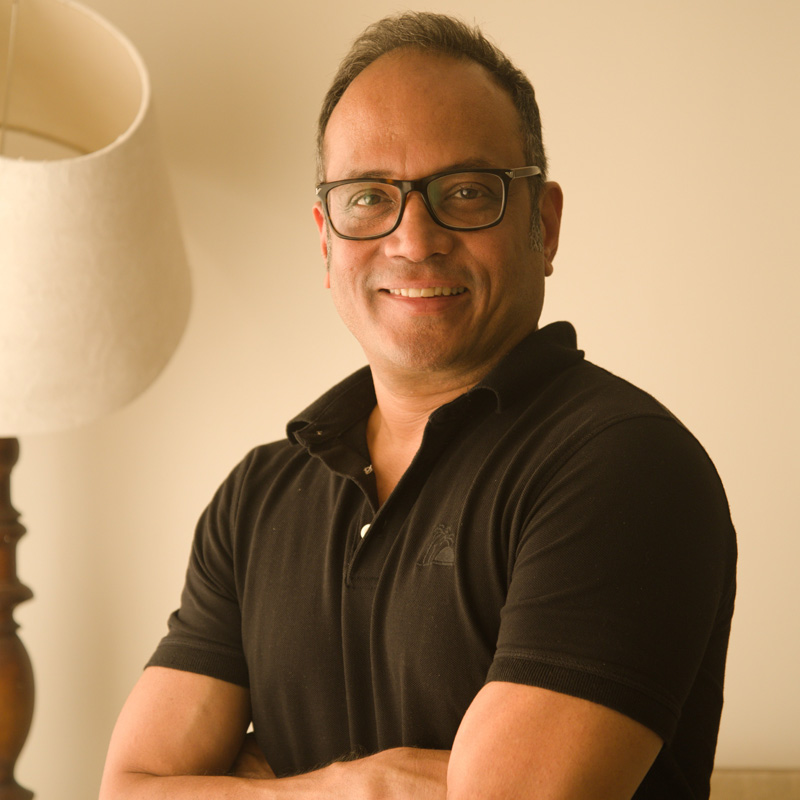
MUMBAI: With the explosion of OTT space in the last decade, the content creation folks are having a gala time like never before. In India alone, there are currently over 30 OTT platforms fighting aggressively for the customer’s wallet-share and screen-time by offering movies, music, sports streaming, satellite channels and original shows.
This ever-increasing demand for original content has opened new avenues for young production enthusiasts, for whom content creation is more than just minting money.
Rajnish Lall is one such movie enthusiast who forayed into production with his debut short movie ‘The Fall’ 13-years ago. Having spent more than a decade in corporate life working with advertising agencies (Clarion, Contract & Bates) and as marketing head of B4U Music, Lall had little experience in production before his first project.
Lall says that he was bored with his life as an ad-film maker and was looking for a new medium to tell stories close to his heart.
His very first project, The Fall, a slickly shot love tale was a 10-minute-long silent movie featuring Rahul Bose and Nauheed Cyrusi.
Recalling his experience, Lall says that the entire movie was shot in a single day with a budget of just over Rs 60,000 including the post-production cost.
“To be honest, even Rs 60,000 felt like a big amount then. We shot the entire movie on Super 16 camera as there were no HD cameras then. I collected old footage left from earlier shoots. I asked my colleagues to edit it for free. Believe me, no one in our team, right from Rahul Bose, Nauheed Cyrusi, cinematographer Vishal Sinha (who shot Bhoot), composer Sandeep Chowta, was paid. People liked the movie and that gave me the confidence to continue making films,” remembers Lall, who since then has produced over 500 ad-films, one movie and two full seasons of a web-series.
“The best thing about this experience was that I could tell stories that I wanted, which was not possible in ad-film making.”
Lall’s next big break was Sooper se Ooper, which he produced in 2013 with Reliance Entertainment. However, he still regrets that the movie did not do as well commercially despite having a good script and some amazing performances.
“2013 was a terrible year. Most of the movies produced by Reliance had tanked. There was Besharam, Zanjeer 2. At one stage, Reliance was not even upbeat about releasing the movie. When it was released, it got a good response, but since the following week was the release of Krrish 3, it could not reach its full potential,” he says, candidly accepting that its failure set him back.
Big success came to Lall soon enough with Thinkistan, a story about changing dynamics of advertising in India in the late 1990s, when satellite TV helped advertisers find new reach. Told through the characters of English-speaking Hema and Hindi-speaking Amit, the series, released on MX Player, is like a love letter to the changing world of Indian advertising.
Lall says that Thinkistan is the story of India in transition in 1990s, told through the contrasting experiences of two advertising professionals, one English-speaking and urban, the other Hindi-speaking and coming from small-town India.
The show mirrors India’s evolution in the 21st century where more and more talent is coming from small-towns, where the likes of Piyush Pandey and Prasoon Joshi have elbowed-out big, established English copywriters and where Hindi is secure about its place in India and co-exists comfortably with English, adds Lall.
The immediate success of Thinkistan, however, has not taken Lall of his feet. Any other usual run-of-the-mill producer would have tried to cash-in on its success by making similar shows. Lall, on the contrary, is taking his time to find a truly inspiring idea.
“We were approached by multiple OTT players following the success of Thinkistan. However, I was clear that I do not want to do any regular, usual thriller, sex-comedy or family soap-opera. I am looking for a unique, big idea. I am in no rush to make just another ordinary show,” says Lall.
Talking about the streaming platforms, Lall says it has definitely improved availability of funds for shows.
“OTT is here to say. However, its success and reach would depend on the quality of content offered,” quips Lall, who believes there is enough space for the more than 30 OTT players to co-exist in the expansive Indian market.
Lall also has no qualms in accepting that he writes and produces shows for a global audience.
“I do not belong to Hindustan, but a place called Thinkistan. My stories are based in India, but the emotions my characters deal with are universal, they cannot be limited to one particular time or society. I am making original, premium, web content for a global audience,” says Lall, adding that the coming of OTT platforms will help Indian content reach global audiences.
To an extent, this has already happened. The international Emmy awards this year definitely has an Indian footprint. Two Indian shows, Sacred Games and Lust Stories, are nominated for Best Drama.
“Indians have a natural talent for storytelling, even longer form storytelling. We gave the world Mahabarata, the world’s longest poem. If Indian producers are honest to their creative integrity, Indian content can truly reach a global audience.”
Talking about censorship on OTT, Lall says that while he is principally opposed to the idea of censorship, he is also honest enough to accept that some of the producers have used the freedom offered by OTT platforms irresponsibly by overdoing nudity and cuss words, even when it’s not required by the script.
“Not all of us are watching shows on mobiles. People are also watching shows on TV with families. And too much nudity is definitely a barrier in providing entertainment to this audience.”
He underlines that while everyone is cashing-in on nudity and violence, there is still some reluctance on the part of Indian producers to take up politically sensitive issues.
While Lall did not share specifics of his current projects, he did tell us that he is working on a show which tells the story of a product over 100 years, starting from the non-cooperation movement in the 1920s to 2019.
Asked about his personal favourite shows, Lall says that he likes the scripting of Family Man and Made in Heaven. In foreign shows, Fauda and Barry.
Having carved a niche space for himself as a producer of ad-films, web series and TV shows, Lall is currently in a happy space, where he is willing to wait and invest his time and energy in a truly inspiring idea, very much like the tag-line of his show Thinkistan – ‘Idea Jiska, India Uska’.