News Broadcasting
Preparations for Ariane 5s dual mission enters final phase
MUMBAI: Preparations for Arianespaces next Ariane 5 flight are entering their final phase as the missions dual-satellite payload is integrated at the Spaceport in French Guiana.
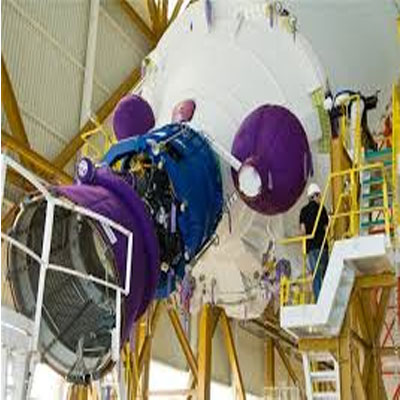
For the upper element of the payload stack, Indias Insat-4A spacecraft has been encapsulated in its ogive-shaped Ariane 5 payload fairing, which will protect the satellite during the launchers initial ascent.
It is the first in India’s new Insat-4 telecommunications spacecraft series that will provide coverage over the Indian subcontinent and carries a mixed payload of 12 Ku-band and 12 C-band transponders. All the 12 Ku Band transponders have been leased out to the new Tata-Sky joint venture for DTH.
Produced by Switzerlands Contraves, the fairing carries noise suppression pads on its interior walls and is to be jettisoned at an altitude of approximately 100 km.
In parallel action at the Spaceport; the European MSG-2 meteorological spacecraft has been installed atop the Ariane 5. This places the spin-stabilised MSG-2 platform in the lower payload position on Ariane 5.
Liftoff of the Ariane 5 with Insat-4A and MSG-2 is set during a launch window that opens at 7:33 pm local time at the Spaceport and continues through 8:01 pm on 21 December (India time 4:03 am to 4:31 am on 22 December).

News Broadcasting
BBC to cut up to 2,000 jobs in biggest overhaul in 15 years
Cost pressures and leadership change drive major workforce reduction plan
LONDON: BBC has unveiled plans to cut up to 2,000 jobs, roughly 10 per cent of its global workforce, in what marks its biggest downsizing in 15 years.
The announcement was made during an all-staff meeting led by interim director-general Rhodri Talfan Davies, as the broadcaster moves to tackle mounting financial pressures and reshape its operations.
Between 1,800 and 2,000 roles are expected to be eliminated from a workforce of around 21,500. The cuts form part of a broader plan to save £500 million over the next two years, aimed at offsetting rising costs, stagnating licence fee income and weaker commercial revenues.
In a communication to staff, BBC interim director-general Rhodri Talfan Davies said, “I know this creates real uncertainty, but we wanted to be open about the challenge,” acknowledging the impact the move would have across the organisation.
The restructuring comes at a time of leadership transition. Former director-general Tim Davie stepped down earlier this month, with Matt Brittin, a former Google executive, set to take over the role on May 18, 2026.
While some cost-cutting measures are being implemented immediately, the majority of the structural changes are expected to roll out over the next few years, with full savings targeted by the 2027–2028 financial year.
The broadcaster had earlier signalled its intent to reduce its cost base by around 10 per cent over a three-year period, warning of “difficult choices” as it adapts to shifting economic realities and audience expectations.
With operating costs hovering around £6 billion annually, the BBC’s latest move underscores the scale of the financial challenge it faces, as it balances public service commitments with the need for long-term sustainability in an increasingly competitive media landscape.