I&B Ministry
Prasar Bharati, Mindshare in talks to increase ad spend on DD


NEW DELHI: If you really cannot beat them, then join them. And Prasar Bharati, the autonomous body which oversees the functioning of pubcasters Doordarshan and All India Radio (AIR), is doing just that.
Taking a leaf out of private satellite channels’ marketing manual, Prasar Bharati, for the first time, has decided to leverage all the channels (both DD and AIR) at its disposal for ad sales and marketing purpose.
If initial response is any indication of the bonus scheme, as it is called, then Prasar Bharati is on its way to strike gold. Mindshare Fulcrum, which does all the media buying for FMCG behemoth Hindustan Lever, is in negotiations with Prasar Bharati to avail of this bonus scheme which will mean HLL’s ad spend on DD will increase dramatically.

But Prasar Bharati has to tread very carefully is what media analysts point out. “With the total number of channels which Prasar Bharati has, it can leverage it to maximise advertising revenues by going in for bonus airtime on other DD and AIR channels,” KS Sarma, chief executive of Prasar Bharati, told indiantelevision.com in an interview.
So, what is the bonus scheme? For example, if an advertiser commits an X amount of money (the various combinations are being worked out by Prasar Bharati) for DD Metro, then that company can and will get bonus airtime on one or more than one radio channels of AIR.
AIR has about 209 radio channels that work 18 hours a day, while Doordarshan has over 20 channels in its stable. The combined airtime that can be made available through cross channel bonuses is huge.
“Considering both AIR and DD’s reach, can a serious advertiser, which wants to reach out to the masses, ignore the total number of channels which we have?” Sarma says, pointing out that the bonus scheme should give a fillip to Prasar Bharati’s advertising revenues too.
According to Sarma, an offer has been made to Mindshare Fulcrum involving HLL: make use of the bonus scheme if HLL commits Rs 1,500 million of advertising on DD this financial year. The FMCG major’s ad spend for DD is said to be close to Rs 1,000 million annually.
Pointing out that negotiations are still on with Mindshare for the HLL deal, Sarma said: “In principle it has been agreed upon and if this finally happens then DD stands to gain substantially.”
When contacted, Vikram Sakhuja, managing director Mindshare Fulcrum South Asia, said: “We are definitely in talks with them (Prasar Bharati) about a deal which can boost our investments on DD. We have presented certain proposals which they are examining and hopefully some of them will go forward.”
For Prasar Bharati, is this all about increasing ad revenue? No. The shrewd businessman that Sarma is turning out to be, he realises that not all commercial time available on DD and AIR is being utilised. And to do that special schemes have to be devised to attract advertisers who spend on bulk time bookings.
Almost 25 per cent of the total air time available on DD and AIR is going waste and Prasar Bharati wants to see if the loophole can be plugged efficiently, Sarma says.





I&B Ministry
India tightens anti-piracy law, blocks sites and Telegram channels
New rules bring jail terms, fines and faster takedowns of illegal content
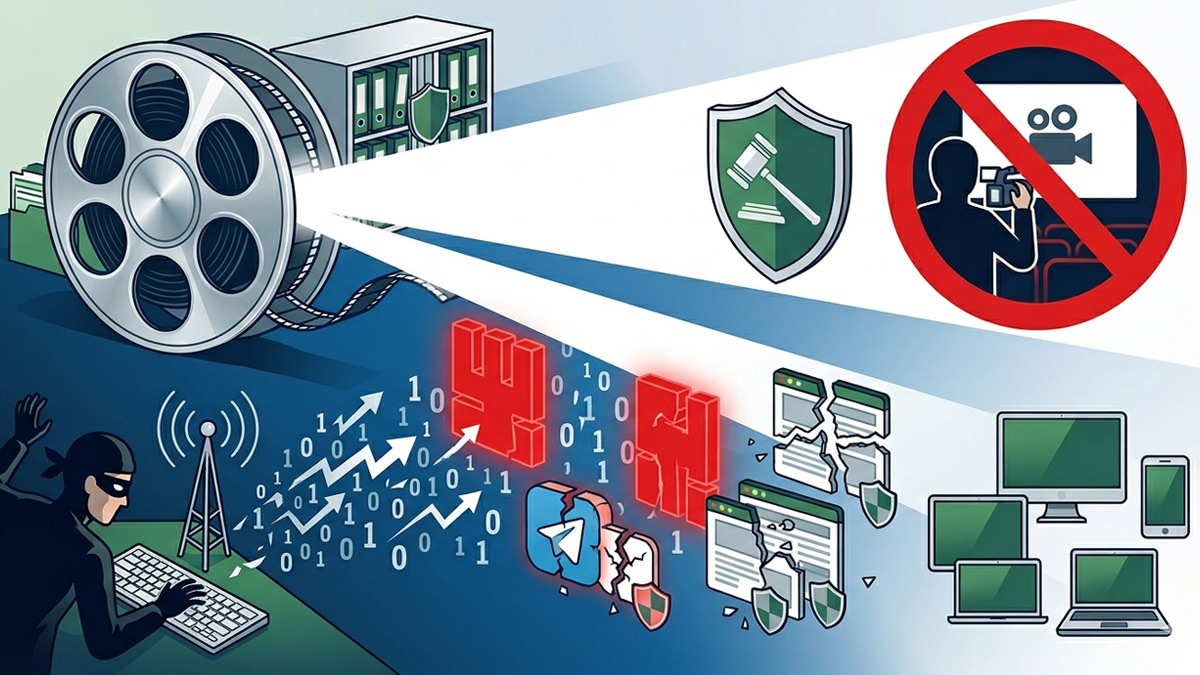
NEW DELHI: The Government of India has stepped up its fight against film piracy, invoking stricter provisions under the Cinematograph Amendment Act 2023 to crack down on unauthorised recording and distribution.
The law now imposes tougher penalties, including jail terms ranging from three months to three years and fines starting at Rs. 3 lakh, which can go up to 5 per cent of a film’s production cost. The provisions target both illegal recording in cinemas and unauthorised online transmission.
In a fresh enforcement push, authorities have notified the Telegram platform to act against piracy, leading to the identification of 3,142 channels allegedly distributing copyrighted content without permission. In parallel, access to around 800 piracy websites has been blocked through internet service providers.
The action has been taken under the Information Technology Act 2000, which empowers the government to direct intermediaries to remove unlawful content. The framework is further reinforced by the Information Technology Rules 2021, requiring platforms to act swiftly when notified of violations.
An institutional mechanism is also in place, allowing copyright holders and authorised representatives to file complaints through designated nodal officers. Once verified, these complaints trigger takedown notices to intermediaries for disabling access to infringing content.
The update was shared in Parliament by Government of India minister of state information and broadcasting l murugan in response to a query from Parimal Nathwani.
The government’s latest move signals a sharper, more coordinated approach to tackling piracy across both physical and digital channels. For the film industry, it is a step towards protecting revenues, while for viewers, it reinforces the shift towards legitimate content consumption.








