iWorld
Over 10 mn paid for OTT video subscriptions in 2019: FICCI-EY report
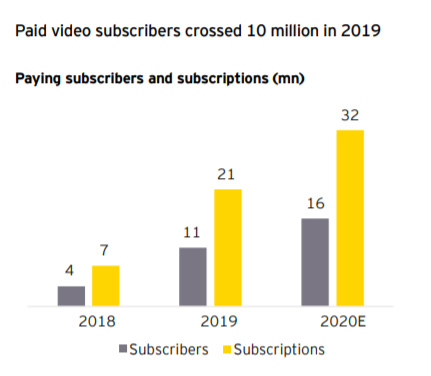
MUMBAI: The Indian media and entertainment industry has moved beyond the era where consumers are not willing to pay for premium content online. Although the number of paying consumers remains low compared to overall users, the growth is visible, according to FICCI-EY 2020 report. In 2019, over 10 million subscribers paid for 21 million OTT video subscriptions for the first time. Overall digital subscription also grew over 100 per cent to reach Rs 29.2 billion.
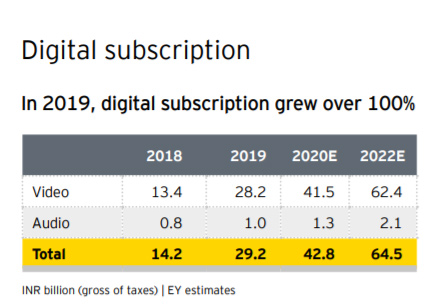
Video subscription revenues grew 111 per cent in 2019 as premium content – originals and sports – went behind the paywall and amounts paid by telcos on behalf of their customers to content owners increased significantly. Audio subscription grew comparatively slower at 18 per cent in 2019 as platforms are still in the customer acquisition phase and several free products are available. However, the percentage of paying subscribers to total OTT consumers remained less than five per cent and one per cent for video and audio, respectively.
One of the key drivers for the growth of video subscription is a cricket-heavy 2019, with Hotstar creating an annual sports pack at Re 1 per day. The report also mentioned that increased television subscription prices due to the implementation of the NTO in February 2019 led to certain viewers, mainly English content viewers, preferring to subscribe to relatively more affordable OTT services. Moreover, over 1600 hours of original content were created for OTT platforms across films and episodic content, which led to increased demand.
There were several moderations in subscription packages also. Free/trial access to leading OTT platforms was provided by telcos and MSOs, bundled with data or television subscriptions, of between one and six months. Major players including Netflix introduced several sachet packs.
The entry of Spotify, Apple Music, YouTube Music, etc. boosted the growth of audio streaming subscription during 2019 along with increasing smartphone penetration in India. The number of music streamers has increased to 180-200 million from 150 million in 2018. However, paid subscribers remained below per cent, due to the prevalence of free options across all the large streaming platforms as well as music availability on YouTube.
The report predicts that overall digital subscriptions will grow at a CAGR of 30 per cent until 2022.

iWorld
Meta plans 8,000 layoffs in new AI-led restructuring wave
First phase from May 20 may cut 10 per cent workforce amid AI pivot.
MUMBAI: At Meta, the future may be artificial but the cuts are very real. The social media giant is reportedly preparing a fresh round of layoffs, with an initial wave expected to impact around 8,000 employees as it doubles down on its artificial intelligence ambitions. According to a Reuters report, the first phase of job cuts is slated to begin on May 20, targeting roughly 10 per cent of Meta’s global workforce. With nearly 79,000 employees on its rolls as of December 31, the move marks one of the company’s most significant workforce reductions in recent years.
And this may only be the beginning. Sources indicate that additional layoffs are being planned for the second half of the year, although the scale and timing remain fluid, likely to be shaped by how Meta’s AI capabilities evolve in the coming months. Earlier reports had suggested that total cuts in 2026 could reach 20 per cent or more of its workforce.
The restructuring comes as chief executive Mark Zuckerberg continues to steer the company towards an AI-first operating model, committing hundreds of billions of dollars to the transition. Internally, this shift is already visible: teams within Reality Labs have been reorganised, engineers have been moved into a newly formed Applied AI unit, and a Meta Small Business division has been created to align with broader structural changes.
The trend is hardly isolated. Across the tech sector, companies are trimming headcount while investing aggressively in automation. Amazon, for instance, has reportedly cut around 30,000 corporate roles nearly 10 per cent of its white-collar workforce citing efficiency gains driven by AI. Data from Layoffs.fyi shows over 73,000 tech employees have already lost jobs this year, compared with 153,000 in all of 2024.
For Meta, the move echoes its earlier “year of efficiency” in 2022–23, when about 21,000 roles were eliminated amid slowing growth and market pressures. This time, however, the backdrop is different. The company is financially stronger, generating over $200 billion in revenue and $60 billion in profit last year, with shares up 3.68 per cent year-to-date though still below last summer’s peak.
That contrast underlines the shift underway. These layoffs are less about survival and more about reinvention. As Meta restructures itself around AI from autonomous coding agents to advanced machine learning systems, the question is no longer whether the company will change, but how many roles will be left unchanged when it does.