iWorld
Orange Alert as Media Chiefs Call Time on Sour Regulation

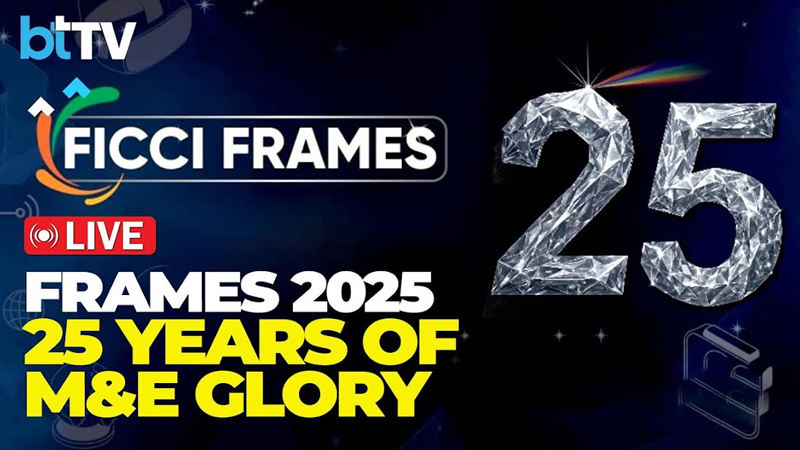
MUMBAI: When your brightest industry minds start comparing creativity to citrus fruit, you know the discussion’s got some zest. At FICCI FRAMES 2025, the session titled “Regulating the Orange Economy: Past, Present, and Future” turned into a spirited masterclass on what’s holding back India’s most vibrant export creativity itself.
Moderated by Koan Advisory’s Vivan Sharan, the panel brought together some of the sharpest voices in Indian broadcasting Avinash Pandey (CEO, Indian Broadcasting and Digital Foundation), Krishnan Kutty, head of cluster, Entertainment (South) – JioStar, Anil Malhotra (COO, Zee Media), and Yatin Gupta (COO, GTPL Hathway). Together, they dissected the bitter-sweet evolution of India’s media and entertainment (M&E) industry from its liberalisation glory days to today’s tangled web of red tape and regulation.
Avinash Pandey kicked things off with a nostalgic rewind. “We were declared an industry in 1996, and for a brief while, we were actually treated like one,” he said dryly, drawing laughter from the crowd. He recounted how the early 2000s saw broadcasting boom as a sunrise sector driven by investment, private innovation, and minimal interference.
“Then came a time when the government helped us grow,” he continued. “But today, every little aspect from pricing to packaging is regulated. We are living under a 2005 framework in a 2025 economy.”
Pandey’s lament set the tone. The orange economy shorthand for industries fuelled by creativity and culture has turned ripe, but over-regulation, panelists warned, risks turning it sour.
Krishnan Kutty of JioStar took the baton, calling for “a lighter hand and a smarter head” in policymaking. He drew a sharp comparison between legacy broadcasters and digital-first platforms. “Television is capped, controlled, and scrutinised. OTT platforms, meanwhile, stream what they want with almost no oversight,” he said.
Kutty argued that the answer isn’t to regulate the new, but to liberate the old. “Over-prescription kills innovation. Consumers don’t need protection from choice they need access to more of it.” His words echoed across an audience that included broadcasters, policymakers, and streaming executives all trying to decode the new power balance between screens.
Anil Malhotra from Zee Media added historical perspective and a dose of irony. “Cable TV arrived in India in 1985. It was regulated only in 1995. Broadcasting began in 2005, got regulated much later,” he said. “Regulation always comes late to the party and then overstays its welcome.”
Malhotra argued that in a digital-first world, it makes no sense to hold traditional media hostage to older rulebooks. “If the government doesn’t regulate new tech like OTT and AI, it must deregulate the old. Otherwise, you’re penalising the legacy systems that built India’s media strength in the first place.”
He also called for a “policy audit,” a comprehensive review of old broadcasting rules to identify those that have outlived their relevance. “We need regulation that enables, not restricts,” he stressed.
GTPL Hathway’s Yatin Gupta brought the discussion closer to ground reality and homes still running on coaxial cables. “We’re the most regulated part of the media chain,” he said bluntly. “Every rate, every fee, every package is dictated. Yet, we’re expected to compete with digital platforms that face no such limits.”
Gupta pointed out that India’s cable homes have dropped from 150 million a few years ago to around 100 million today, a staggering 30 per cent loss in a market still hungry for affordable entertainment. “We can’t evolve if we’re boxed in,” he added. “If the aim is to take India fully digital, we must support the legacy infrastructure that connects Bharat to the world.”
He called for skill development, broadband integration, and hybrid models that let cable operators transform into full-fledged digital service providers. “If we don’t, we’ll end up with an uneven playing field and an excluded audience.”
By the time Avinash Pandey took the mic again, his tone had sharpened. “Regulators talk about ‘orderly growth’,” he said with a knowing smile. “That’s a Soviet-era phrase. You can’t dictate how creativity grows, it defeats the very nature of innovation.”
He urged policymakers to think of the media sector as a living organism, one that thrives on unpredictability. “Creativity doesn’t follow command-and-control models. It needs chaos, experimentation, and freedom to fail.”
The audience broke into applause when he declared, “If you want free markets, let the market breathe.”
Despite the fiery debate, the panel didn’t write television off. Far from it. “TV still delivers high-quality entertainment at the lowest cost per viewer,” Pandey noted. “There are over 100 million Indians yet to own a television. Growth is far from over but it will stall if innovation is strangled.”
The panellists agreed that the future of India’s media sector lies in convergence television and digital not competing, but coexisting. With global streamers investing heavily in Indian stories and regional content booming across states, the creative economy stands at a crossroads.
As the discussion wound down, what emerged was less of a gripe and more of a roadmap: deregulate the old, modernise the law, empower talent, and let creativity not bureaucracy set the tone.
In a nation bursting with storytellers, artists, and innovators, the message was clear: the Orange Economy shouldn’t be juiced dry by rules made for an analogue age.
If India truly wants to be a global creative powerhouse exporting not just IT services but imagination, it must give its creators the same freedom its coders enjoy. Or as one delegate quipped while leaving the hall, “You can’t make lemonade with red tape.”