iWorld
Online Video remains the growth engine of content investment with local content still key to acquiring subscribers: AVIA OTT Summit

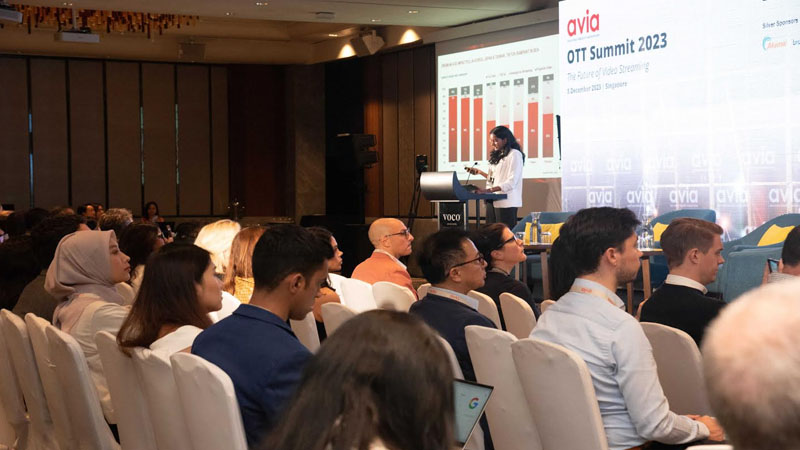
Mumbai: The Asia Video Industry Association (AVIA), held its annual OTT Summit in Singapore on 5 December, where over 90 per cent of the speakers were senior female executives from across the video industry in Asia Pacific. This year’s summit was designed to try and redress the gender imbalance seen in many industry conferences.
The Summit opened with Media Partners Asia head of content & platform insights, lead analyst Dhivya T, presenting an overview of the state of streaming in Asia, a market where competition was very much driven by a battle for share of time, with premium video on demand (VOD) fighting with social media and user-generated content (UGC).
Competition was also giving rise to new business models and strategies beyond the traditional AVOD and SVOD models, including mobile gaming, ecommerce and bundle subscriptions becoming more common. And with a higher focus in increasing ARPUs, price increases have also become prevalent.
Ex-China, online video revenues in Asia Pacific were expected to hit US$46 billion in 2028, up from US$29 billion this year. While SVOD was expected to have a CAGR of 6.4 percent, premium AVOD will see a growth rate of almost 18 percent, led by Japan, India, and Korea. In Southeast Asia, Indonesia was emerging as the leading market for AVOD, with Thailand for SVOD.
In terms of content trends and investment, although pay TV remained the largest vertical, online video was the growth engine of video content investment, with local and Asian content leading premium VOD viewership with the highest reach. Hence local content remained key to acquiring subscribers in the region, and constantly over-indexing with new users.
In the world of streaming, Free Ad-Supported Streaming TV (FAST) was also much talked about at the Summit as the new kid on the block, as it mimicked the experience of linear TV, delivering scheduled content, with advertising included. Driving the growth of FAST in Asia was the penetration of Smart TVs in the region, with 80 per cent of OTT viewers in APAC using Connected TV (CTV), and with one-third of OTT viewing on CTV, shared Samsung Ads APAC head of product marketing Samantha Cooke. But FAST channels were not always about making money, as FAST was also used for marketing, outreach and brand building, added Brightcove senior product marketing manager Roberta Cambio.
Senior marketeers from the major platforms too chimed in on the importance of brand building, as the mantra was no longer acquiring subscribers at all costs but focus on keeping the ones you have. For Shemaroo Entertainment CMO Anuja Trivedi, marketing was now more aligned to the business, as consumers who saw campaigns engaged better as well. And partnerships which built more value can only build more excitement for the product and engagement for the platform, said Trivedi. Akamai Technologies senior solutions engineer Sarah Lim, also added that people, platform and the technology were what will help drive your strategy forward for the future. “Marketing is greater than the sum of its parts,” said Lim.
With 71 per cent of viewers in APAC watching advertising supported streaming on top of linear TV viewing, OMG Singapore chair for media & measurement, AAMS & CEO Chloe Neo, was also seeing growth from regional clients with a greater inclination to look at branding, with the reallocation of budgets into OTT tending to be from the big brands, due to their expectations on quality content. While investment was coming from the linear TV side, more clients were now embracing CTV and addressability for strategic benefit, and not just for incremental reach, added GroupM CIO Southeast & North Asia, Chair, APAC Investment Committee Anita Munro.
A strong focus on content closed off the Summit, with panellists agreeing that Asian content could not be lumped together. There was huge variety within what is labelled Chinese or Indian content. ZEE5 CCO Hindi Originals Nimisha Pandey emphasised that storytelling trumped investment. “Audiences don’t care how much money has gone into content, if it connects, it connects,” she said.
Viu content acquisition and development chief Marianne Lee noted, “Each local market has their own strategy which complements the regional strategy. While it is important for the content to travel outside, the content must also do well locally,” said Lee. In agreement, Agnes content director Agnes Rozario added, “There will always be certain types of content that travel better than others. But it has to work in the home market first.”
One market which saw things a little differently was Thailand where True Corporation deputy director, planning & business development, strategic content group Kirana Cheewachuen, saw huge potential in the overseas growth and popularity of Thai content, and international success was her primary goal.
Sharing her strategy for the Pacific Rim in the closing session, Paramount ANZ EVP, chief content officer & head Beverley McGarvey said that Australia was a mature market at a pivotal point now as audiences were adjusting between more traditional legacy media and streaming. Hence accelerating growth in streaming while maintaining linear businesses and making content that can work across platforms was what was needed in order to remain viable.