iWorld
Nielsen: Millennials big-time streamers, watch 27% less TV than over 35s

MUMBAI: It’s hard enough to hold one person’s attention, let alone an entire generation’s. Millennials—now the largest generational group in the U.S.—have grown alongside advancements in technology and media platforms, placing them in intriguing territory with regard to media habits. When it comes to television, their eyes are glued to the screen. With commercials, they’re still tuned in—but their eyes are on their cell phones.
Nielsen’s inaugural Millennials on Millennials report is unique in two ways: It offers critical insight into the evolving media habits of this highly digital demographic, and it was produced by a team of Nielsen Millennial associates keen to help clients engage and reach a generation that every modern marketer is seeking a connection with.
As marketers and advertisers look for the best opportunities to reach this demographic, they need precise insight into the evolving viewing and consumption habits of Millennials, which are closely watched and coveted.

Here are three things you might not have known about Millennials that the report uncovered.
MILLENNIALS LOVE TV-CONNECTED DEVICES
TV still constitutes the majority of video consumption, but every other screen is much more valuable to Millennials. TV-connected devices (DVD players, VCRs, game consoles and digital streaming devices) compose four times the percentage of Millennials’ total video minutes than adults 35 and older: TV-connected devices account for 23% of Millennials’ total time with video, compared with just 6% for consumers 35 and older. And as a result, Millennials spend about 27% less time watching traditional TV (89% among 35+ vs. 66% among Millennials).

MILLENNIALS ARE A DISTRACTED AUDIENCE
The report looked at a handful of popular, primetime programs to understand the dynamics of multi-tasking and attention among Millennials compared with other generations. During premiere episodes of various primetime programs in the fall of 2015, Millennials were least likely to change the channel during commercial breaks.
Less than 2% of 18-34 year olds changed the channel during commercials, compared with 5.5% of 35-54 year olds and more than 8% of viewers 55 and older. Given their engagement with other devices, however, Millennials had the lowest program engagement and lowest ad memorability scores during the studied shows.
Knowing that audiences, including Millennials, may opt to skip advertising if given the choice, content providers often disable ad-skipping features in their VOD content. In terms of openness to advertising, however, Millennials are quite open to viewing ads as long as the content they are viewing is free on their mobile devices. As a result, marketers and advertisers have a notable opportunity to present their value propositions to young viewers who are tapping into the realm of content available via their connected devices.
Upon further review of Millennial habits during commercials, these viewers report that they’re most likely to use their phones—a prime outlet to engage with social media. Smartphones provide a plethora of ways users can engage with other forms of content and social media serves as a notable slice of that pie.
Given their engagement with social media during commercial breaks, it’s not surprising that Millennials score lower than older generations when it comes to ad memorability. Nielsen’s recent Millennial Media Advisors Report notes that TV ads have an average memorability of 38% among Millennials, 10 percentage points lower than among Gen X’ers 35 and over (48%).
The low memorability rates, however, don’t stem from a dislike of advertisements.
Rather, Millennials understand the necessity of ads in order for brands to inform the public of their products and services (79%) and many say that overall, ads don’t bother them (46%)—especially if the content they’re viewing is free (75%).

SOCIAL MEDIA STARS ARE “CELEBRITIES”
Among Millennials, social media stars are becoming synonymous with the word “celebrity.” In a write-in section of our custom survey, numerous respondents named several social media stars multiple times when asked: “Please list your current top five favorite celebrities.” When tested against mainstream stars, social media stars hold their own in terms of celebrity status. For example, according to Nielsen’s N-Score, a measure of a celebrity’s marketability, male Millennials have a higher opinion of trending social media stars than they do for sports stars, pop stars, actors and actresses.

METHODOLOGY
The Millennials on Millennials Report is led by Nielsen Millennial associates and analyzes the unique nature of this demographic group by leveraging Nielsen data-sets and fielding a custom survey to understand the “why’s” behind the data trends. The report includes data from The Nielsen Connected Device Report, Nielsen Custom Survey, Nielsen TV Brand Effect, Nielsen Total Media Fusion, Nielsen N-Score/Talent Analytics, Nielsen National TV Toolbox, Nielsen Social, and The Q1 2016 Comparable Metrics Report. Eight TV programs analyzed for this report were from all premiere episodes of 2015. They include a variety of genres including comedies and dramas from an assortment of different networks and episode lengths.






iWorld
Micro-Dramas Surge in India, Redefining Mobile Content Habits
Meta-Ormax study maps rapid rise of short-form storytelling among 18–44 audiences.
MUMBAI: Micro-dramas aren’t just short, they’re the snack that ate Indian entertainment, and now everyone’s bingeing between the sofa cushions. Meta, in partnership with Ormax Media, has released ‘Micro Dramas: The India Story’, a comprehensive study unveiled at the inaugural Meta Marketing Summit: Micro-Drama Edition. The report maps how the vertical, bite-sized format is reshaping content consumption for mobile-first audiences aged 18–44 across 14 states.
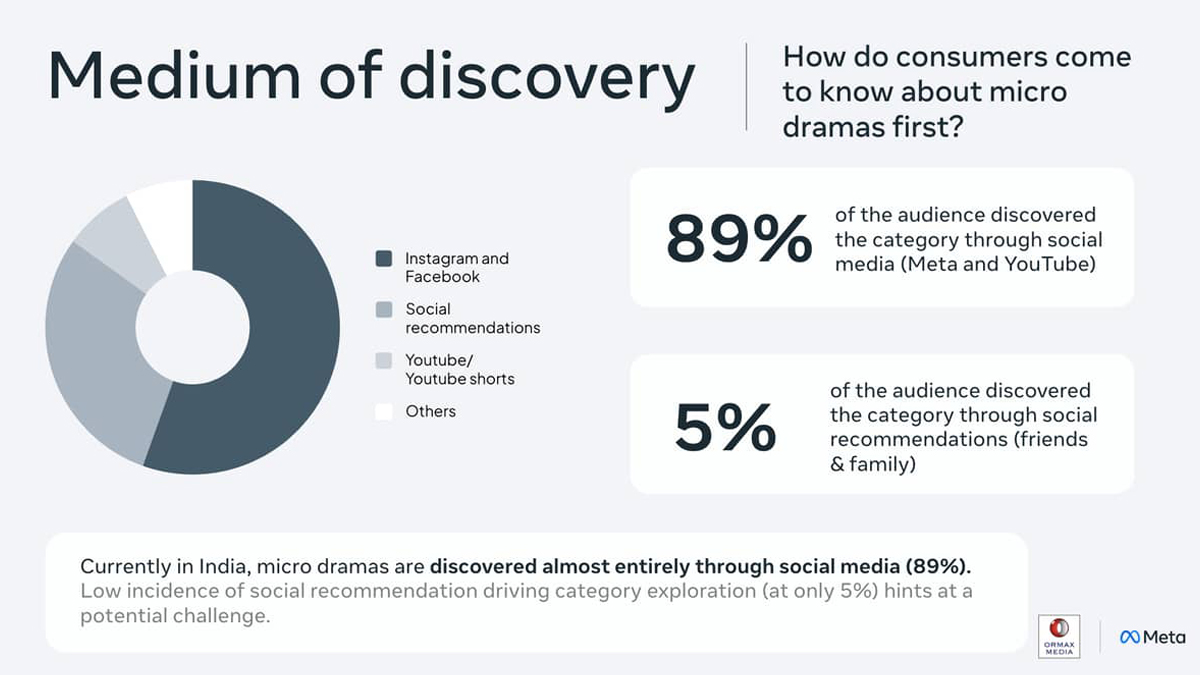
Conducted between November 2025 and January 2026 through 50 in-depth interviews and 2,000 personal surveys, the research reveals that 65 per cent of viewers discovered micro-dramas within the last year proof of explosive adoption. Nearly 89 per cent encounter the format through social feeds and recommendations, making algorithm-driven discovery the primary engine rather than active search.
Key viewing patterns show a median of 3.5 hours per week (about 30 minutes daily) spread across 7–8 short sessions. Consumption peaks between 8 pm and midnight, with additional spikes during commutes and work breaks classic “in-between moments” that the format fills perfectly. Around 57 per cent of viewing happens in ambient mode (while doing something else), and 90 per cent is solo, enabling more intimate, personal storytelling.
Romance, family drama and comedy lead genre preferences. Audiences show growing openness to AI-generated content, 47 per cent find it unique and creative, while only 6 per cent say they would avoid it entirely. Regional languages are surging after Hindi and English, Tamil, Telugu and Kannada dominate consumption.
Meta, director, media & entertainment (India) Shweta Bajpai said, “Micro-drama isn’t a passing trend, it’s rewriting the rules of Indian entertainment. In under a year, an entirely new category of platforms has emerged, built audience habits from scratch, and created a business vertical that is scaling fast.”
Ormax Media founder-CEO Shailesh Kapoor added, “Micro-dramas are beginning to show the early signs of becoming a distinct content category in India’s digital entertainment landscape. When a format aligns closely with how audiences naturally engage with their devices, it has the potential to scale very quickly.”
The study proposes ecosystem-wide responsibility, universal signposting of commercial intent, shared accountability among advertisers, platforms, creators, schools and parents, built-in safeguards, and formal media literacy in schools.
In a feed that never sleeps and a day that never stops, micro-dramas have slipped into the cracks of every spare minute turning 30-second stories into the new national pastime, one vertical swipe at a time.







