News Broadcasting
News channels hit record viewership in terror week


MUMBAI: As the deadly terror attacks struck Mumbai on 26 November, Indians all over the country stayed glued to news channels. Providing regular updates and a rigorous 60 hours of live TV coverage, the news genre gained immensely during this period.
Hindi news channels occupied 22.4 per cent of the entire TV viewing share for the four days (26 to 29 November) of terror coverage, the highest the genre has ever recorded in Indian television. Hindi general entertainment channels, which enjoy maximum TV viewing, had a share of 19.5 per cent while Hindi movie channels took away a 15.1 per cent share, as per Tam data (C&S, 4+, HSM).
For the week ended 29 November, Hindi news channels have seen a 10 per cent surge in market share to 16.1 per cent, from an average of 6.7 per cent in the prior four weeks (26 October to 22 November).

Hindi general entertainment channels, which were not showing any fresh content due to the dispute between TV producers and workers, were hard hit, with the genre share sliding to 22 per cent for the week, from a previous four-week average of 32.4 per cent.
The high-voltage drama has fetched Aaj Tak the highest number of viewers among the Hindi news channels. Aaj Tak has gained 6 per cent to enjoy a market share of 23 per cent for the week ended 29 November. The next big gainer in the Hindi news genre is Zee News, with a 3 per cent rise to 11 per cent.
In the pack, Star News is at 16 per cent (gained 1 per cent) while India TV and IBN7 has seen no change which stand at 16 per cent and 11 per cent respectively.
NDTV India also remains static at 8 per cent, followed by News24 and Samay both at 4 per cent. Tez has slipped by 1 per cent, DD news, Live India have fallen by 2 per cent each.
In the English news genre, NDTV 24X7, which has gained 5 per cent, has captured the highest market share for the week with 30 per cent (C&S, 15+, All India). Times Now also gained 5 per cent to garner a share of 28 per cent.
CNN-IBN lost in the numbers game, slipping 6 per cent to have a share of 24 per cent. Down the ladder, NewsX gained marginally to have a 9 per cent share among English news channels while Headlines Today fell from 13 per cent to 9 per cent.






News Broadcasting
News18 India launches Command Centre war explainer with Arya
New show shifts from debates to decoding global conflicts and impacts
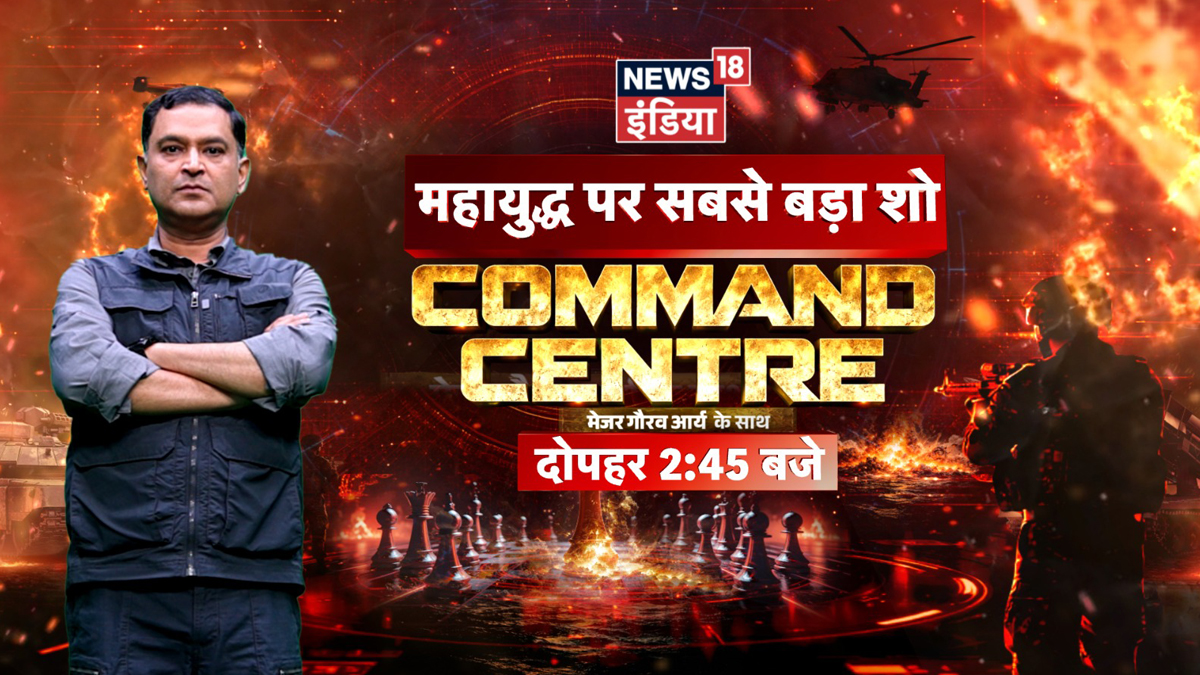
MUMBAI: News18 India has rolled out a new war-focused programme, Command Centre, featuring Gaurav Arya, as it looks to offer viewers a sharper, more grounded take on global conflicts amid rising tensions in West Asia.
Positioned as an “insider war room”, the show moves away from conventional panel debates and instead focuses on explaining military developments, decoding strategy and connecting global events to their everyday impact, from fuel prices to economic shifts.
The format leans heavily on visuals and data. The studio has been designed like a command hub, complete with large LED war maps, real-time graphics and an alert system to track developments as they unfold.
At the centre of it all is Arya, who brings his military background to simplify complex war strategies for viewers. His signature line, “Seedhi baat samjhiye”, anchors the show’s promise of clarity over noise.
News18 India managing editor Jyoti Kamal said, “Command Centre, featuring Major Gaurav Arya is designed to deliver accurate insights and a clear perspective on how evolving conflicts impact everyday life, from household budgets to national security. With expert voices analysing every development in real time, the show goes beyond headlines to decode what’s happening now, what it means, and what could come next.”
Echoing the intent, Gaurav Arya added, “In times of war, confusion is the biggest threat. With News18 India’s Command Centre, we are bringing viewers inside the war room, decoding strategies, tracking every escalation, and explaining, in the simplest terms, what it means for India and for every household. Seedhi baat samjhiye, this is where you understand not just what is happening, but what happens next.”
The weekday show will air in the afternoon slot and will also feature Gaurav Shukla, adding to its editorial depth.
With its mix of analysis, visuals and a clear focus on impact, the show reflects a broader shift in news consumption. Viewers are no longer just watching events unfold, they are looking to understand what those events mean for them.







