News Broadcasting
NDTV YUVA announces line-up for the fifth edition of its conclave

Mumbai: NDTV presents the fifth edition of Yuva Conclave – a day-long event dedicated to exploring the hopes, challenges, and aspirations of India’s youth. Scheduled for 19 September 2024, NDTV claims this year’s conclave promises to be more engaging and impactful, featuring an impressive line-up of speakers and panellists addressing the key issues shaping India’s future.
Building on the success of previous editions, NDTV YUVA returns with renewed energy, bringing together thought leaders and influencers from diverse sectors. From politics to sports, social media to the environment, and entertainment, the conclave is set to spark insightful conversations with India’s most prominent voices.
As per the press release leading the conversation at NDTV YUVA, Chirag Paswan, minister of food processing industries and a torchbearer of young political leadership, is reshaping India’s future with a bold, forward-thinking vision that connects with the aspirations of millions. Alongside him, Bansuri Swaraj, MP, Lok Sabha – a dynamic legal mind, stands out with her sharp intellect and commitment to diplomacy and public service, using her expertise to foster meaningful change. Then there’s Deepender Singh Hooda, MP, Lok Sabha; Member, CWC – a steadfast advocate for transformation, bringing his passion to policymaking, driving socio-economic reforms that uplift and empower communities across India.

In the realm of young business icons, Zerodha, co-founder Nikhil Kamath shines as a pioneering entrepreneur, reshaping India’s fintech landscape and inspiring the next generation to challenge conventional norms and embrace disruptive solutions. Manu Bhaker, an Olympic Medallist- a prodigy in Indian sports, symbolizes precision and power, showing young athletes the heights they can reach with determination and focus, followed by Shamsher Singh, an Indian Field Hockey Player, a stalwart in Indian field hockey, inspiring youth with his exemplary dedication to the sport, with invaluable lessons on discipline, teamwork, and perseverance. Sakshi Sindwani, a celebrated content creator, model and entrepreneur, who challenges societal norms with her message of self-love and body positivity. Finally, Nikhita Gandhi, a versatile and soulful singer, is taking the music world by storm, blending her Indian roots with global sounds and inspiring young artists to fearlessly express their creativity.
Together, these leaders from politics, entrepreneurship, sports, entertainment, and self-empowerment will weave a rich tapestry of insights, inspiring the youth to rise above challenges, innovate, and build a future that’s both inclusive and extraordinary. The NDTV YUVA Conclave 2024 will not just be an event but a movement, urging India’s next generation to take charge and lead with confidence, vision, and heart.
The conclave live on NDTV 24×7 and NDTV India starting at 2:00 PM on 19 September 2024.





News Broadcasting
Network18 channels lead YouTube news viewership in March 2026
CNN-News18, News18 India and CNBC channels top categories with record views
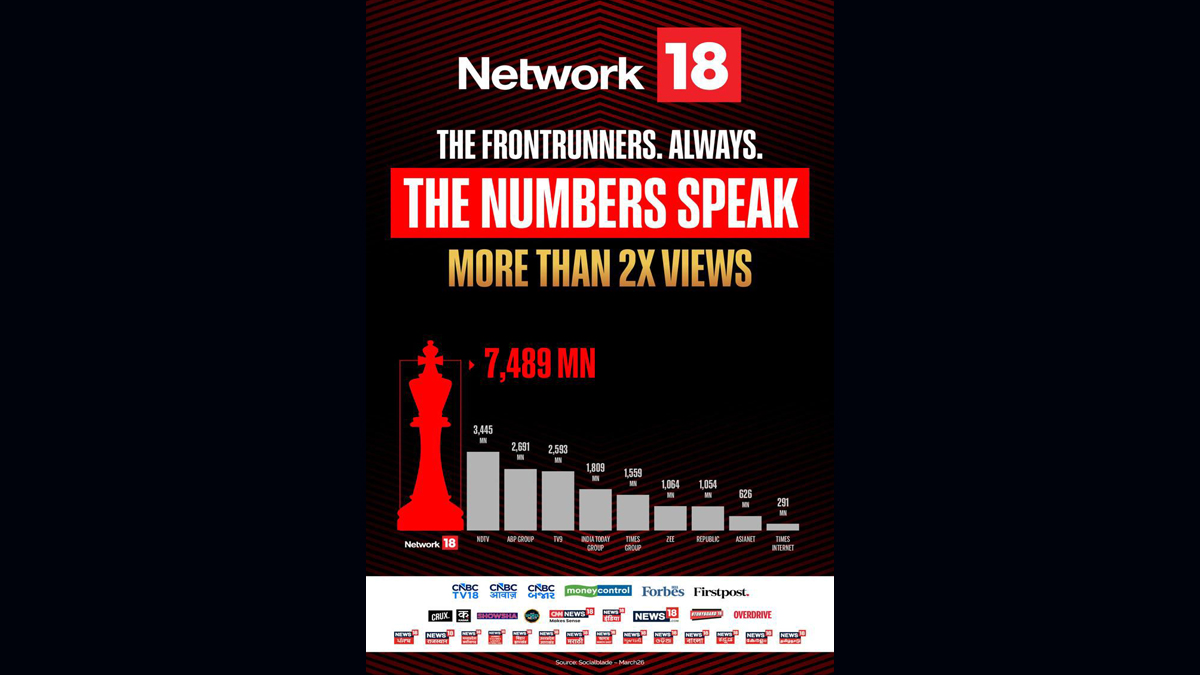
MUMBAI: When the world hit refresh on breaking news, Network18’s channels were already streaming ahead. As geopolitical tensions and war-driven headlines fuelled a surge in global news consumption, the network’s digital playbook delivered big clocking record Youtube viewership across English, Hindi and business news categories in March 2026.
At the forefront was CNN-News18, which emerged as the clear leader in the English news segment with 130 million live and video-on-demand views. The channel edged past competitors such as Times of India (126.5 million), Times Now (101.1 million), India Today (88.2 million) and NDTV (77.5 million), according to Databeings data for March.
In the Hindi news arena, News18 India delivered a commanding performance, racking up a staggering 3,297 million views on YouTube. The channel comfortably outpaced NDTV India, which recorded 3,119 million views, underlining its deep reach and consistent engagement with mass audiences, as per Playboard data.
The network’s dominance wasn’t confined to general news. In the Hindi business segment, CNBC Awaaz topped the charts with 92 million views, narrowly ahead of Zee Business (90 million) and well ahead of ET Now Swadesh (57 million). Meanwhile, its English counterpart CNBC-TV18 posted a strong 58 million views, reinforcing the network’s cross-category strength.
The spike in viewership reflects a broader shift in audience behaviour, with viewers increasingly turning to digital platforms particularly Youtube for real-time updates and in-depth coverage during high-intensity news cycles. For Network18, the numbers signal more than just scale; they underline the effectiveness of a multi-platform strategy that blends speed, credibility and continuous coverage.
In a month where the news never paused, it seems viewers chose to stay tuned where the stream never stopped.






