News Broadcasting
Korean companies gung ho on digital multimedia broadcasting

MUMBAI: Want a digital multimedia broadcasting (DMB) service delivered on your mobile phone? Several Korean companies have launched this service via the terrestrial or satellite route.
TU Media is bullish and expects to rope in 6.6 million DMB subscribers by 2010, driven by affordable service rate plans and content. Currently, it has 437,000 subscribers.
The company displayed its wide array of products at the TV Korea Showcase 2006, held in Mumbai today. Among the other participants were companies like Seoul Broadcasting System (CBS), Alticast and Korean Broadcasting System (KBS).

The Korean companies expressed their intent to play a major role in expanding mobile broadcasting in India. A good geographical location makes India a suitable market for satellite DMB. Besides, India’s configuration of ground is generally flat, implying that there are less shadow areas.
Speaking on the occasion, Alticast vice president Eun Sang Yun elaborated on the change in market demand for interactive TV service in Korea. “We are seeing on-demand type of services across the media markets. Also, there is a strong demand of interactivity in the mobile environment,” Yun said.
While the cost of technical solutions has come down, Korea has adopted open standard solutions. This is easy to deploy, raises the quality of service, lowers costs for interactive TV solutions, and sets up a route for export. “This model can be adopted to the Indian market,” Yun said.
There are interesting statistics for DMB subscribers. TU, which has funded $200 million till October 2005, has found that male viewers comprise 66 per cent of the base while 72 per cent of the audience is in the age group of 20 years to early 30s. Drama, game, news and movies are very popular. Sporting events like football have a very high viewership. The average usage per day is one hour with watching on mobile TV dominating the daytime. There is a trend for viewership to drop on the weekends which is controlled by conventional TV.
TU charges a registration fee of $20 million and a monthly subscription rate of $13 million. The satellite DMB capabilities allow you to view high definition broadcasts while on the move via a frequency transmitted from the satellite to your vehicle-mounted TU terminal and your TU handset that receives both satellite DMB and cellular services. It also offers a broad range of interactive multimedia services that let you directly participate in such broadcast programmes as wireless internet, home shopping, and M-commerce.
The TU handset for both satellite DMB and cellular service does not offer only mobile phone functions, but it also provides a wireless internet connection function, and an on-air broadcast programme capture and recording function.
The portable receiver for DMB services is equipped with a multimedia file reproduction function, as well as a capture and recording function. It carries a built in antenna receiving signals from terrestrial repeaters and provides a removable antenna receiving signals from satellite.
TU Media plans to invest a total of $6.68 million in the content area over the next five years. It offers 11 video and 26 audio channels.
SBS, the biggest private terrestrial broadcasting company in Korea, has developed various digital broadcasting technologies including digital multimedia broadcasting radio model.







News Broadcasting
UDF poised to return to power in Kerala, says Manorama-CVoter survey
Massive opinion poll projects shift in Kerala politics ahead of 2026 Assembly elections.
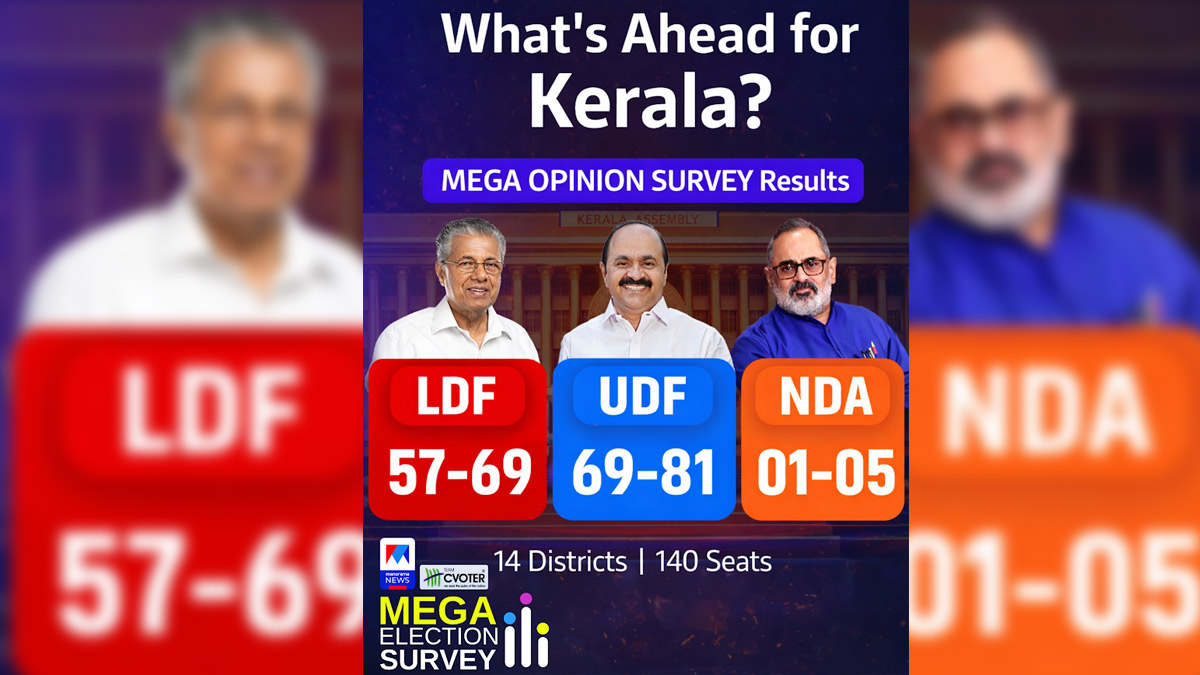
MUMBAI: The winds of change appear to be blowing through Kerala’s political landscape and this time, they seem to favour the United Democratic Front. A comprehensive mega opinion survey conducted by Manorama News in partnership with CVoter projects a potential comeback for the UDF in the upcoming Kerala Legislative Assembly Elections 2026. The survey, covering all 140 constituencies with a massive sample size of nearly 90,000 respondents, predicts the UDF could win between 69 and 81 seats.
The ruling Left Democratic Front (LDF) is expected to secure 57 to 69 seats, a significant drop from the 99 seats it won in the 2021 elections. This would mean the LDF losing 30 to 42 of its sitting seats. Meanwhile, the National Democratic Alliance (NDA), which drew a blank in 2021, is projected to open its account with 1 to 5 seats.
Region-wise, the UDF is expected to make strong gains in Malabar, winning 25 to 34 out of 48 seats, and in Central Kerala, where it could bag 29 to 33 out of 53 seats. In South Kerala, the LDF is likely to retain an edge with 21 to 25 seats, while the UDF may improve to 12 to 16 seats. The NDA could pick up 1 to 3 seats in the southern region.
The survey was conducted between 14 and 26 March 2026, with additional tracker and snap polls carried out from December 2025 to March 2026. A total of 89,693 respondents participated, ensuring representation across all demographics and social segments.
Manorama News has a strong track record of accuracy, with its previous projections closely matching the actual results of the 2019 and 2024 Lok Sabha elections as well as the 2021 Kerala Assembly polls.
In Kerala’s famously fierce political battles, this survey suggests the pendulum may be swinging back. Whether the final verdict matches these numbers or throws up another surprise, one thing is clear, the 2026 Assembly elections are shaping up to be one of the most keenly watched contests in the state’s history.






