Hollywood
Joy takes over! Inside Out 2 reaches $1 billion in record time
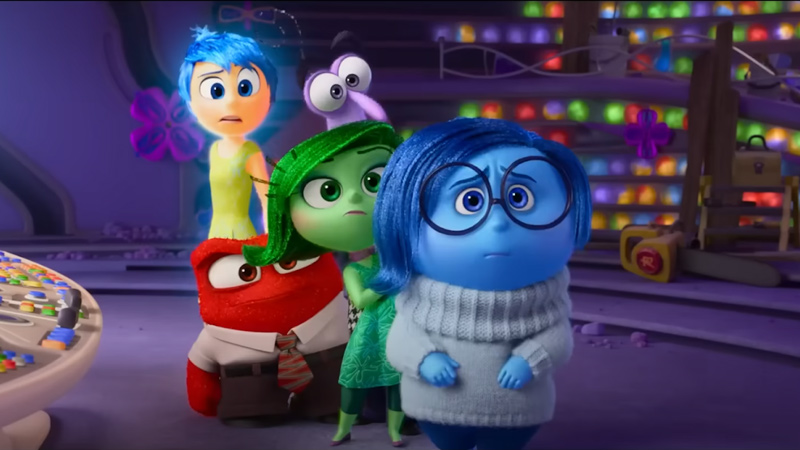
Mumbai: Disney and Pixar’s much-anticipated sequel, Inside Out 2, has taken the world by storm, rewriting the record books for animated films. In a stunning feat, the movie has become the fastest animated film to ever reach the coveted $1 billion mark at the global box office, achieving this milestone in less than three weeks!!
This record-breaking performance surpasses the previous record holder, Frozen 2, which took 25 days to reach the same benchmark. Inside Out 2’s phenomenal success is further underscored by its impressive performance in India. The film raked in a whopping Rs 101.48 crores ($12.7 million) within just 19 days, becoming the fastest animated film to enter the exclusive 100 crore club in the country. This prestigious club recognizes animated films that have achieved a lifetime gross of over Rs 100 crores ($12.3 million) at the Indian box office. Notably, eight out of the eleven films currently in this club are from Disney and Pixar, solidifying their dominance in the animation genre.
Inside Out 2’s emotional journey resonated with audiences worldwide. The film’s ability to delve deeper into the complexities of our inner world, introducing new characters representing fresh emotions, seems to have struck a chord. With its critical acclaim and record-breaking box office numbers, Inside Out 2 has cemented its place as a true animation powerhouse.
Directed by Kelsey Mann, Inside Out 2 was released on 14 June 2024 in cinemas worldwide. Amy Poehler, Maya Hawke, Phyllis Smith, Lewis Black, Tony Hale, and Liza Lapira gave their voices to the beloved animated characters of the film. Written by Meg LeFauve, the animated film continues to weave its Pixar magic in theatres in India and across the world!

Hollywood
Utopai Studios partners Huace to deploy PAI for long form content
Deal includes revenue sharing as Huace adopts AI engine across global ops
MUMBAI: Lights, camera… algorithm, the script just got a silicon co-writer. In a move that signals how storytelling itself is being re-engineered, U.S.-based Utopai Studios has partnered China’s Huace Film & TV Co. Ltd. to bring artificial general intelligence into the heart of long-form content creation.
At the centre of the deal is PAI, Utopai’s cinematic storytelling system, which Huace will deploy as a core engine across its production pipeline from development and creative iteration to global localisation. The partnership includes a large-scale annual usage commitment from Huace, alongside a usage-based revenue-sharing model, underscoring both ambition and commercial confidence on both sides.
For Huace, one of China’s largest film and television companies, the bet is not on automation alone but on scale with control. With distribution spanning over 200 countries and a presence across more than 20 international platforms, including Netflix and YouTube, the company brings a vast content ecosystem where even marginal efficiency gains can translate into significant output shifts. Its extensive TV IP library further positions it as fertile ground for AI-assisted storytelling workflows.
The choice of PAI follows what Huace described as a rigorous evaluation of existing AI tools, many of which remain limited to fragmented use cases such as video generation or editing. What tipped the scales, according to the company, was PAI’s ability to handle long-form narrative complexity maintaining continuity, structure, and creative coherence across entire story arcs rather than isolated clips.
Utopai, for its part, is using the partnership to anchor its international expansion strategy, pitching PAI as an enterprise-ready system built for customisation, privacy, and regulatory adaptability across markets. That positioning becomes particularly relevant as global media companies increasingly scrutinise how AI integrates into proprietary workflows.
The timing is notable. Earlier this month, Utopai upgraded PAI to support three-minute 4K video generation and advanced multi-shot sequencing features designed to tackle one of AI storytelling’s biggest hurdles: consistency across scenes.
What emerges is not just another tech collaboration, but a glimpse into how the grammar of filmmaking could evolve. Because if stories were once crafted frame by frame, the next chapter might just be coded scene by scene.