News Broadcasting
Journalists, anyone?


MUMBAI: The past few months have seen established news channels showing their employees the door; be it a TV18 Broadcast or UTV Bloomberg or NDTV, which took the cake when it shut down the entire Mumbai office as cost-cutting measure. Media as a whole – particularly English news channels – has sunk into a lull. However, all’s not lost. There’s still hope for aspiring journalists in the form of a smattering of channels that are out to hire in the time of widespread lay-offs.
A case in point is the ITV Network – comprising English news channel News X and Hindi news channel India News – which is currently hiring people both in its editorial and management departments. Not so long ago, the network roped in known faces such as Rahul Shivshankar and Diptosh Majumdar as Managing Editor and National Affairs Editor, respectively. “We ensure team structure and size is controlled in order to optimise cost,” says ITV Network HR Shikha Rastogi.
Popular news channel India TV too is looking to fill vacancies in editorial and digital media. About 20-30 people have already been hired in various departments in the last quarter.

Even in these difficult times, many new channels are making their way into the ecosystem, paving the road for hiring more people. So, while English news channels have started containing themselves, a number of new Hindi and regional news channels have cropped up.
Just launched Hindi news channel, Jia News, will complete its second phase of hiring within the next two or three months. News Nation, another Hindi news channel which was launched earlier this year, did a significant amount of hiring to reach its current 350 staff strength. Hereon, the channel will hire as per specific requirements. There are also instances of new channel additions, where hiring is not really a prerogative except when the need arises.
MCCS (Media Content and Communication Services) is adding a Punjabi news channel to its existing flock of ABP News, ABP Majha and ABP Ananda but no hiring is taking place in the ABP channels presently. Ditto for ZMCL, which added Zee Rajasthan Plus to its portfolio and recently acquired Maurya TV that runs in Bihar and Jharkhand. “We only hire when we need to. No attrition has taken place so no addition will either,” says MCCS CEO Ashok Venkatramani.
 |
|
Anurradha Prasad says that the situation can be much better once pay TV kicks in
|
BAG Films and Media MD Anurradha Prasad, which owns the channel News 24 agrees that the scenario is not too good but since elections are approaching they will be looking at hiring competent people to cover it. Overall, there isn’t any such post vacant in the channel.
Again, many channels are looking at getting their staff to multi-task to restrict hiring to the minimum. Sahara Samay Editor (Network Operations) Sanjay Banerjee says that their company has not fired any employee since their hiring itself is kept to a bare minimum. “Only when we have vacancies will we fill them as we did with the recently re-launched Sahara Samay NCR as Samay Rajasthan,” he adds. The Samay Rajasthan re-launch took place in mid-September and a good number of reporters and cameramen were hired in many cities of Rajasthan.
Meanwhile, industry insiders feel the whole ruckus has been caused due to hiring more people than required. “A lot of unnecessary hiring has happened. Where just two people could do the work, six people have been taken in,” says an industry source. “The field hasn’t matured in all these years. There’s no formula to reach the top and there’s no benchmark either. At the same time, recession is happening and then if you aren’t a strong team, you are going to be in a mess,” opines a channel editor.
Asked about what could be the reason for this sudden lull Prasad points out :”The cost of producing news has not come down in all these years and the system of pay TV has not yet kicked in.” Most channels say they are incurring losses rather than making a profit out of the business. The wait is on for digitisation to set in which will see news channels getting a better share of revenue.
And though the gloom hasn’t passed yet, journalists would do well to hold on to whatever they have or look for and accept any opportunity as a stepping stone till an established name in the business is ready to hire once again.






News Broadcasting
UDF poised to return to power in Kerala, says Manorama-CVoter survey
Massive opinion poll projects shift in Kerala politics ahead of 2026 Assembly elections.
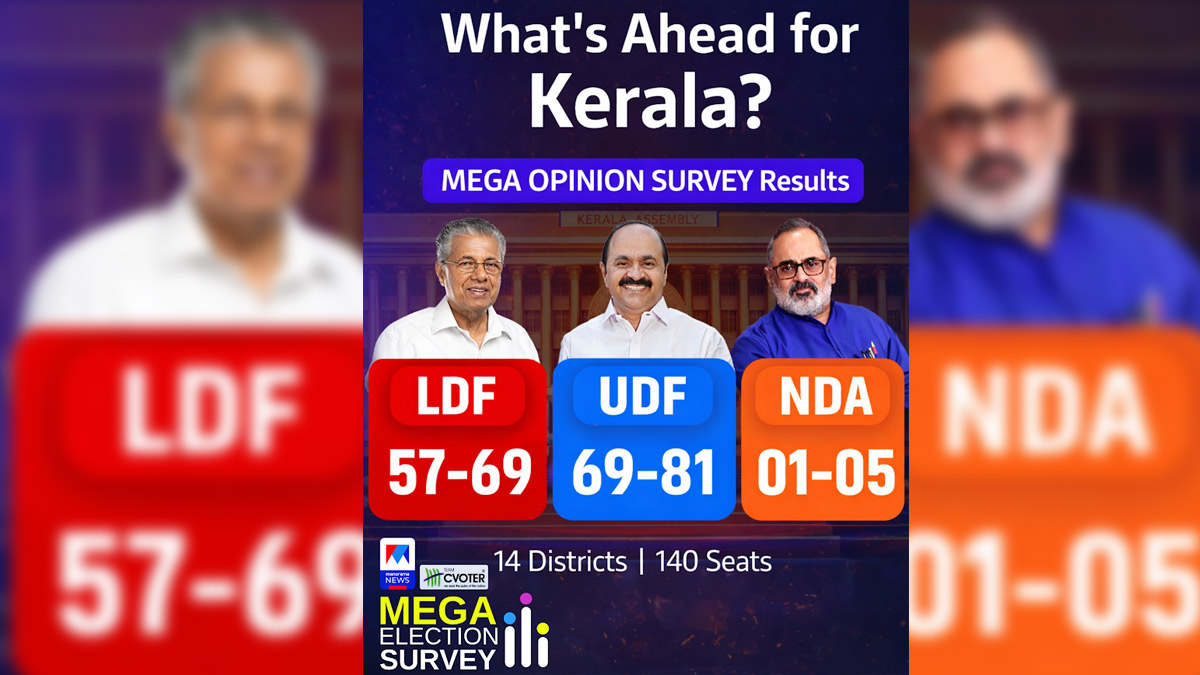
MUMBAI: The winds of change appear to be blowing through Kerala’s political landscape and this time, they seem to favour the United Democratic Front. A comprehensive mega opinion survey conducted by Manorama News in partnership with CVoter projects a potential comeback for the UDF in the upcoming Kerala Legislative Assembly Elections 2026. The survey, covering all 140 constituencies with a massive sample size of nearly 90,000 respondents, predicts the UDF could win between 69 and 81 seats.
The ruling Left Democratic Front (LDF) is expected to secure 57 to 69 seats, a significant drop from the 99 seats it won in the 2021 elections. This would mean the LDF losing 30 to 42 of its sitting seats. Meanwhile, the National Democratic Alliance (NDA), which drew a blank in 2021, is projected to open its account with 1 to 5 seats.
Region-wise, the UDF is expected to make strong gains in Malabar, winning 25 to 34 out of 48 seats, and in Central Kerala, where it could bag 29 to 33 out of 53 seats. In South Kerala, the LDF is likely to retain an edge with 21 to 25 seats, while the UDF may improve to 12 to 16 seats. The NDA could pick up 1 to 3 seats in the southern region.
The survey was conducted between 14 and 26 March 2026, with additional tracker and snap polls carried out from December 2025 to March 2026. A total of 89,693 respondents participated, ensuring representation across all demographics and social segments.
Manorama News has a strong track record of accuracy, with its previous projections closely matching the actual results of the 2019 and 2024 Lok Sabha elections as well as the 2021 Kerala Assembly polls.
In Kerala’s famously fierce political battles, this survey suggests the pendulum may be swinging back. Whether the final verdict matches these numbers or throws up another surprise, one thing is clear, the 2026 Assembly elections are shaping up to be one of the most keenly watched contests in the state’s history.






