Movies
Jio Studios & SVF Entertainment unveil “Athhoi” teaser
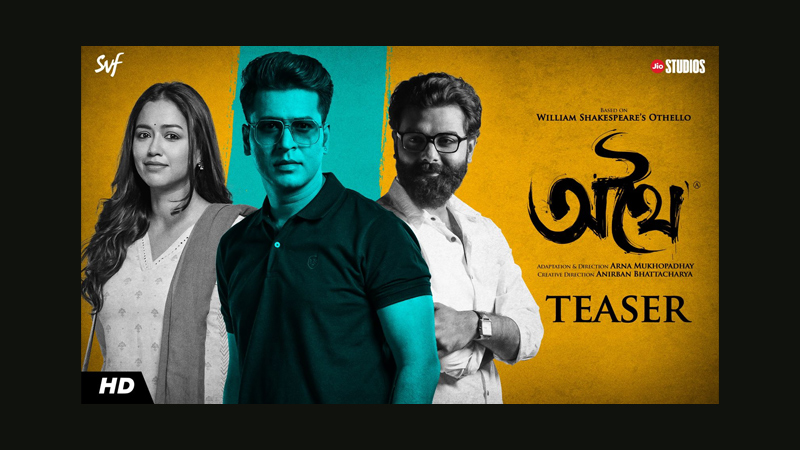
Mumbai: Jio Studios and SVF Entertainment dropped the teaser of Bengali language film Athhoi offering a tantalizing glimpse into this eagerly anticipated cinematic experience. Capturing the essence of Shakespeare’s exploration of human emotions, Athhoi promises to be a compelling portrayal of love, deception, and rivalry in a modern setting.
Witness the intrigue and drama unfold by watching the teaser here:
The teaser opens with the chilling line, “Every individual harbours animosity towards one another,” setting the tone for a narrative that intricately weaves together themes of honesty and love against a backdrop of intrigue and ambition.”
In this adaptation, Sohini Sarkar breathes life into the spirited and intelligent character of Diya, reminiscent of Desdemona, while sirector Arna Mukhopadhyay brings depth and complexity to the role of Dr. Athhoi Lodha (Othello). Anirban Bhattacharya takes on the enigmatic character of Gogo, echoing the Iago from Shakespeare’s original work, and serves as the creative director of the film.
“Athhoi,” director Arna Mukhopadhyay remarked, “With ‘Athhoi,’ our aim is to delve deep into the complexities of human emotions and present a modern interpretation of Shakespeare’s timeless tale. Through this film, we hope to engage and provoke audiences, sparking conversations about love, jealousy, and ambition in today’s world.”
The film is set to release on 14 June, “Athhoi” is poised to be a cinematic milestone, eagerly anticipated by audiences worldwide. Through its innovative interpretation, the film promises to offer viewers a thought-provoking exploration of jealousy, ambition and love in today’s society.

Hollywood
Utopai Studios partners Huace to deploy PAI for long form content
Deal includes revenue sharing as Huace adopts AI engine across global ops
MUMBAI: Lights, camera… algorithm, the script just got a silicon co-writer. In a move that signals how storytelling itself is being re-engineered, U.S.-based Utopai Studios has partnered China’s Huace Film & TV Co. Ltd. to bring artificial general intelligence into the heart of long-form content creation.
At the centre of the deal is PAI, Utopai’s cinematic storytelling system, which Huace will deploy as a core engine across its production pipeline from development and creative iteration to global localisation. The partnership includes a large-scale annual usage commitment from Huace, alongside a usage-based revenue-sharing model, underscoring both ambition and commercial confidence on both sides.
For Huace, one of China’s largest film and television companies, the bet is not on automation alone but on scale with control. With distribution spanning over 200 countries and a presence across more than 20 international platforms, including Netflix and YouTube, the company brings a vast content ecosystem where even marginal efficiency gains can translate into significant output shifts. Its extensive TV IP library further positions it as fertile ground for AI-assisted storytelling workflows.
The choice of PAI follows what Huace described as a rigorous evaluation of existing AI tools, many of which remain limited to fragmented use cases such as video generation or editing. What tipped the scales, according to the company, was PAI’s ability to handle long-form narrative complexity maintaining continuity, structure, and creative coherence across entire story arcs rather than isolated clips.
Utopai, for its part, is using the partnership to anchor its international expansion strategy, pitching PAI as an enterprise-ready system built for customisation, privacy, and regulatory adaptability across markets. That positioning becomes particularly relevant as global media companies increasingly scrutinise how AI integrates into proprietary workflows.
The timing is notable. Earlier this month, Utopai upgraded PAI to support three-minute 4K video generation and advanced multi-shot sequencing features designed to tackle one of AI storytelling’s biggest hurdles: consistency across scenes.
What emerges is not just another tech collaboration, but a glimpse into how the grammar of filmmaking could evolve. Because if stories were once crafted frame by frame, the next chapter might just be coded scene by scene.