I&B Ministry
Industry welcomes I&B ministry’s guidelines to restart Film, TV and OTT production

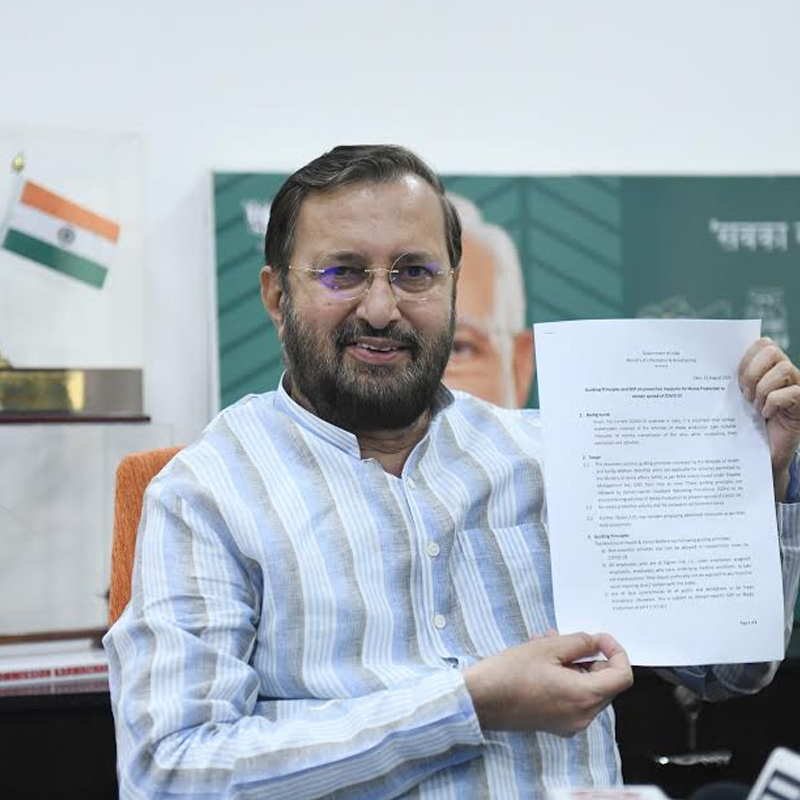
MUMBAI: Yesterday, Information and Broadcasting Minister Prakash Javadekar released a comprehensive set of standard operating procedures (SOPs) aimed at the resumption of production for film, television, and OTT originals. The announcement came in as a sigh of relief for many in the industry. The SOPs are in line with the protocols followed across the globe, which also specifies safe distances on shooting locations, in edit rooms, studios, and others. It includes rules on sanitization, fumigation, face masks, and availability of PPE kits. The SOPs also mention the need for an appointment of an on-set Covid2019 coordinator. Javadekar said, “Today we are laying out standard operating procedures as per the international experience and with the consultation of the health ministry and the home ministry.”
Today @MIB_India have released a detailed SOP for resuming work in the media production industry. The general principles behind the SOP will help create a safe working environment for cast and crew in the industry. pic.twitter.com/UU0NbqONeO
— Prakash Javadekar (@PrakashJavdekar) August 23, 2020
He further explained that contact minimisation is at the core of the SOPs. It will be ensured by minimal physical contact and sharing of props and PPEs for hairstylists and make-up artists, among others. Javadekar also highlighted that the characters in front of the camera would be exempted from wearing masks. Making this announcement on Doordarshan Javadekar said that formulating SOP measures as part of the overall decision to revive economic activities. He added, “For the last six months, this industry had come to a standstill, and many people had lost their jobs. We hope all States will adopt these SOPs.”


For a detailed list of the SOPs, click here. In a special interaction with indiantelevision.com film producer, Ramesh Taurani said, “I think it is a very good step from the government. Shoots have already started, but now they can be done in other locations as well, as the new SOPs will benefit everyone. These are practical and manageable SOPs, and the film industry is very happy. Now things will happen at a macro level. As the film shooting has started workers, actors, technicians can start work with full protection. It is a good step towards restarting the economy, as more people will get employment. The announcement came from the central government, and now it is up to the respective state government to take it forward.” Apart from laying down the social distancing norms, the ministry has also asked the production houses to ensure extensive planning. It also states that physical distancing of at least six feet is to be followed as far as feasible at all locations at all times, while sitting, standing in queues, etc. FICCI official spokesperson said, "It is a welcome move and the industry has been looking forward to this. It will help open the industry in a phased manner with all the necessary precautions . We are looking forward to working with the government to ensure we get back to business with all the norms that have been put in place. This move from central government is the umbrella document for state governments to adopt so that there is basic uniformity across the country . This is one plan laid out by the central government for the state government to follow and they can add some important details as per the specific requirement." Aspects such as scenes, sequences, set-ups, camera locations, positions of various crew members, seating arrangements, food and catering arrangements, staggered meal timings, etc. shall be planned while giving due consideration to physical distancing norms. According to the guidelines, measures shall be taken by the production team to involve a minimum number of cast and crew members during the shoot. IFTPC chairman TV wing JD Majethia shares, “It is a very welcome move. We all have been waiting for this for a very long time. It is a relief that the centre has eased out the restrictions. As shooting is now allowed across India, it would be easier for film, television, and OTT shows to shoot in different locations and studios, which was difficult to do earlier. Many people will get their employment back, hopefully in Maharashtra. If trains are allowed from next month onwards, a lot of people will get their jobs back.” He further added that the guidelines laid down by the I&B ministry are more detailed, and they have included a lot of aspects. “The measures are clear in nature. Everyone will know what to do in these circumstances. However, the state government can add or modify policies as per their requirement. States with less number of cases can ease out restrictions, whereas things will be stricter in areas where there are a higher number of cases,” adds Majethia. The Ministry has also advised that no visitors or audiences are to be allowed. In the case of outdoor shootings, necessary coordination has to be done with local police and administration to minimize spectators.
The SOP ensures adequate distancing at shoot locations and other work places and contains measures including proper sanitization, crowd management and provision for protective equipments pic.twitter.com/BCTTIzKffG
— Prakash Javadekar (@PrakashJavdekar) August 23, 2020
It is a moment of joy for film and OTT platforms as the Covid2019 halted the shoots at other locations, especially with large crews. "It's great news for the TV and film industry. What's more interesting is that the SOPs suggest some points for the opening of the exhibition. We are now looking forward to the opening of cinemas and getting the whole movie industry back on track," says SVF Entertainment co-founder director Mahendra Soni. Juggernaut Productions chief operating officer OTT-business Samar Khan mentions that the issuance of these SOPSs is a step in the right direction. He adds, “All of us have been eagerly awaiting the resumption of shoots but are also aware that crew safety is of utmost importance, following these guidelines will ensure that we can maintain the highest standards of safety while gradually resuming work.”

The ministry has also advised the industry to discontinue usage of lapel mics or at least to ensure that these are not shared. It also highlights that costumes, hair wigs, and makeup items for actors should not be shared. The SOPs states that artists should be encouraged to do their hairstyling and make-up remotely with the help of professionals. Panorama Studios run by Kumar Mangat Pathak and Abhishek Pathak is a subsidiary of Panorama Studios International. Abhishek Pathak has also directed movies like Ujda Chama and Boond. He thanked the I&B ministry for focussing on contact minimisation. "We welcome these guidelines. Yes, shooting will be a huge challenge in the Covid2019 era, but I think with vigilance and precautions, we can make a comeback steadily. This decision brings huge relief for industry dwellers whose livelihood depends on the creation of movies, series, and other content." Planet Marathi founder and filmmaker Akshay Bardapurkar who also produced AB Aani CD said that it is great news from the I&B minister himself. “However now with the opening of the shoots it would be great also to see theatres also opening up. He mentions that more than 100 films are stalled, and producers are suffering. I hope that the central government issues SOPs for theatres soon and opens them too,” adds Bardapurkar.






I&B Ministry
India turns up the heat on piracy, orders Telegram to axe 3,142 channels and blocks 800 websites
New legal teeth, nodal officers and notices to intermediaries signal that the government is done playing nice with copyright thieves

NEW DELHI: India’s war on film piracy just got significantly more aggressive. The government has ordered Telegram to remove 3,142 channels distributing pirated content, blocked access to around 800 websites through internet service providers, and put the full weight of freshly sharpened legislation behind the crackdown. The message from New Delhi is unambiguous: the free ride for copyright thieves is over.
Minister of state for information and broadcasting L. Murugan spelled out the legal architecture to the Lok Sabha on Wednesday. The Cinematograph (Amendment) Act, 2023, he said, now contains specific provisions designed to make piracy a genuinely painful proposition. Sections 6AA and 6AB prohibit unauthorised recording and transmission of films, with violations attracting a minimum of three months’ imprisonment and a fine of Rs 3 lakh. At the upper end, offenders face three years behind bars and fines of up to 5 per cent of a film’s audited gross production cost — a figure that, for a big-budget production, could run into crores.
The legislation also gives the government powers to act against intermediaries hosting infringing content, by notifying them under Section 79(3) of the Information Technology Act, 2000, and compelling takedowns and blocking actions. Under Section 79(3)(b), intermediaries are legally required to remove or disable access to unlawful content upon receiving government notice or court orders. The Information Technology (Intermediary Guidelines and Digital Media Ethics Code) Rules, 2021, add a further layer of obligation, requiring platforms to ensure their services are not used to host or distribute content that violates copyright or proprietary rights.
To put enforcement into practice, the Ministry of Information and Broadcasting has established a dedicated institutional mechanism, complete with nodal officers to receive complaints. Copyright holders, authorised representatives or individuals can report piracy through a prescribed format, after which the government issues notices to intermediaries to disable access to infringing links.
The most headline-grabbing action came on 11 March 2026, when Telegram was formally notified under Section 79(3)(b) of the IT Act and directed to remove and disable 3,142 channels found to be distributing unauthorised content belonging to OTT platforms, content owners and producers. The complaints that triggered the action came from OTT platforms including JioCinema and Amazon Prime Video, which alleged that copyrighted films, web series and other material were being shared on the platform on a massive scale. Telegram’s architecture, with its large file-sharing limits and capacity for user anonymity, has made it a favoured vehicle for exactly this kind of large-scale piracy.
The Telegram action sits within a broader pattern of escalating enforcement. Just days before the Lok Sabha statement, the ministry banned five OTT platforms for streaming obscene content: MoodXVIP, Koyal Playpro, Digi Movieplex, Feel and Jugnu. In July 2025, the Centre ordered the blocking of 25 OTT platforms accused of streaming obscene, vulgar or pornographic material, a list that included ALTT, ULLU, Big Shots App, Desiflix, Boomex, Navarasa Lite, Gulab App, Kangan App, Bull App, Jalva App, ShowHit, Wow Entertainment, Look Entertainment, Hitprime, Feneo, ShowX, Sol Talkies, Adda TV, HotX VIP, Hulchul App, MoodX, NeonX VIP, Fugi, Mojflix and Triflicks.
Rule 3(1)(b) of the IT (Intermediary Guidelines and Digital Media Ethics Code) Rules, 2021, provides the regulatory hook for those actions, prohibiting platforms from hosting content that is obscene, pornographic, invasive of privacy, gender-harassing, racially or ethnically objectionable, or that promotes hatred and violence.
For an industry that loses billions of rupees annually to piracy, the direction of travel is welcome. The question, as always, is not whether the laws exist, but whether the enforcement machinery can keep pace with the ingenuity of those determined to circumvent it. Three thousand channels down, and the pirates are already busy opening three thousand more.







