News Broadcasting
Indias path to Nation’s Future at Business Today’s India@100 Summit


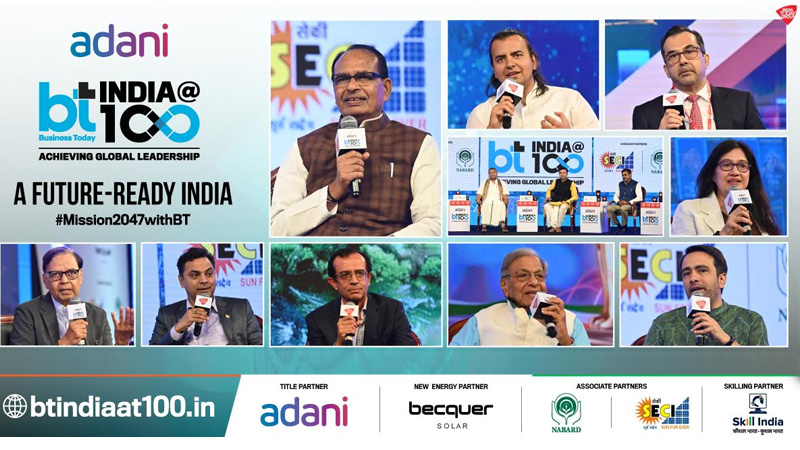
Mumbai: At the third edition of the Adani BT India@100 summit, held on August 20 at the Leaders’ Lounge, Bharat Mandapam in New Delhi, the discussions centered around strategies for India’s future as the country approaches the centenary of its Independence in 2047.
Hosted by Business Today, the summit brought together over 300 delegates, including top government officials, policymakers, entrepreneurs, and business leaders, for a series of 14 insightful sessions. The summit was supported by Title Partner Adani, New Energy Partner Becquer Solar, Associate Partners NABARD and SECI, and Skilling Partner Skill India.
Arvind Panagariya, Chairman of the Sixteenth Finance Commission, stated that India could become a $50 trillion economy by 2047 by focusing on sustainability, digital transformation, and public-private partnerships. He emphasized these areas as crucial for driving growth and establishing India as a global leader.
Krishnamurthy Subramanian, Executive Director at the International Monetary Fund, took that number a notch up, saying with sustained investment in infrastructure, technology, and education, the country could potentially reach a $55 trillion economy by its centennial. He pointed out that this would require a 15-fold increase in the current economy, which stands at $3.3 trillion.
Nivruti Rai, Managing Director and CEO of Invest India, outlined the country’s target of attracting $1 trillion in foreign direct investment (FDI) over the next decade. She identified sectors such as pharmaceuticals, textiles, renewable energy, and technology as crucial to this effort and stressed the need for India to strengthen its supply chain, simplify regulations, and invest in a skilled workforce.
Addressing public sector inefficiencies, N.K. Singh, former Chairman of the 15th Finance Commission, called for regulatory reforms and modernisation, particularly in the telecommunications sector. He noted that issues like spectrum allocation and service disruptions during elections have hindered the sector’s growth and argued that reforms are essential for improving service delivery and ensuring public sector organisations contribute effectively to national growth.
Shivraj Singh Chouhan, Union Minister of Agriculture & Farmers Welfare, presented a five-point strategy for the agriculture sector at the summit. He emphasized the government’s focus on increasing production, reducing costs, ensuring fair crop prices, addressing global farming threats, and diversifying crops beyond staples like wheat and rice. Chouhan highlighted Prime Minister Narendra Modi’s commitment to transforming India into a developed nation, particularly through advancements in agriculture.
Ruchir Sharma, Chairman of Rockefeller International, provided a cautious perspective on India’s economic future, questioning whether the country could achieve developed nation status by 2047 without significant reforms and higher growth rates. He underscored the challenge of sustaining the necessary 10-12% annual GDP growth, noting that only a few countries, such as China and South Korea, have managed to do so over long periods.
Employment and skill development were also key themes. Manish Sabharwal, Vice Chairman of TeamLease Services, highlighted the issues of low wages and skills mismatches, pointing out that nearly 85% of India’s workforce is in the informal sector. Jayant Chaudhary, Minister of State for Skill Development and Entrepreneurship, announced new skilling initiatives aimed at aligning vocational training with market demands.
Ola Founder Bhavish Aggarwal emphasized the importance of data sovereignty and robust management policies to leverage India’s vast digital ecosystem. He introduced his AI initiative, Krutrim, as part of efforts to build India’s capabilities in artificial intelligence, stressing that the country must retain control over its data resources.
Sanjiv Puri, Chairman & MD of ITC, discussed challenges facing the MSME sector, which accounts for about 30% of India’s GDP and employs over 110 million people. He highlighted the need for inclusive growth, climate action, and support for MSMEs, stressing the importance of intellectual property and innovation in maintaining India’s competitive edge globally.
The summit also saw Congress leader Karti Chidambaram express concerns over lateral entry into the Indian bureaucracy, advocating for the preservation of social justice and affirmative action. His views were challenged by BJP leaders, who defended the current administration’s policy, arguing that it infuses new energy and expertise into the bureaucracy.
Vikram Gandhi, a professor at Harvard Business School, discussed the financial challenges of achieving India’s net-zero carbon emissions target by 2070, pointing out that substantial international financial assistance and investment in green technologies are crucial for meeting these climate goals.
As India approaches its centenary of independence, the Adani BT India@100 summit underscored the opportunities and challenges the nation faces on its path to becoming a global economic powerhouse.







