Hollywood
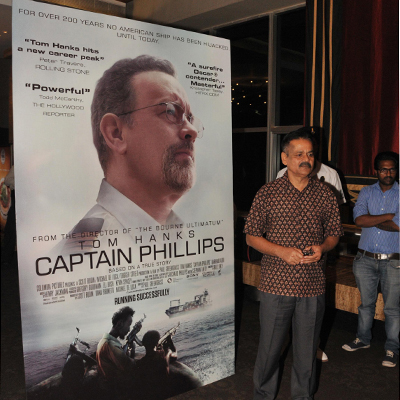
Indian Navy watches Tom Hanks Captain Phillips
MUMBAI: Captain Phillips, the movie that has taken the world by storm, has even caught the attention of the Indian Navy now. At a special request, Sony Pictures organised a special screening for the Indian naval officers, including the Commander-in-Chief, Western Naval Command, Shekhar Sinha in Mumbai on the official India release date of 18 October.
With very few movies being made on this very relevant and current subject, the theme of Captain Phillips seems to have found a connection with the officers as it deals with the hijack of a container ship and the kidnapping of its captain by Somali pirates. Captain Phillips is based on real life story of Captain Richard Phillips who was held captive by four Somali Pirates in 2009.
Two-time Oscar winner Tom Hanks plays the role of Richard Phillips in the movie. The movie which was recognised as one of the best movies of 2013 by Rolling Stone magazine is directed by Paul Greengrass.
Sony Pictures India MD Kercy Daruwala said, “An extensive local word-of-mouth programme for the film has built excitement for this film. We are confident that the film is a commercial entertainer as well as a critical success and are expecting great things for this film in In
Commander- in- Chief, Western Command – Indian Navy, Vice Admiral Shekhar Sinha commented on the film saying, “Captain Phillips is an amazing movie. The film is a realistic portrayal of a hostage situation. Captain Richard Phillips’ character played by Tom Hanks is also very inspiring.”
Captain Phillips recounts the true-life ordeal of Richard Phillips, the captain of a US-flagged cargo ship, the MV Maersk Alabama, sailing with a 20-man crew and 17,000 metric tons of cargo that was bound for Kenya in April 2009 when it was abducted by Somali pirates. The movie is already being pronounced as Oscar-worthy (especially for Tom Hanks’ portrayal) and received a standing ovation at the New York Film Festival recently.

Hollywood
Utopai Studios partners Huace to deploy PAI for long form content
Deal includes revenue sharing as Huace adopts AI engine across global ops
MUMBAI: Lights, camera… algorithm, the script just got a silicon co-writer. In a move that signals how storytelling itself is being re-engineered, U.S.-based Utopai Studios has partnered China’s Huace Film & TV Co. Ltd. to bring artificial general intelligence into the heart of long-form content creation.
At the centre of the deal is PAI, Utopai’s cinematic storytelling system, which Huace will deploy as a core engine across its production pipeline from development and creative iteration to global localisation. The partnership includes a large-scale annual usage commitment from Huace, alongside a usage-based revenue-sharing model, underscoring both ambition and commercial confidence on both sides.
For Huace, one of China’s largest film and television companies, the bet is not on automation alone but on scale with control. With distribution spanning over 200 countries and a presence across more than 20 international platforms, including Netflix and YouTube, the company brings a vast content ecosystem where even marginal efficiency gains can translate into significant output shifts. Its extensive TV IP library further positions it as fertile ground for AI-assisted storytelling workflows.
The choice of PAI follows what Huace described as a rigorous evaluation of existing AI tools, many of which remain limited to fragmented use cases such as video generation or editing. What tipped the scales, according to the company, was PAI’s ability to handle long-form narrative complexity maintaining continuity, structure, and creative coherence across entire story arcs rather than isolated clips.
Utopai, for its part, is using the partnership to anchor its international expansion strategy, pitching PAI as an enterprise-ready system built for customisation, privacy, and regulatory adaptability across markets. That positioning becomes particularly relevant as global media companies increasingly scrutinise how AI integrates into proprietary workflows.
The timing is notable. Earlier this month, Utopai upgraded PAI to support three-minute 4K video generation and advanced multi-shot sequencing features designed to tackle one of AI storytelling’s biggest hurdles: consistency across scenes.
What emerges is not just another tech collaboration, but a glimpse into how the grammar of filmmaking could evolve. Because if stories were once crafted frame by frame, the next chapter might just be coded scene by scene.