News Headline
Hockey wizard Dhyan Chand’s name suggested for Bharat Ratna by Sports Ministry

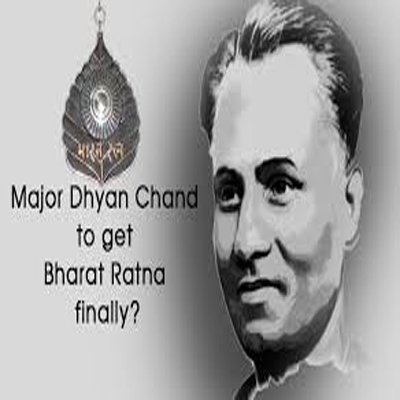
NEW DELHI: The Sports Ministry has recommended the name of the late Major Dhyan Chand who is considered among the greatest hockey players of all time for the top national civilian honour, the Bharat Ratna.
This was revealed in Parliament today by Sports Minister Jitendra Singh who said the recommendation was for Dhyan Chand’s achievements in the field of sports.
Dhyan Chand (29 August 1905 – 3 December 1979) was a field hockey player widely considered to be one of the greatest players of all time.
Chand is most remembered for his goal-scoring feats and for his three Olympic gold medals (1928, 1932, and 1936) in field hockey, during an era where India was dominant in the sport.
Known as “The Wizard” for his superb ball control, Chand played his final international match in 1948, having scored more than 400 goals during his international career.
Born in Allahabad, he was the elder brother of another player Roop Singh. His father Sameshwar Dutt Singh was in the British Indian Army, and he played hockey in the army. Dhyan Chand had two brothers – Mool Singh, and Roop Singh. Because of Sameshwar Dutt’s numerous army transfers, the family had to move to different cities and so Chand had to terminate his education after only six years of schooling. The family finally settled in Jhansi. Being in the military, Dhyan’s father got a small piece of land for a house.
Young Chand had no serious inclination towards sports, though he loved wrestling. He joined the Indian Army at the age of 16.
Between 1922 and 1926, Chand exclusively played army hockey tournaments and regimental games. Chand was ultimately selected for the Indian Army team which was to tour New Zealand. The team won 18 matches, drew two and lost only one, receiving praise from all spectators. Following this, in the two Test matches against the New Zealand squad, the team won the first and narrowly lost the second. Returning to India, Chand was immediately promoted to Lance Naik.
After successfully lobbying for reintroducing field hockey in the Olympics, the newly formed Indian Hockey Federation (IHF) made preparations to send its best possible team for the 1928 Amsterdam Olympics. In 1925, an Inter-Provincial Tournament was held to select India’s national field hockey team. Five teams participated in the inaugural nationals – United Provinces (UP), Punjab, Bengal, Rajputana, and Central Provinces. Chand got permission from the Army to play for the United Provinces team.
In the 1928 Amsterdam Summer Olympics, the Indian team was put in the division A table, with Austria, Belgium, Denmark and Switzerland. On 17 May the Indian national hockey team made its Olympic debut against Austria, winning 6-0, with Chand scoring 3 goals. The next day India defeated Belgium 9-0; however Chand only scored once. On 20 May, Denmark lost to India 5-0, with Chand netting 3. Two days later, he scored 4 goals when India defeated Switzerland 6-0 in the semi-finals.
The final match took place on 26 May, with India facing the home team of the Netherlands. The Indian team’s better players Feroze Khan, Ali Shaukat and Kher Singh were on the sick list and Chand himself was ill. However, even with a skeletal side, India managed to defeat the hosts 3-0 (with Singh scoring 2), and the Indian team won its country’s first Olympic gold medal. Keeper Richard Allen created a unique record of not conceding a single goal. Chand was the top scorer of the tournament by a large margin, scoring 14 goals in 5 matches.