News Broadcasting
HDFC Life’s ‘Birthday’ gift


MUMBAI: “Not today but surely tomorrow,” is something we all say even though tomorrow never comes. And if it does, it’s usually because someone or something triggers us into action.
Similarly, HDFC Life’s new campaign ‘Birthday’ to promote its long-term financial plan to secure the future of a child tries to inculcate among young parents the habit of disciplined and systematic investment planning by using their kid’s birthday as trigger.
HDFC Life didn’t want its campaign to be labelled as something that simply lures people but as an informative ‘trigger’ that would help them secure their child’s future.
Watch the video: YoungStar Plans from HDFC Life

Drawing a parallel with the Cadbury ad which uses the tagline ‘Shubh Aarambh’ telling people to eat something sweet before starting something new, HDFC marketing, product, and direct channels senior executive vice president Sanjay Tripathy says: “Previously too, brands, especially FMCG brands, have used trigger-based communication successfully. Hence, we thought of using the same thought.”
“Birthday seemed the best option because as parents, one can plan a long-term and every b’day will act as a reminder for the payment of the premium. Timing and the context plays a very important part. We did this by showing in our film a younger kid and young parents and one of our contextual ads also shows age for buying the product, which is between 3-9 years so that parents can have a long investment horizon of 10-15 years for a bigger corpus available when the child turns 16, 18 or 21, ready to take up under or post graduation.”
Won’t the economic slowdown impact the plan and in such a scenario, will the trigger work?
Child plans are some of our major plans and close to 15% of our business comes from this, says Sanjay Tripathy
“Child plans are some of our major plans and close to 15% of our business comes from this. And when we did research, we found out that the parents are very involved in the planning of birthday celebrations, the other part that came out was that the mother is very involved in the planning of the financial future of the child. And lastly, people are not very clear about when to take the step? So we thought this a nice way to convey the message of when is the right time for the parent to start investing,” replies Tripathy.
The 360-degree campaign covers TV, print, radio, OOH and digital and will run for six weeks. Asked about the spend break-up, he says: “Television and print by nature are costly, and the amount I’m spending on digital might be less compared to them but it might be sufficient for that medium so I won’t be fair to break it down.”
With Leo Burnett having done the ATL (print, TV and radio), NCD KV Sridhar talks about campaign execution as: “Most of the times, the important parenting decisions are overshadowed by urgent ones. Through our campaign, we’ve tried to communicate to parents that investing in a child plan at the right time is equally important. And we thought what better day than a child’s birthday to remind parents to start investing for their future. After all, only when they invest on time will their children get the support they need to fulfil their dreams when they grow up”.
Digital agency Propaganda has handled the campaign’s digital side.






News Broadcasting
UDF poised to return to power in Kerala, says Manorama-CVoter survey
Massive opinion poll projects shift in Kerala politics ahead of 2026 Assembly elections.
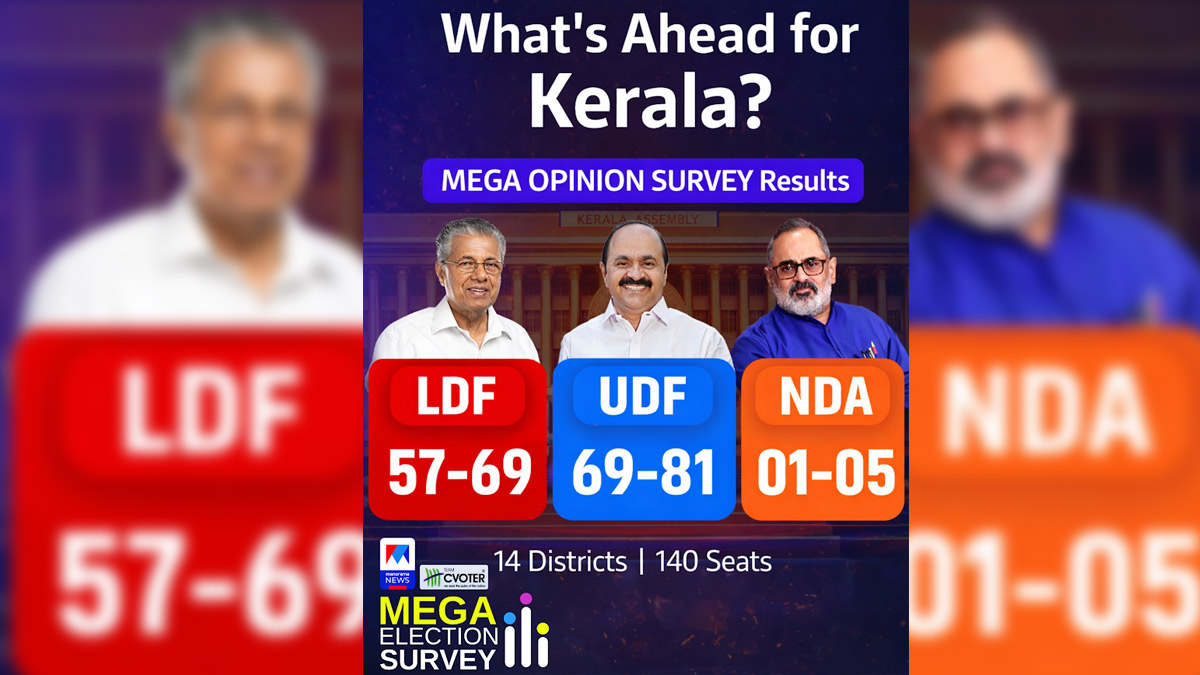
MUMBAI: The winds of change appear to be blowing through Kerala’s political landscape and this time, they seem to favour the United Democratic Front. A comprehensive mega opinion survey conducted by Manorama News in partnership with CVoter projects a potential comeback for the UDF in the upcoming Kerala Legislative Assembly Elections 2026. The survey, covering all 140 constituencies with a massive sample size of nearly 90,000 respondents, predicts the UDF could win between 69 and 81 seats.
The ruling Left Democratic Front (LDF) is expected to secure 57 to 69 seats, a significant drop from the 99 seats it won in the 2021 elections. This would mean the LDF losing 30 to 42 of its sitting seats. Meanwhile, the National Democratic Alliance (NDA), which drew a blank in 2021, is projected to open its account with 1 to 5 seats.
Region-wise, the UDF is expected to make strong gains in Malabar, winning 25 to 34 out of 48 seats, and in Central Kerala, where it could bag 29 to 33 out of 53 seats. In South Kerala, the LDF is likely to retain an edge with 21 to 25 seats, while the UDF may improve to 12 to 16 seats. The NDA could pick up 1 to 3 seats in the southern region.
The survey was conducted between 14 and 26 March 2026, with additional tracker and snap polls carried out from December 2025 to March 2026. A total of 89,693 respondents participated, ensuring representation across all demographics and social segments.
Manorama News has a strong track record of accuracy, with its previous projections closely matching the actual results of the 2019 and 2024 Lok Sabha elections as well as the 2021 Kerala Assembly polls.
In Kerala’s famously fierce political battles, this survey suggests the pendulum may be swinging back. Whether the final verdict matches these numbers or throws up another surprise, one thing is clear, the 2026 Assembly elections are shaping up to be one of the most keenly watched contests in the state’s history.






