I&B Ministry
Government has no intentions to impose any regulations on the media: Javadekar

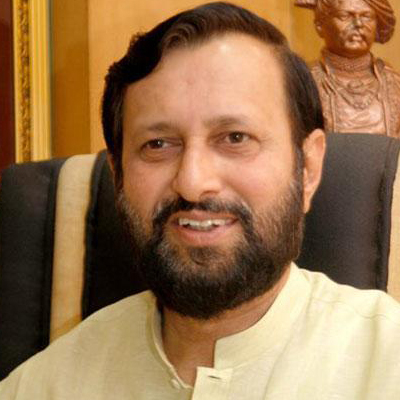
NEW DELHI: Newly appointed Information and Broadcasting Minister Prakash Javadekar said today that freedom of the press is the cornerstone of a democracy and his first aim in his new portfolio will be to find ways to strengthen this freedom.
Speaking soon after taking charge of his portfolio, the Minister said that the media and politicians must work together to highlight the problems of the people and bring them before the government.
Describing himself as ‘just a soldier’, he said he had always stood for freedom of the press and had suffered a 16-month imprisonment during the national emergency in 1975 in this fight as he belongs to a family of journalists.
Noting that the press has conducted itself in a responsible manner and set up self-regulatory bodies, he said the government would not impose any regulations on the fourth estate.
The media in its present form gives a ‘rainbow of choices’ and even dissent has its own place in a democratic system of functioning. Constructive criticism is therefore welcome.
Asked about the frictions with Prasar Bharati, Javadekar said he had not had time to study the issues yet but would like to work in partnership with all the autonomous media units including Prasar Bharati.
He said in reply to a question that he did not agree with his immediate predecessor that there was no need for an Information and Broadcasting Ministry in the present context.
Referring to social media, he said that while it presently came under the Information Technology Act, but he would study it and see how it can be helped. He said he would meet all the officials of the Ministry, understand the issues involved and then make some suggestions to the Prime Minister.
Soon after meeting the media, he met senior officials of the Ministry and also media units, apart from Prasar Bharati CEO Jawhar Sircar and Director of Film Festivals Shankar Mohan.
Contrary to expectations, Prime Minister Narendra Modi has not upgraded the post of Information and Broadcasting to cabinet rank.
Like his immediate predecessor Manish Tewari, Javadekar will be a Minister of State with independent charge of Information and Broadcasting Ministry. (He has also been given charge of Environment and Parliamentary Affairs). However, he has ample experience as far as dealing with the media and its problems are concerned, since he like Tewari has served as party spokesperson for the past few years.
Javedekar has also been one of the nominated members from Parliament to the Press Council of India and hence has dealt with media issues such as paid news. A member of the Rajya Sabha from Maharashtra, Javadekar was born in Pune on 30 January 1951 and became associated with the Akhil Bharatiya Vidyarthi Parishad in his young days.
He commenced his professional life as an employee in the Bank of Maharashtra for 10 years from 1971 to 1981 and also worked in the Rural Development Department.
His father Keshav Krishna Javadekar was a senior leader of Hindu Maha Sabha who worked as joint editor of Marathi Daily started by Lokmanya Tilak – Kesari before having stints with some other newspapers like Tarun Bharat and Kaal as journalist. He still occasionally writes his thoughts in some newspapers.
Javadekar has been president of GLOBE India (Global Legislators Organisation for Balanced Environment); In-charge BJP Economic Forum and Cells related to Economy; President, NOINO (National Organisation of Insurance Officers) and president, KCKU (Khadi Commission Karmachari Union).
As a member of Parliament, he has served as member of the Press Council of India; the Public Accounts Committee; Standing Committee on Human Resources and Development; Consultative Committee for Ministry of Power; Committee on Subordinate Legislation and Committee on Wakf.
He has earlier served as executive president of the State Planning Board in Maharashtra (1995–1999); been a member of the Maharashtra Legislative Council from Pune Division Graduate Constituency for 12 years from 1990; chairman of the Task Force on IT in Maharashtra (1977–1999) and chairman of the Working Group on ‘IT for Masses’ of the central government.
He has also led a delegation to Boston to negotiate Media Lab Asia Project in 2000.