News Broadcasting
FIC hires Indian distribution veteran Rahul Sood


MUMBAI: Former NDTV distribution head Rahul Sood is moving base to Singapore. The highly experienced distribution executive will be joining the 21st Century Fox owned Fox International Channels (FIC) as vice-president of affiliate sales and commercial come 9 December.
He will be responsible for FIC’s sales and channel development of new markets across the region, with emphasis on newly emerging areas. Rahul will also be developing FIC’s sales strategy for commercial establishments such as hotels and other out-of-home opportunities.

In addition, Rahul will focus on the international distribution beyond APAC and the Middle East of FIC’s suite of Chinese channels, which includes SCM, the network’s powerhouse Chinese movies channel. This emphasis underscores FIC’s commitment to the ambitious goal of promoting Chinese-language content beyond Asia and taking the SCM brand global.
Rahul brings over 17 years of leadership experience in various roles in Asia’s TV industry. Prior to joining FIC, he spent 10 years as the head of affiliate sales and network distribution at NDTV, one of India’s leading news networks. Prior to that he held the role of executive director of affiliate sales for south Asia at Turner Broadcasting and was part of the initial core team which established the New Delhi office.
Says Rahul: “It’s a real honour to join a network with such a strong commitment to building great partnerships with affiliates. I look forward to expanding FIC’s distribution network and working closely with existing and new platform partners to build the business together.”
He will be reporting in to executive vice-president of affiliate partnerships and syndication for Asia Pacific and the middle east.
Giving company to Rahul as a new joinee at FIC is Helena Coe who hopped on board at FIC on 18 November as vice-president of syndication based out of Hong Kong.
Helena has been given the task of working with channel and business development teams, as well as country managers to establish region-wide syndication policies and drive the distribution of FIC Asia’s sports, factual and entertainment content rights to multiple platforms. She joins FIC from sports rights marketing agency Sportfive International, where she held the position of managing director of the Hong Kong office, leading activities for Sportfive’s TV rights in Hong Kong, Japan and Korea, and digital rights across Asia Pacific. Helena was also previously vice president of digital media, Asia Pacific at IMG Media.
“Both Helena and Rahul bring a great wealth of experience to FOX International Channels and we are very pleased to welcome them on board,” said Alex Lambeek. “Their appointments serve to demonstrate our commitment to work closely with our affiliate partners to further FIC’s presence across Asia Pacific and the middle east.”







News Broadcasting
Network18 channels lead YouTube news viewership in March 2026
CNN-News18, News18 India and CNBC channels top categories with record views
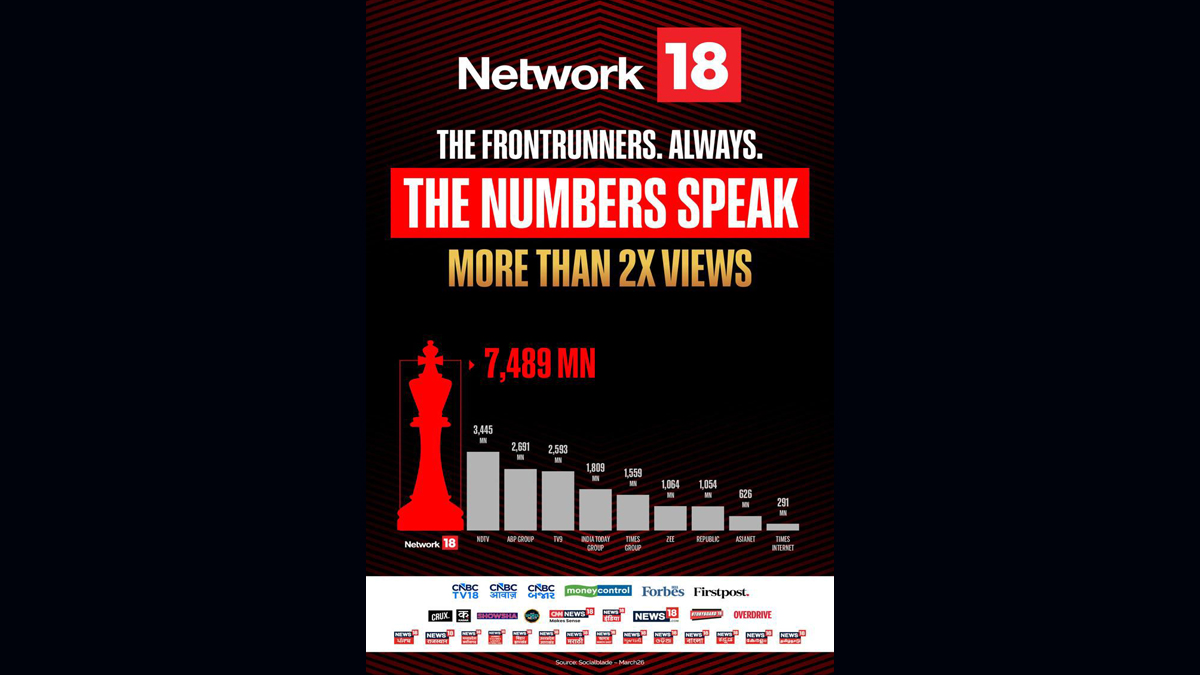
MUMBAI: When the world hit refresh on breaking news, Network18’s channels were already streaming ahead. As geopolitical tensions and war-driven headlines fuelled a surge in global news consumption, the network’s digital playbook delivered big clocking record Youtube viewership across English, Hindi and business news categories in March 2026.
At the forefront was CNN-News18, which emerged as the clear leader in the English news segment with 130 million live and video-on-demand views. The channel edged past competitors such as Times of India (126.5 million), Times Now (101.1 million), India Today (88.2 million) and NDTV (77.5 million), according to Databeings data for March.
In the Hindi news arena, News18 India delivered a commanding performance, racking up a staggering 3,297 million views on YouTube. The channel comfortably outpaced NDTV India, which recorded 3,119 million views, underlining its deep reach and consistent engagement with mass audiences, as per Playboard data.
The network’s dominance wasn’t confined to general news. In the Hindi business segment, CNBC Awaaz topped the charts with 92 million views, narrowly ahead of Zee Business (90 million) and well ahead of ET Now Swadesh (57 million). Meanwhile, its English counterpart CNBC-TV18 posted a strong 58 million views, reinforcing the network’s cross-category strength.
The spike in viewership reflects a broader shift in audience behaviour, with viewers increasingly turning to digital platforms particularly Youtube for real-time updates and in-depth coverage during high-intensity news cycles. For Network18, the numbers signal more than just scale; they underline the effectiveness of a multi-platform strategy that blends speed, credibility and continuous coverage.
In a month where the news never paused, it seems viewers chose to stay tuned where the stream never stopped.






