News Broadcasting
Election broadcast must be seen in context of electoral constituencies: NBSA

MUMBAI: A case had been filed against English news channels CNN-IBN, NDTV, Times Now and Headlines Today regarding a piece of news that was broadcast on 7 April 2014.
The complaint filed by Vishal Kudchadkar and Syed Ali Hussaini claimed that on the particular day, some constituencies in Assam and Tripura went to polls but the above mentioned channels chose to broadcast the BJP manifesto release on the same day. According to the complainants, they have violated the Section 126 (1) of the Representation of People Act, 1951, which prohibits any public display of election matter by means of cinematography, television and other similar apparatus during the period of 48 hours prior to the end of polling.
This apart they allege that it also violates the direction of the Election Commission of India and Guideline 12 of the NBA guidelines for election broadcasts.

The NBSA sought a reply from the ECI in this regard to which it said, “The legal opinion (obtained by EC) on the issue relating to Section 126 of RP Act was that the said section, being a penal provision, had to be strictly construed; and that the telecasting of an election related event such as release of election manifesto or an election address or a press conference outside the limits of a constituency going to the poll would not attract the penal provisions of Section 126; and that the prohibition regarding the release of a manifesto or election address or press conference will have to be restricted to any election matters relating to that constituency and the candidates in that constituency.”
Guideline 12 of the NBA says, ‘The broadcasters shall not broadcast any ‘election matter’ that is, any matter intended or calculated to influence or affect the result of an election during the 48 hours ending with the hours fixed for the conclusion of poll, in violation of Section 126 (1) (b) of the Representation of People Act. 1951.’ The EC was proposing to consider the broadcast of the BJP manifesto as a violation of section 126 of RP Act.
Therefore, the NBSA feels that this falls in the jurisdiction of the criminal courts. It says that it could have considered that the broadcasters had violated the provision of section 126 (1)(b) of the RP Act, had the words ‘in violation of section 126(1)(b) of the Representation of People Act, 1951’.
The election matter also involves the fact that whether anything was done to disturb or tilt the voting scenario in the area where it is being held rather than throughout the country. Therefore, the NBSA says that the complaints have no merit and can be closed.







News Broadcasting
Network18 channels lead YouTube news viewership in March 2026
CNN-News18, News18 India and CNBC channels top categories with record views
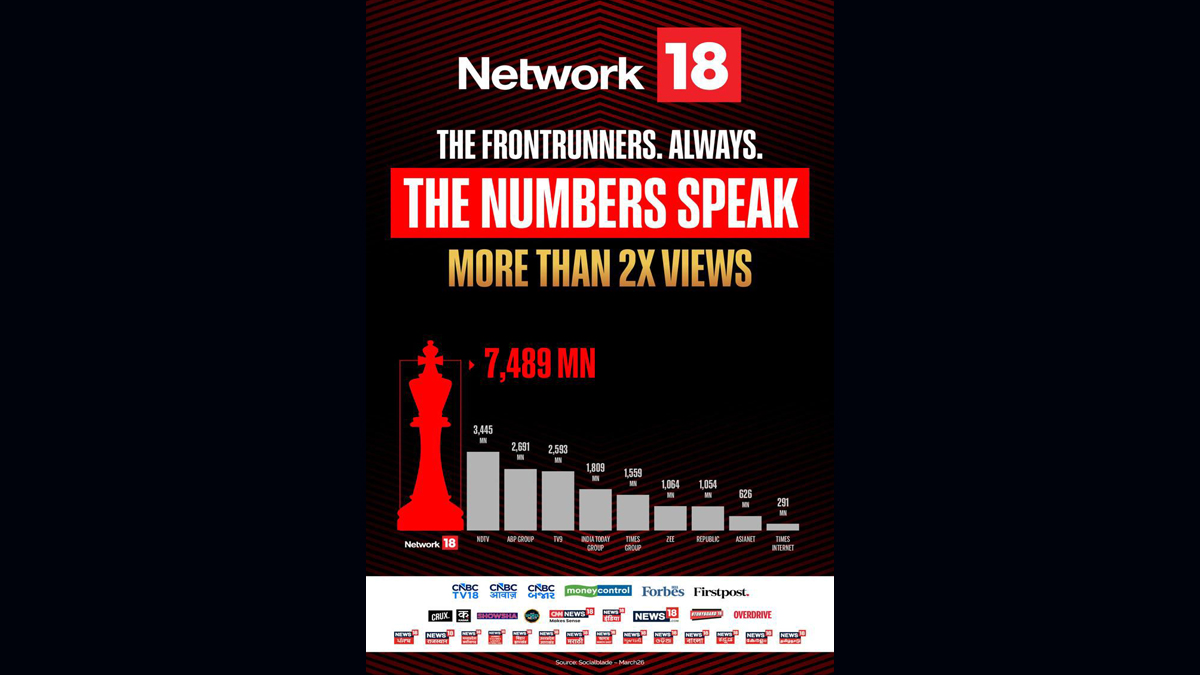
MUMBAI: When the world hit refresh on breaking news, Network18’s channels were already streaming ahead. As geopolitical tensions and war-driven headlines fuelled a surge in global news consumption, the network’s digital playbook delivered big clocking record Youtube viewership across English, Hindi and business news categories in March 2026.
At the forefront was CNN-News18, which emerged as the clear leader in the English news segment with 130 million live and video-on-demand views. The channel edged past competitors such as Times of India (126.5 million), Times Now (101.1 million), India Today (88.2 million) and NDTV (77.5 million), according to Databeings data for March.
In the Hindi news arena, News18 India delivered a commanding performance, racking up a staggering 3,297 million views on YouTube. The channel comfortably outpaced NDTV India, which recorded 3,119 million views, underlining its deep reach and consistent engagement with mass audiences, as per Playboard data.
The network’s dominance wasn’t confined to general news. In the Hindi business segment, CNBC Awaaz topped the charts with 92 million views, narrowly ahead of Zee Business (90 million) and well ahead of ET Now Swadesh (57 million). Meanwhile, its English counterpart CNBC-TV18 posted a strong 58 million views, reinforcing the network’s cross-category strength.
The spike in viewership reflects a broader shift in audience behaviour, with viewers increasingly turning to digital platforms particularly Youtube for real-time updates and in-depth coverage during high-intensity news cycles. For Network18, the numbers signal more than just scale; they underline the effectiveness of a multi-platform strategy that blends speed, credibility and continuous coverage.
In a month where the news never paused, it seems viewers chose to stay tuned where the stream never stopped.






