GECs
Downlink Policy: Chandra has reservations


MUMBAI: The government may come out with a downlinking policy soon but Zee Telefilms chairman Subhash Chandra has reservations on whether it would be a complete mechanism in regulating content on television channels.
“The proposed downlinking policy is still discriminatory and is a compromise. Who, for instance, will monitor it? Only a post mortem is possible. No preventive measure can be taken,” Chandra said on Friday. He was speaking on “Regulate the industry – Is TV content going overboard?” at the third of a series of interactions between the television industry and media, organised by Tam Media Research and Press Club, Mumbai.
Making uplinking from India mandatory would be a more effective mechanism to control foreign channels. Broadcasters like Star and Sony uplink from outside the country.

Incidentally, the downlinking policy, which is awaiting Cabinet nod, is expected to give the government control over channels beaming into India, but uplinking from abroad. The channels will have to register themselves in India, and set up an India office. The government wants to tackle issues such as adult content.
Stressing on the need to regulate the TV industry, Chandra said the Cable Television Networks (Regulation) Act was not clear in defining “adult content” as in the West. In Europe, for instance, there were seven categories of adult channels. Under a conditional access system (CAS) environment, such content would have given the viewers a choice as they could use the parental lock. “But the trouble is that broadcasters are not together with some even lobbying against CAS.
And it is very easy for foreign broadcasters to say that the Indian laws are not applicable to them,” he said.
Zee Telefilms has suggested to the information and broadcasting ministry (I&B) that each programme be codified like in films so that the family could decide whether to watch it. They could then completely block it with their own code number,” he added.
The regulation is such that broadcasters can “turn and twist” to get around with it. “We have been asking for a separate regulator rather than having the Telecom Regulatory Authority of India for it,” Chandra said, remarking on the need to regulate the broadcast industry.
Speaking on the occasion, senior advocate Mukesh Vashi accused TV channels of violating the Cinematography and Cable TV Acts. Drawing instances where several channels were screening obscene acts, he stressed on the need for a regulatory board to regulate contenton TV. “Though the law is there, no regulatory authority is available. A regulatory body is urgently needed,” Vashi said.
Tam CEO LV Krishnan believed technology could also be used to intervene and regulate adult content. “It is mainly the music channels which are showing such content,” he said.






GECs
Pocket FM partners with Indian Open Pickleball 2026
Audio platform joins forces with major tournament to engage young fans.
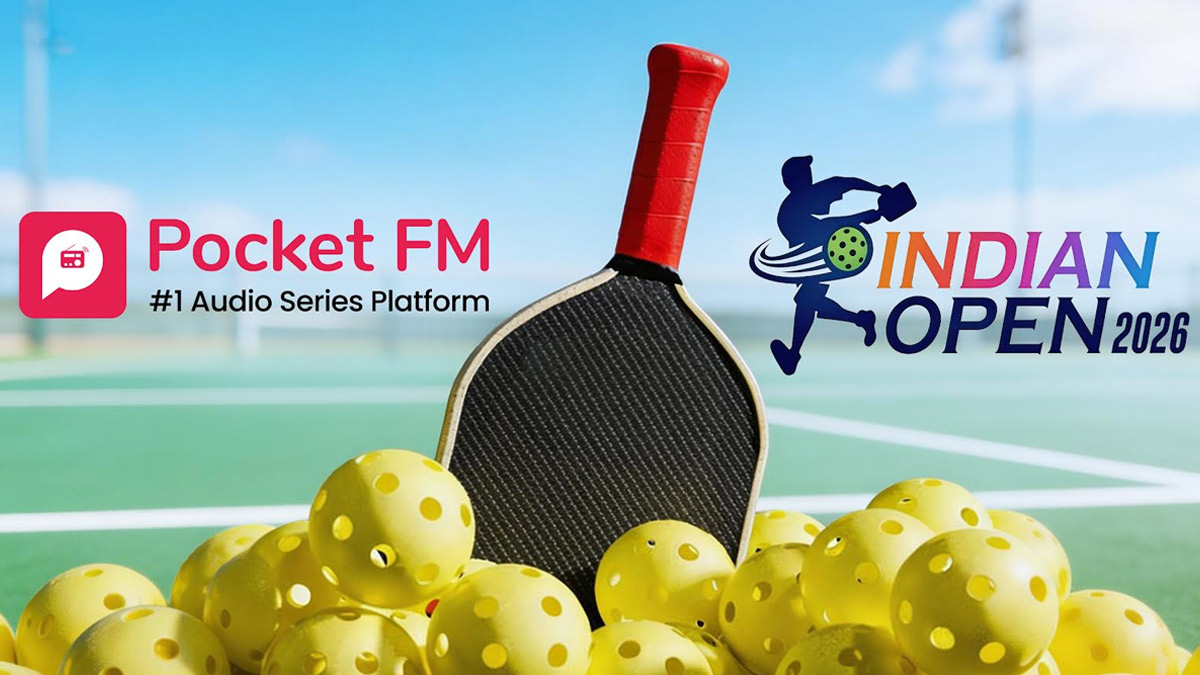
MUMBAI: Pocket FM just served up a perfect partnership because when audio storytelling meets pickleball’s fast-paced rallies, even the sidelines start listening. Pocket FM, the world’s largest audio series platform, has announced a strategic partnership with Indian Open 2026, one of India’s biggest pickleball tournaments organised by Global Sports in Hyderabad in association with Pickl’Out and Crosscourts Sports Club.
The collaboration brings Pocket FM’s immersive storytelling to one of the fastest-growing emerging sports in India. Pickleball, known for its accessibility, energy and strong community appeal, is rapidly attracting younger, digitally savvy audiences making it an ideal platform for Pocket FM to deepen its cultural relevance.
Under the partnership, Pocket FM will enjoy extensive on-ground and digital visibility throughout the tournament, which begins on 1 April 2026. This includes centre court branding, venue-wide presence, presenting rights for select matches, player lounge branding, team jersey integration, and strong integration across live streaming and social media.
Pocket FM, SVP and global head for brand marketing and partnerships Vineet Singh said, “Pickleball is building a strong connection with young and engaged audiences in India. This partnership allows us to connect with people in a meaningful way through strong on-ground presence and digital visibility.”
Global Sports and Indian Open 2026, founder Hemal Jain added, “Partnering with Pocket FM adds an exciting new dimension to the experience. As a brand that has built deep resonance with young audiences, Pocket FM is a strong fit for the energy and ambition of this tournament.”
The move reflects Pocket FM’s continued strategy of aligning with emerging passion points and building deeper engagement with communities driven by competition and shared experiences.
In a country where sports and stories often collide, Pocket FM isn’t just sponsoring a tournament, it’s turning every rally into a narrative, proving that the best audio moments sometimes happen when the paddle meets the ball.