English Entertainment
Disney Entertainment co-chairman Dana Walden outlines corp strategic vision

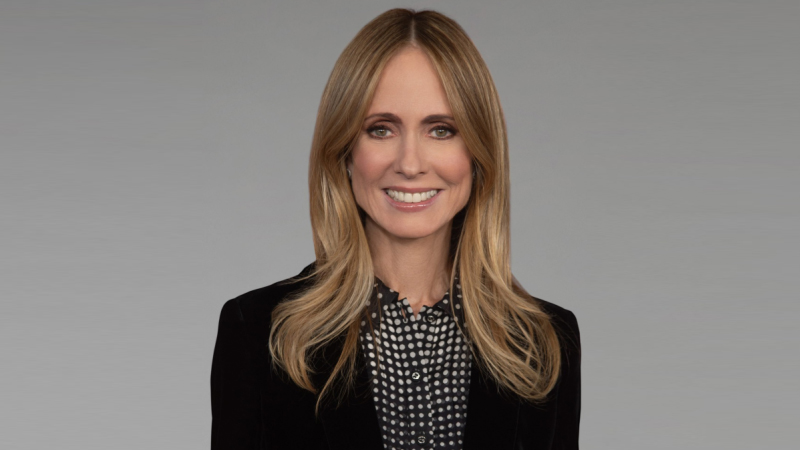
MUMBAI: Dana Walden, co-chairman of Disney Entertainment, delivered a comprehensive overview of the company’s operations and future direction at the Morgan Stanley Technology, Media & Telecom Conference on 4 March 2025, addressing key areas of investor interest including streaming profitability, content strategy, and technological innovation.
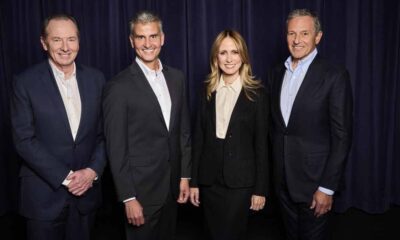
Walden explained how Disney’s restructuring under CEO Bob Iger has created a “clean structure” with three segments: Disney experiences under Josh D’Amaro, ESPN under Jimmy Pitaro, and Disney entertainment co-led by herself and Alan Bergman. Within their division, Bergman oversees film studios and branded series, whilst Walden manages global television, with joint responsibility for Disney+ and Hulu, including ad sales, technology, and platform distribution.
She emphasised that this structure has “restored the authority to creative executives” who understand “how to create stories at scale” whilst connecting “the people who approved the spending to the revenue.” Disney Studios achieved market dominance with $5.5 billion at the box office, which Walden suggested was “more than all the other studios combined, or very close.” The company also claimed half of the top ten most streamed shows of the year.

Walden highlighted a dramatic financial improvement in Disney’s streaming business, transitioning from “losing over $1 billion a quarter” to becoming “profitable, growing revenue and delivering with visibility towards double-digit margins.” She noted that Disney+ is still only five years old, emphasising the rapid pace of achievement.
The integration of Hulu on Disney+ for bundle subscribers was described as “an extraordinary value” that is “driving engagement” and “improving our churn dynamic.”
Upcoming content releases like Moana 2 (arriving on Disney+ on 12 March) will serve as “a huge event for subscribers, both in terms of acquisition and engagement,” followed by Mufasa in late March.
Disney’s creative prowess was underscored by its 60 Emmy Awards, which Walden pointed out was “more than any of our competitors ever,” whilst “the rest of the industry split the other 69 awards.”
Regarding international growth, Walden discussed the company’s investment in local content development over the past two years, citing the Korean series Moving which attracted “over 1.5 million subscribers.” She outlined a three-tiered approach: “local for local, local for regional, and global for the whole world.”
On ESPN’s upcoming direct-to-consumer service, Walden confirmed the flagship product would launch later this year with “new features that will really blow people away.” She highlighted recent additions to Disney+, including an ESPN tile with over 3,000 hours of programming and the newly launched SC+, a daily SportsCenter show that provides “a daily touch point for sports” and a “reason every day to open the app.”
In the competitive children’s entertainment space, Walden asserted Disney’s dominance in the preschool segment, with Bluey emerging as the most streamed show in the United States last year, driving “60 billion minutes of engagement on Disney+.” She acknowledged the fragmented viewing habits of older children across social media, gaming and YouTube, noting Disney’s “meaningful and great partnership with YouTube” where they produce “thousands of videos” with Disney Junior having “22 million subscribers.”
Walden revealed that Disney is developing technology features that will “specifically address how kids are interacting with content right now in a very contemporary way,” whilst also highlighting the success of Disney Playtime, a linear-style channel that helps “introduce this young audience to multiple franchises.”
On technology, Walden countered the notion that Disney needs to become a great technology company, asserting “Disney is a great technology company and a great storytelling company,” citing the Imagineers’ work in parks, Pixar’s production innovations, and the acquisition of BamTech. She highlighted key technology hires including Adam Smith from YouTube as Head of Technology and Andre Rohe from YouTube and Meta as Head of Engineering, who are focused on “algorithmic programming and personalization, deploying AI across all of our services.”
Walden identified advertising as “absolutely a growth area,” leveraging Hulu’s position as “the original ad solutions partner on streaming video.” She touted Disney’s technological advantages in “automation, programmatic targeting, the ability to work with the biggest DSPs to share data in a clean room,” claiming Disney is “significantly ahead of our competitors in this space.”
Concluding her remarks, Walden expressed confidence in Disney’s leadership team, describing the company as being in “incredibly good hands” under CEO Bob Iger, with “a small leadership team who deliver so much value” and “excellent” company culture.




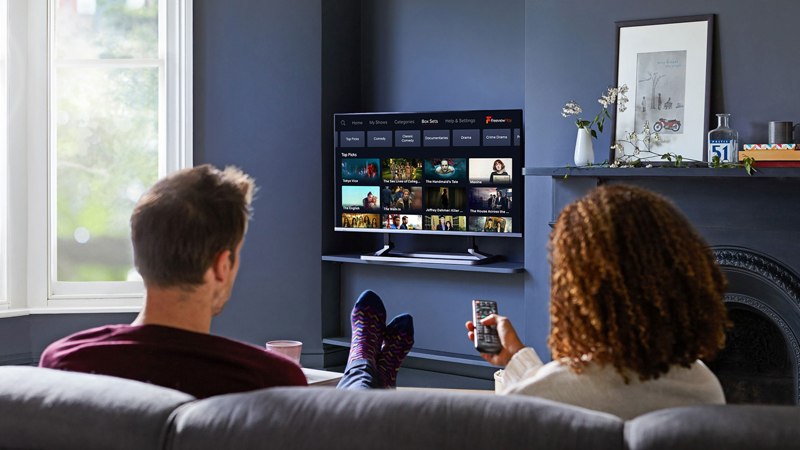
UK: The aerial is losing its grip. As broadband becomes the default way Britons watch television, the UK is edging towards a decisive, and divisive, question: should Freeview be switched off by 2034? The issue, highlighted in reporting by The Guardian, has exposed deep fault lines over access, affordability and the future of public service broadcasting.
For nearly 25 years, Freeview has delivered free-to-air television from the BBC, ITV, Channel 4 and Channel 5 to almost every corner of the country. Even now, it remains the UK’s largest TV platform, used in more than 16m homes and on around 10m main household sets. Yet the same broadcasters that built it are now pressing for its closure within eight years.
Their case rests on a structural shift in viewing. Smart TVs, superfast broadband and the Netflix-led streaming boom have pulled audiences online. Advertising economics have followed. By 2034, the number of homes using Freeview as their main TV set is forecast to fall from a peak of almost 12m in 2012 to fewer than 2m, making digital terrestrial television, or DTT, increasingly costly to sustain.
But critics say the rush to switch off risks abandoning those least able, or least willing, to move online.
“I don’t want to be choosing apps and making new accounts,” says Lynette, 80, from Kent. “It is time-consuming and irritating trying to work out where I want to be, to remember the sequence of clicks, with hieroglyphics instead of words. If I make a mistake I have to start again.”
Lynette is among nearly 100,000 people who have signed a “save Freeview” petition launched by campaign group Silver Voices. She fears the government is about to “take [Freeview] away from me and others who either don’t like, can’t afford, or can’t use online versions”.
Official figures underline the fault lines. A report commissioned by the Department for Culture, Media and Sport estimates that by 2035, 1.8m homes will still depend on Freeview. Ofcom’s analysis shows those households are more likely to be disabled, older, living alone, female, and based in the north of England, Wales, Scotland and Northern Ireland.
Freeview is owned by the public service broadcasters through Everyone TV, which also operates Freesat and the newer streaming platform Freely. After two years of review, DCMS is expected to set out its position soon, drawing on three options proposed by Ofcom: a costly upgrade of Freeview’s ageing technology; maintaining a bare-bones service with only core PSB channels; or a full switch-off during the 2030s.
The broadcasters have rallied behind the third option. They argue that 2034 is the logical cut-off, when transmission contracts with network operator Arqiva expire. By then, they say, the cost of broadcasting to a dwindling audience will far outweigh the returns from TV advertising.
Ofcom agrees a crunch point is approaching. In July, the regulator warned of a “tipping point” within the next few years, after which it will no longer be commercially viable for broadcasters to carry the costs of DTT.
Others see risks beyond economics. Questions remain over whether internet TV can reliably deliver emergency broadcasts, such as the daily Covid updates, in the way that universally available DTT can. The UK radio industry has also warned that an internet-only future for TV could push up distribution costs and force some radio stations off air if PSBs no longer share Arqiva’s mast network.
“It is a political hot potato,” says Dennis Reed, founder of Silver Voices, who says he has “dissociated” his organisation from the government’s stakeholder forum, which he believes is “heavily biased” towards streaming.
The Future TV Taskforce, representing the PSBs, counters that moving online could “close the digital divide once and for all”. “We want to be able to plan to ensure that no one is left behind,” a spokesperson says, adding that rising DTT costs could otherwise mean cuts to programme budgets.
The numbers show the scale of the challenge. Of the 1.8m Freeview-dependent homes projected for 2035, around 1.1m are expected to have broadband but not use it for TV. The remaining 700,000 are forecast to lack a broadband connection altogether.
Veterans of the analogue switch-off, completed in 2012 after 76 years, recall similar fears of “TV blackout chaos”. Around 6 per cent of households were labelled “digital refuseniks”, yet a targeted help scheme and a national campaign, fronted by a robot called Digit Al voiced by Matt Lucas, delivered a largely smooth transition.
This time, the BBC is less keen to foot the bill. Tim Davie, the outgoing director general, has said the corporation should not fund a comparable support programme for a Freeview switch-off.
Research for Sky by Oliver & Ohlbaum suggests that with early awareness campaigns and digital inclusion measures, only about 330,000 households would ultimately need hands-on help ahead of a 2034 shutdown.
Meanwhile, viewing habits continue to fragment. Audience body Barb says 7 per cent of UK households no longer own a TV set, choosing to watch on other devices. In December, YouTube overtook the BBC’s combined channels in total UK viewing across TVs, smartphones and tablets, albeit measured at a minimum of three minutes.
That shift may accelerate. YouTube has recently blocked Barb and its partner Kantar from accessing viewing session data, limiting transparency just as online platforms consolidate power.
“When the government chose British Satellite Broadcasting as the ‘winner’ in satellite TV it was Rupert Murdoch’s Sky instead that came out on top,” says a senior TV executive quoted by The Guardian. “There already is such an outsider ready to be the winner in the transition to internet TV; it is YouTube.”
Freeview’s future now hangs on a familiar British dilemma: modernise fast and risk exclusion, or protect universality and pay the price. Either way, the aerial’s days as king of the living room look numbered.






