Hindi
‘Children of War’ releases in India and Bangladesh

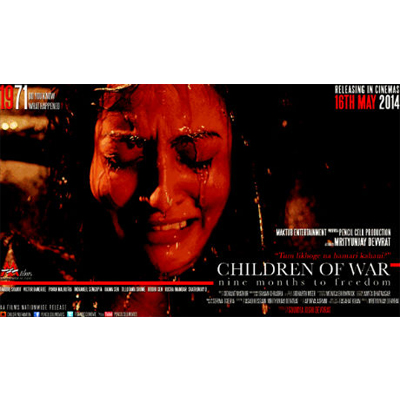
NEW DELHI: ‘Children of War’, a chilling tale of the freedom movement in (then) east Pakistan for creation of a free Bangladesh and its effect on the common people, will be released simultaneously in India and Bangladesh.
However, the version released in Bangladesh is dubbed in Bengali, according to producer Soumya Joshi Devvrat.
The only other time an Indian film had simultaneous release in these two countries was that of Goutam Ghose’ Bengali film ‘Moner Manush’ which was based on the life of Lalan Fakir and had a Bangladeshi co-producer.
Asked why the film has one song in Bengali while the others are in Hindi, she said it was because the song tells a story of emotions of the people at the time.
Loosely-inspired by the unfinished biography of Banga Bandhu Sheikh Mujibur Rahman who led the Mukti Bahini, the film was released in India and Bangladesh in 450 screens.
Inspired by the biography, Devrat and her husband Mrityunjay who has directed the film researched several documents and also met some Indian Army veterans. She says that as several documents on Bangladesh were not available in India, they had to be procured from the United Kingdom.
The movie begins in March 1971 and covers a period of nine months showcasing the atrocities and the crude inhumane methods adopted by the military of West Pakistan. With the support of the Americans and the Chinese, the Pakistani soldiers go on a rampage killing and raping hundreds of thousands of people across the region.
She reveals that the choice to follow three separate stories during the Bangladesh War was a deliberate decision to give a wider picture of what happened before the Indian Army stepped in, as taking a linear story would not have done justice to the story about the birth of a new country.
Thus, the narrative follows the story of a boy, his sister and his father’s word, a liberal patriotic journalist who is forced to take to arms, a war child’s search for acceptance, and the atrocity of the Pakistani army which raped over 400,000 women and killed millions of people. As the film progresses towards its climax, the three stories begin to intertwine with one another.
The film stars Riddhi Sen, Rucha Inamdar, Victor Banerjee, Farooque Shaikh, Indraneil Sengupta, Raima Sen, Tilotama Shome, Rupa Ganguly, and Pavan Malhotra in a powerful negative role.
The film has music by Ishaan Chhabra with songs by Sidhant Mathur. Cinematography is by Fasahat Khan with editing by Apurva Asrani.