iWorld
Bing releases the top search trends of 2013
MUMBAI: Women are on top, literally! The 2013 search trends released by Bing that includes search data from Australia, Brazil, Canada, China, France, Germany, India, Italy, Japan, Spain, the U.K. and the U.S, reveal that women ruled and were in the top searches. In eight of the 12 participating countries around the world, women were the most searched. Beyoncé reigned in the US, while Miley Cyrus’s highly publicised twerking made her the top-searched person in both Australia and Canada.
Former flames Justin Bieber and Selena Gomez were the most-searched people in the U.K. and Germany, respectively. Actress and actors Bruna Marquezine, Wen Zhang and Salman Khan were the most-searched people in Brazil, China and India, while singers Rihanna and David Bisbal ranked at the top for France and Spain, and gorgeous TV personalities Danmitsu and Belen Rodriguez were favorites in Japan and Italy.
It was also a year of American songs, superhero movies, Facebook love, high-end designer brands, controversial sports stars, European getaways and fierce women.
Bing search trends, found at www.BingTrends.com, indicate what has most captivated people around the world in 2013.
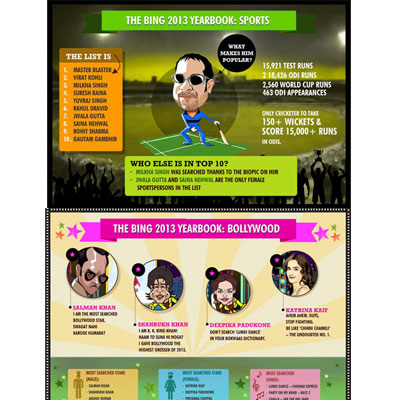
However, when it came to the top searches in India, surprisingly, it was not the master blaster Sachin Tendulkar, who bid adieu to international cricket in 2013, who was searched the most. He was at number four, only after Salman Khan, Shah Rukh Khan and Katrina Kaif.
While he may have led the search among actors, Salman’s films did not feature in the top ten most searched films. The fast paced action flick Race 2 bagged top honours followed by Shahrukh starrer Chennai Express. And the surprise package among the top 10 Hindi movies was Nasha, starring Poonam Pandey. And Shah Rukh Khan may have missed top spot in the most searched actor and film, but his Lungi Dance from Chennai Express made it to the top of charts as the most searched song in India. This was followed by Party on My Mind from Race 2 and Challa from Jab Tak Hai Jaan.
Sports stars too were popular. While Sachin Tendulkar was the most searched among sports stars, young and feisty Virat Kohli too made it to the top ten. However, the surprise entry was sprinter Milkha Singh, proving that the biopic on him did arouse curiosity about him in the country. Shuttlers Jwala Gutta and Saina Nehwal made sure that their sport was represented in the top ten dominated by cricketers.

iWorld
Uber spotlights Rs 25 bike rides with music led IPL campaign
Uber uses 15 second music films with Divine and Roll Rida to push Rs 25 rides
MUMBAI: In a season where ads usually swing for sixes with celebrity spectacle, Uber has chosen to play a clever single sharp, fast, and straight to the point. Uber has rolled out a distinctly stripped-down IPL campaign, putting its product Uber Bike rides starting at Rs 25 for up to 3 km front and centre, rather than leaning on big-budget storytelling. The campaign features hip-hop artist Divine in Mumbai and Roll Rida in southern markets, using music as the primary vehicle for recall.
IPL advertising has long been dominated by high-production narratives packed with cricketers and film stars. Uber’s approach flips that playbook. Instead of elaborate storytelling, the brand opts for 15-second music-led films quick, rhythmic bursts designed to mirror the pace of urban mobility itself.
The message is deliberately simple, affordable, fast rides that cut through city traffic. No layered plots, no extended build-up just a functional promise delivered with cultural flair.
In the Mumbai-led film, Divine zips through traffic on an Uber Bike, turning the Rs 25 price point into a hook with his signature wordplay around “pachisi”. The campaign cleverly reframes affordability as a moment of delight, the kind that leaves commuters with a “32-teeth smile” after beating traffic at minimal cost.
Meanwhile, Roll Rida’s version leans into southern sensibilities, blending Telugu and Tamil influences with high-energy visuals. Set to the beat of tape drums, the film celebrates how low-cost rides can unlock a more connected and vibrant city experience. Together, the films reflect a conscious push towards regional authenticity, rather than a one-size-fits-all national narrative.
The campaign also signals Uber’s sharper focus on India’s growing bike taxi segment. While the company offers multi-modal services spanning cars, autos, metro integrations and intercity travel, this push zeroes in on two-wheelers as a key growth lever in dense urban markets.
By anchoring the campaign around a Rs 25 entry price for short distances, Uber is targeting everyday commuters, particularly younger users navigating congested cities where speed and cost matter more than comfort.
With IPL advertising clutter at its peak, even the most straightforward message risks getting lost. Uber’s answer is to embed the proposition within culture using music, regional nuance and repeat-friendly short formats to drive recall. The creative team has also layered subtle visual cues including multiple references to “25” within frames encouraging repeat viewing and reinforcing the core message without over-explaining it.
The campaign reflects a broader shift in advertising priorities. As attention spans shrink and media environments get noisier, brands are increasingly favouring clarity over complexity and speed over scale.
Uber’s IPL play may not shout the loudest, but it lands where it matters in the everyday commute. Because sometimes, in a marketplace full of grand narratives, a Rs 25 ride is story enough.