
Movies
AI won’t replace filmmakers, it will test their imagination: Whistling Woods’s Chaitanya Chinchlikar
Whistling Woods CTO says AI’s true power lies in expanding creativity, not cutting costs


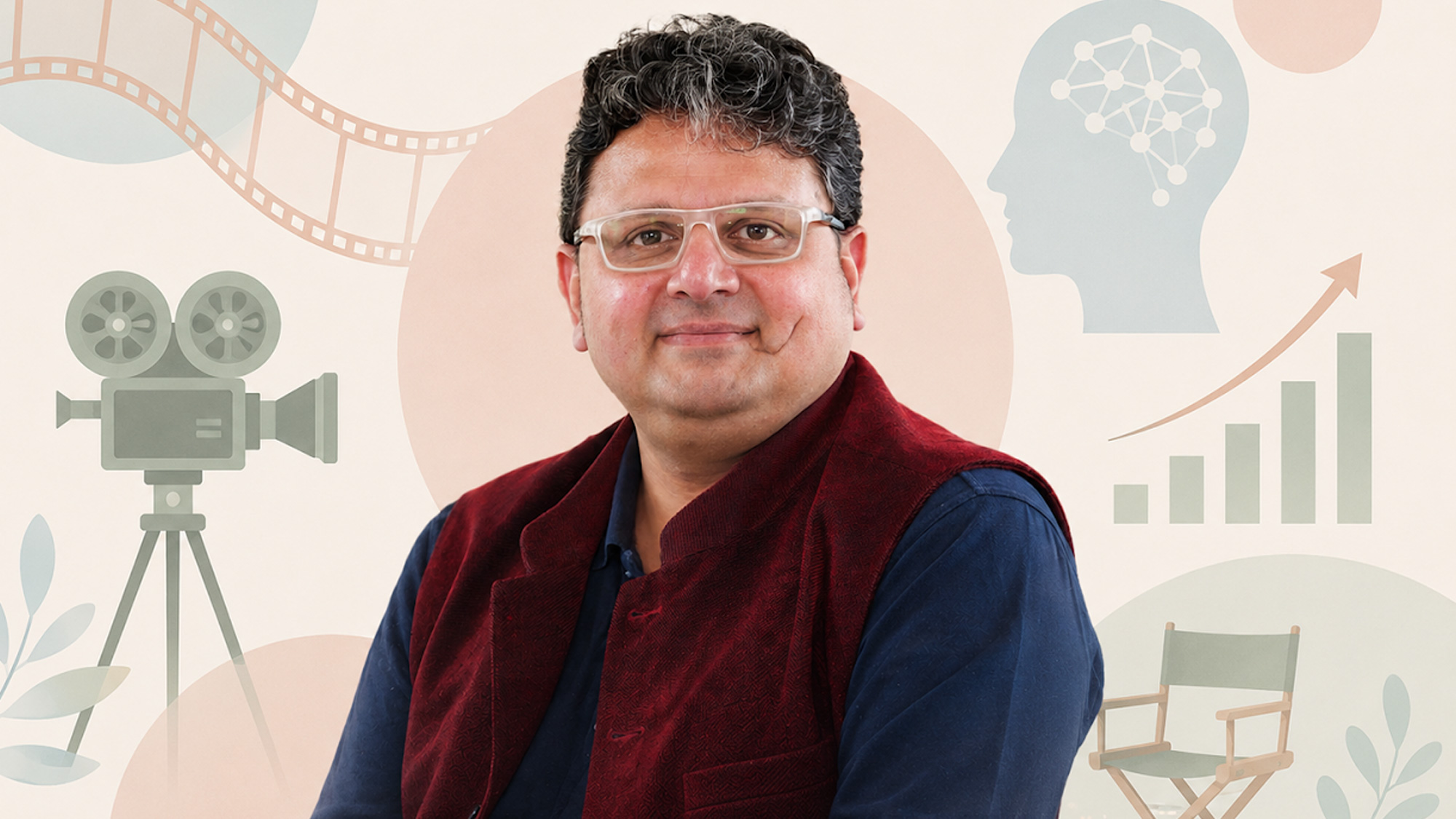
MUMBAI: If you are waiting for the age of the “AI film” to arrive and transform cinema as we know it, Chaitanya Chinchlikar has a gentle but firm piece of advice for you: stop waiting, because it is already here, and it looks a great deal less dramatic than you might expect.
Chinchlikar, the vice president and chief technology officer at Whistling Woods International, one of India’s most prestigious film and media schools, and a member of the Oscars jury, is not the sort of person who gets swept up in hype. A recipient of the Pioneer of the Visual Effects Industry award, he has spent decades watching new technologies arrive with much fanfare, only to quietly settle into the everyday rhythm of filmmaking. He is quite confident that AI will do precisely the same.
“You don’t set out to make a VFX film,” he said, in his characteristically plain-spoken manner. “You set out to make a film. In some films, you need a lot of VFX, some films you don’t need too much VFX. In some films, you need a lot of AI, some films you don’t need too much AI.”
“What you should actually look at as filmmakers is not how can I do things quicker, faster, cheaper with AI, but what can I imagine with AI that I could not imagine before?” –Chaitanya Chinchlikar
It is a refreshingly grounded take from a man who has seen every wave of technological disruption in India’s media and entertainment industry. And yet, beneath the measured tone lies a genuine excitement about what this particular wave makes possible.
That excitement, it turns out, has very little to do with efficiency. Chinchlikar is impatient with the idea that AI is chiefly a cost-cutting or time-saving device. The real promise, he argues, lies somewhere far more interesting.
“Today, if I want a car to jump off earth, land on Venus and then land on Jupiter, I can do it,” he said, with barely concealed relish. “There has to be an imaginative reason why the car is doing it. So I have to have that spectrum of imagination to expand in order for that car to do that.”
That is the crux of his argument. AI does not free filmmakers from the burden of thinking. If anything, it raises the bar. When execution is no longer the constraint, imagination becomes the only currency that matters. “That is really how you should approach AI,” he says, “as an imagination-expanding tool.”
Which brings him, almost inevitably, to the films that have been loudly marketing themselves as the world’s “first AI film” or some variation of the same boast. Chinchlikar is not particularly impressed, though he is not uncharitable about it either.
“It’s a marketing hook,” he said, with a slight shrug in his voice. “There are lots of people who use lots of marketing hooks to sell their films. The current marketing hook is AI. Don’t deny them their marketing hook. They want to sell it in the name of AI film. Let them sell it. What’s the big deal?”
His reasoning is simple, and rather difficult to argue with: audiences do not go to see technology, they go to see good films. “People are going to see it if it’s a good film, people are not going to see it if it’s a bad film,” he said. “If the first ten people who see the film say it’s rubbish, nobody is going to see it. If the first ten people go and see it and it’s a very good film, the whole world will go to see it.”
He also points out, with some historical perspective, that AI is not nearly as new to filmmaking as the current conversation would suggest. “There are elements of AI which have been part of the filmmaking world for 30 years now,” he noted. “If you are doing virtual production, it’s still AI. If you are doing green screen replacement, it’s still visual AI. If you are doing mo-cap, there is AI in it.”
Generative AI, he concedes, is a newer phenomenon. But even that, he suspects, will lose its novelty billing soon enough. “After some time, nobody will care whether a film was made assisted by AI, fully AI, half AI, quarter AI.”
For film students, though, that future indifference is precisely the point. Chinchlikar is enthusiastic about them learning AI, but with a pointed caveat. His advice is unambiguous: be very bullish on it, treat it as an excellent tool in your arsenal, but do not, under any circumstances, use it as a substitute for learning the craft itself.
“Learn how to do a storyboard on your own so you know whether AI is doing a good storyboard or not,” he urged. “Learn how to do some of the workflows that AI executes right now. Learn how to do them on your own so you know whether AI has done a good job or not.”
“AI is a servant. Keep it like a servant and get it to work. The moment you start relying on AI to do the work for you, now you are serving AI. Now it has become the master.” – Chaitanya Chinchlikar
It is a master-and-servant relationship, and Chinchlikar is very clear about who should be holding the reins. “If you are telling AI to do this and that, then you are stuck with whatever AI gives you, if you don’t know how to do it yourself or if you don’t know whether this is good or not.”
The ultimate skill, he argues, is that irreducible filmmaker instinct: the ability to look at an image, a cut, a frame, and know whether it is right. Without that, even the most sophisticated AI tools become a very expensive crutch.
“Audio-visual narrative storytelling, that is your work,” he says, slipping momentarily into Hindi before returning to English. “Your work is not to use AI. AI is a tool. It’s a very good tool. Use it as a very good tool.”
And then he says something that stops you in your tracks, something that cuts against a great deal of received wisdom in the industry. AI, he says flatly, is not a time-saving technology.
“AI is not a time-saving thing,” he stated. “Anybody who thinks AI is a time-saving thing is wrong. Often times it takes longer to achieve the same quality and same level of output.”
He does not mince words. Models are expensive. Training data is expensive. And the creative iteration that goes into producing AI-generated content of genuine quality can take two or three times longer than simply shooting it conventionally. “In many cases it doesn’t even get done,” he said. “People just abandon AI and say, no, let’s shoot again.”
“It’s a fallacy that everything in AI is quicker. That everything in AI is faster and better. It may be cheaper. Depends on what output you want. Depends on what the shot is. It’s very subjective. There is no generic one-size-fits-all scene.”
Yet for all his scepticism about hype, Chinchlikar is quietly optimistic about the broader social impact of AI on filmmaking, particularly in India. He sees it playing out much as digital filmmaking and mobile filmmaking did before it: making the craft more accessible, and in doing so, making it more competitive.
“Just like digital filmmaking made filmmaking more democratic, mobile filmmaking made filmmaking more democratic, similarly, AI will make filmmaking more democratic and create more competition,” he said. “You can have more competition only if it’s more democratic.”
His one current frustration is linguistic. Right now, most AI tools default to English, forcing Indian-language filmmakers to translate their prompts and work in a second language. But he does not expect that barrier to last long. “Within 12 months, 18 months, all these tools will come in with Indian languages, because India is too big a market for them to ignore a Tamil or a Telugu or a Marathi or any of these.”
The picture he paints, ultimately, is one of cautious but genuine optimism. Not a revolution, but a very significant and useful evolution. AI will not replace the filmmaker. It will not render the craft redundant. It will, if handled with wisdom and a solid grounding in the fundamentals, give filmmakers the ability to imagine things they never could before.
Which, when you think about it, is about as good as any tool gets.






