GECs
Bigg Boss creators unpack how the 800-day juggernaut rules screens nationwide

MUMBAI: If reality TV had a heartbeat, Bigg Boss would be the one thundering at 800 beats a year. And yes, you read that right 800 days of Bigg Boss in a 365-day calendar. Even its own creators admit they have to repeat that number because investors assume they misheard. But as Deepak Dhar, founder and group CEO of Banijay Asia & EndemolShine India, told a packed room at the Vidnet Summit 2025, the goal now is even more outrageous: “We want to hit 1,000 days, we’re not stopping.”
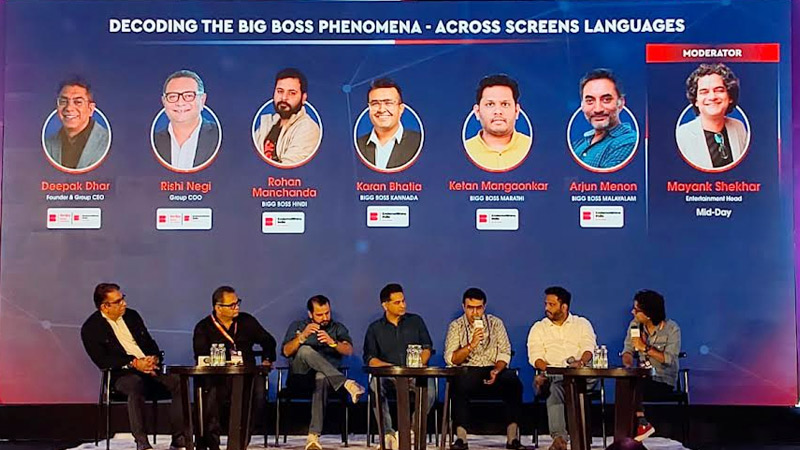
At the Masterclass titled Decoding the Bigg Boss Phenomena – Across Screens & Languages, Dhar traced a journey that began in 2005 with raised eyebrows and raised temperatures. “People thought I was mad,” he laughed, remembering being told Bigg Boss was “sleaze” and “semi-porn” when he flew to Amsterdam to buy the format. The original versions from the UK, US and Australia were “really out there,” so his mission was clear: Indianise it before India rejected it.
The first battle was the name. “I told them I’m not calling it Big Brother, I’m calling it Bigg Boss,” Dhar said. The Amsterdam executives, baffled at losing their precious title fee, gave in. Months later he called again: “My Bigg has a double G.” A bigger shock, an extra G and the birth of a phenomenon that would redefine Indian reality TV.
From there, localisation became the backbone. Sets, hosts, housemates, tasks everything looked Indian, felt Indian and sounded like someone’s mother, chachi or maasi would happily watch it at 9 pm. Dhar calls this approach “making the global format walk in local shoes”.
Moderator Mayank Shekhar, who once spent 24 hours inside the Bigg Boss house with 39 journalists, declared the show a “huge, huge social experiment”. “By the end of the day, we were all fighting,” he said. “There’s something in the goddamn format. You can’t script that.”
Rishi Negi, Group COO, explained the philosophy that has kept the format fresh across two decades and six major languages: evolve endlessly, but never touch the core.
Isolation stays isolation. No interference stays no interference. Whether it’s Hindi or Malayalam, Bigg Boss follows its commandments “to the T”.
Negi revealed that 24×7 live streams, once an experiment at midnight in 2008 are now a fandom ritual. “You’ll be surprised how many people watch it. Viewership even peaks at 12 or 1 am when people return from parties and start discussing Bigg Boss.” A 20-minute delay keeps out the language that shouldn’t escape to air.
Today the format reaches a staggering 500 million viewers annually, nearly half of India’s TV universe. And the multilingual versions are no less dramatic.
Mudit Vinayak (Bigg Boss Telugu) broke it down: the real magic is the casting. “Get your casting right and you’ve got a hit show.” Telugu audiences, he said, want balance emotion, comedy, drama and action, “not too much fighting”.
Karan Bhatia (Bigg Boss Kannada) said Karnataka treats the show like a state festival. “Even the DCM tweets about it,” he said, adding the audience loves rooted heartland characters who evolve over the season.
Ketan Mangaonkar (Bigg Boss Marathi) called Maharashtra “a difficult market” because viewers also watch the Hindi version and expect Marathi shows to match its glamour but with local soul. Casting becomes a cultural chessboard, juggling Mumbai, Pune, Vidarbha, Khandesh and Western Maharashtra, each with its own dialect and attitude. “People want national Marathi celebrities with regional flavour,” he said.
Across the table, Arjun Menon (Bigg Boss Malayalam) nodded each region has its own appetite. In Malayalam, it’s debates. Lots of them. That becomes part of the show’s signature.
Meanwhile, in Hindi, Rohan Manchanda said what matters most is the arc. “It’s the journey and the story inside the house. Some contestants just resonate more.”
Salman Khan in Hindi. Mohanlal in Malayalam. Kichcha Sudeep in Kannada. Nagarjuna in Telugu. Ritesh Deshmukh in Marathi.
Each brings a regional swagger, not just celebrity wattage.
Kichcha watches every second of the live feed, said Bhatia. Nagarjuna is the “pole star” in Telugu, guiding housemates through their weekly moral compass. Ritesh, Mangaonkar said, is “Bhau”, soft-spoken but firm, a total contrast to Mahesh Manjrekar’s “Dada” energy from earlier seasons.
When asked about favourite contestants, Dhar didn’t name winners. He named stories. Imam Siddiqui, “the terror of the house”; Sunny Leone, whose stint launched a Bollywood career. Negi cited Rakhi Sawant and Shehnaaz Gill icons born inside those walls. Mudit and Rohan added Gautam Gulati, Siddharth Shukla, MC Stan, Elvish stories that “bare it all”.
Because in the end, Bigg Boss isn’t only a show. It’s India’s loudest mirror.
Across languages, across screens, across sensibilities, the show has transformed into a 1,000-day ambition, a cultural beast that feeds on region, character, audience and chaos.
Or as the panel joked, “Half the country says they don’t watch Bigg Boss which is exactly how you know they absolutely do.”