News Broadcasting
Bertelsmann’s Thielen keen on India TV prodn, publishing

NEW DELHI: India seems to be shining. Or at least its media and entertainment industry is.
The $20 billion Bertelsmann AG, Europe’s largest media conglomerate, is so bullish on this sector that it is looking at setting up an Indian subsidiary and also pick up equity stakes in Indian media companies, especially TV software production houses, apart from targeting the publishing sector more aggressively.
The Gütersloh (Germany)-headquartered company is also keen to expand a business process outsourcing (BPO) unit here for the organisation’s internal needs and is also taking a stab at “bunching other European companies” to invest in the BPO sector in India. About nine months back Bertelsmann tied up with the Bhatia family-controlled Bird Group to set up a BPO unit here.
Pointing out that Bertelsmann has identified book publishing, entertainment and BPO sectors as areas for investment, Bertelsmann AG’s chairman and chief executive Gunter Thielen told select journalists here today, “We are looking at business opportunities in all these areas as the environment for investment is very positive.”
India’s entertainment industry, including radio, television and films, according to a study undertaken by the Federation of Indian Chambers of Commerce and Industry (Ficci), is projected to grow to a whopping Rs 285 billion by 2005.
According to him, seeing the conducive atmosphere for investments in India, the parent company is contemplating setting up an Indian subsidiary, which can be in association with an Indian partner too. “We plan to have one entity, wholly owned or otherwise, in India that would look after all our business interests,” Thielen explained, adding that a tentative name for the local arm is Bertelsmann India.
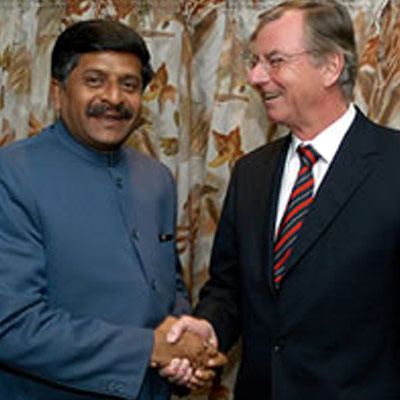
I&B minister RS Prasad with Gunter Thielen
Thielen is leading a strong delegation of German business houses, including media companies like BMG, in India which are here to explore business opportunities. Apart from interacting with Ficci’s entertainment committee, the delegation discussed various issues with India’s I&B minister Ravi Shankar Prasad today and is slated to hold “exploratory talks” with the country’s entertainment industry in Mumbai tomorrow.
The German delegation’s visit to India comes close on the heels of Vivendi chief, J Fourto and Time Warner chairman, Richard D Parsons, flying visits to India in recent times.
Though Thielen said that his company would like to kick start business ventures by focusing on the publishing business — group company Random House is already looking at enhancing its presence in India through partnerships — television is another area that would be given importance.
According to Thielen, Bertelsmann mainly dabbles in TV
content, despite running the “biggest TV network in Europe,” and would like to strike up partnerships with Indian companies in this field for buying and selling of TV software.
Asked by indiantelvision.com whether Bertelsmann would
pick up equity stakes in India media companies, especially TV software production houses, Thielen said, “We are open to that too.” However, he pointed out that no particular Indian partner(s) has(ve) yet been identified.
The Bertelsmann chairman is optimistic that there would be buyers for the content that is generated by the European company in India.
The European media house, which is slated to declare its financial results for the year 2003 next month, has said that it went against the market trend in 2002, improving its results in a challenging economic environment. Operating EBITA rose to $936 million from $573 million the previous year.
The operating return on sales climbed to 5.1 per cent, against three percent the previous year. Net income before minority interests amounted to $968 million. Despite high investments, net financial debt was below $3 billion. Cash flow increased from $294m to $1.1 billion. The number of employees was 80,632 as of 31 December 2002.
Bertelsmann, which till few years back had a joint venture for record labels in India, called BMG Crescendo before it was wound up, thinks that unless steps are taken by the Indian government to arrest rampant piracy in the music sector, it would not make business sense to enter the music business, though it’s a big market.
“Music is core to our business (but) because there’s lot of piracy happening here, it’s hard (to survive financially).”
Bertelsmann Music Group (BMG) with its roughly 200 labels (RCA, Arista, Jive, J Records) and artists such as Alicia Keys, Dido and Pink, as well as the special-information publisher BertelsmannSpringer, also stand for creativity and powerful brands.
RS Prasad with the German business delegation representatives
Asked by indiantelevision.com whether he would reconsider BMG’s operations here in India, Thielen, while exhorting Prasad to look into the issue, said, “If piracy problem is curbed we can look at reviving BMG (in India).”
Dr Gunter Thielen, a 24-year Bertelsmann veteran, has been chairman and CEO since 5 August, 2002. In January 2004, the Bertelsmann AG supervisory board unanimously decided to extend Thielen’s contract through 31 August, 2007.
On the publishing side, an enthused Thielen felt that there is a growing interest about Indian authors and books.
“We have a fairly good business here and are looking how it can be expanded and strengthened through partnerships,” he said. “In few years from now we must look at developing Indian authors (writing in English) and also other Indian languages. May be we can start off with Hindi,” he added.
Asked about comparative business environment in India and China — Bertelsmann is reported to have invested several billions of Euros in China over the last few years — Thielen admitted that China has a slight edge over India.
“China may be a little ahead (of India) at the moment in development, but India is one of the most interesting markets in the world. Since we work on a long term basis, with the GDP rising and an all round growth here, we are keen to look at local partners.”
Bertelsmann, a media and entertainment company, commands globally leading positions in the major markets. Its core business is the creation of media content.
Bertelsmann includes RTL Group, Europe’s biggest television and radio networks, as well as the world’s biggest book-publishing group, Random House, with some 250 publishing imprints (Alfred A. Knopf, Bantam, Siedler Verlag, Goldmann). Bertelsmann’s direct-to-customer businesses are bundled in DirectGroup: book and music clubs with more than 40 million members all over the world.
The arvato corporate division bundles the group’s media services, which include the expanding units arvato logistics services and arvato direct services (service centers, distribution, customer relationship management), along with state-of-the-art printers, storage media production and comprehensive IT-services.