Connect with us

Hardware

Are Android STBs a step too far for India?

Published

on

MUMBAI: Even as the cable and television industry prepares to take on digitisation, there’s another advanced technology which has arrived rather quietly on Indian shores.


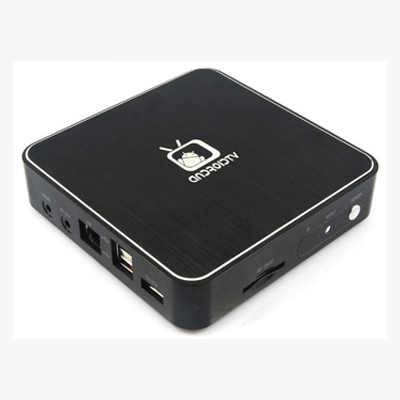
We’re talking Android set top boxes (STBs) from Willett STB Technologies which are in the market since sometime last month. These hybrid STBs carry all the applications available on the Android Play Store and allow customers to switch seamlessly between television and the internet. Given the recent buzz about Google bringing YouTube on TV, such a technology may just be what the doctor ordered. However, for a variety of reasons, the Android STBs don’t seem to be finding enough traction in the industry.

Advertisement


Speaking to indiantelevision.com, Willett STB Technologies director Deepak Wadhwa refuted the MSOs’ claim that STBs are not upgraded to carry YouTube as a Video-on-demand (VoD) service on television. “The STBs come in different models and frankly, we are ready with the technology. The Android box is the answer to this new development.”


Advertisement

However, Wadhwa was quick to point out that the problem lies in MSOs’ unwillingness to accept the technology. “The MSOs are not ready to promote the boxes. Even though we are ready with the upgraded technology, there are deployment issues,” he said.


So what was keeping MSOs from adopting the new technology? A major reason, according to Wadhwa, was the cost, where each Android STB carried a price tag of Rs 4,000. Additionally, customers would have to pay for video services.

Advertisement


The Willett Android 4.2 STB is a hybrid box, with both Android and DVBC features. “The box allows customers to switch between Android play store and TV channels. It also converts a normal TV to a smart TV,” informed Wadhwa.


Advertisement

Elaborating on the cost factor, he said: “The MSOs are already tied up with MPEG2 boxes. Also in smaller cities, where people are used to viewing TV at Rs 75 to Rs 100, they are opposing STBs which cost Rs 1000, so accepting the Android boxes seems a far thing to imagine.”


Meanwhile, an MSO defended cable operators’ stance saying: “These OTT boxes don’t give us revenue which goes to the service provider instead. So why should we use them?”

Advertisement


Media consultant Sanjeev Hiremath opined: “As far as the cable industry is concerned, technology gets adapted step-by-step. No one is ready to take two steps at a time. Obviously, the advantage of the Android box is that you can incorporate the experience of OTT service also in that. So then you can avoid cable and can directly take a broadband connection and experience both TV and the world of internet. If customers are not ready to pay Rs 1000-2000 for normal STBs, of course they will not buy these at double the rate.”
Maybe, India needs to work towards faster adoption of new technologies just as it has in developing them…


 

Advertisement
Click to comment

Leave a Reply

Your email address will not be published. Required fields are marked *

Hardware

Specs Inc. partners with Qualcomm for next-generation smart glasses

Snap subsidiary to power future Specs with Snapdragon XR platforms.

Published

on

MUMBAI: Snap’s Specs are about to get a serious upgrade and this time, they’re teaming up with Qualcomm to make sure the future looks crystal clear. Specs Inc., a Snap subsidiary, has announced a multi-year strategic agreement with Qualcomm Technologies to power future generations of its advanced smart eyewear with Snapdragon system-on-a-chip (SoC) technology.

This marks the first flagship engagement for Specs Inc., which is preparing to launch its standalone, see-through smart glasses for consumers later this year. The Specs are designed to seamlessly blend digital experiences into the physical world, allowing users to see, hear, and interact with digital content as if it were part of their real surroundings.

By integrating Snapdragon XR platforms, the glasses will benefit from edge AI and high-performance, low-power computing. This combination enables intelligent, context-aware experiences to run directly on the device, delivering faster and more private interactions.

Advertisement

The partnership builds on more than five years of collaboration between Snap and Qualcomm, during which Snapdragon platforms have powered multiple generations of Snap’s Spectacles.

Snap Inc., co-founder and CEO Evan Spiegel said, “We believe the future of computing will be more human and grounded in the real world. Our work with Qualcomm provides a strong foundation for the future of Specs, bringing advanced technology and performance that pushes the boundaries of what’s possible.”

Qualcomm Incorporated president and CEO Cristiano Amon added, “The next era of computing will be defined by devices that understand what you see, hear and say, and respond instantly to the world around you. Our collaboration on Specs will enable power-efficient interactive AR devices that feel natural and intuitive.”

Advertisement

The agreement establishes a scalable foundation for developers and partners building experiences for Specs, supporting a predictable product roadmap and increasingly sophisticated digital interactions over time.

In a world racing toward augmented reality, Specs Inc. and Qualcomm are ensuring that the next pair of smart glasses doesn’t just look good on paper, they perform brilliantly in real life. The future of wearable computing just got a powerful new lens.

Advertisement
Continue Reading

Advertisement News18
Advertisement
Advertisement
Advertisement
Advertisement Whtasapp
Advertisement Year Enders

Indian Television Dot Com Pvt Ltd

Signup for news and special offers!

Copyright © 2026 Indian Television Dot Com PVT LTD

This will close in 10 seconds