iWorld
APOS 2025: Amazon demystifies dual platform strategy and amazing road map ahead

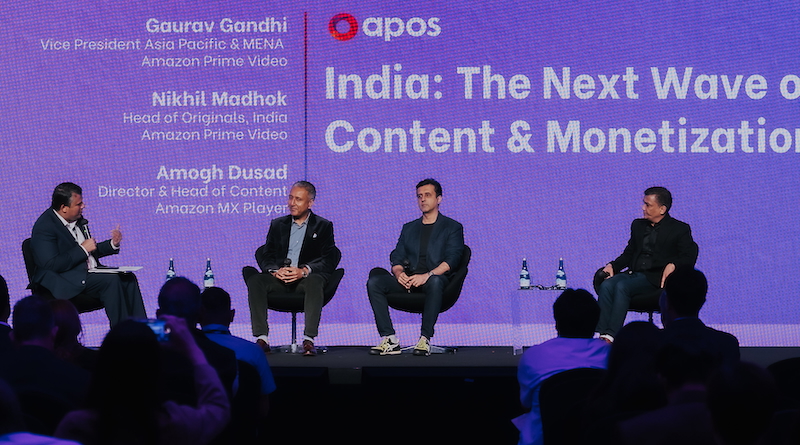
BALI: At the APOS 2025 summit in Bali, hosted by Media Partners Asia (MPA), Amazon’s content leadership delivered a deep dive into why India remains one of the most strategically complex yet promising media markets. Taking the stage were Prime Video vice president, Asia Pacific & MENA Gaurav Gandhi, Prime Video India director & head of originals Nikhil Madhok and Amazon MX Player director & head of content Amogh Dusad. The session was moderated by MPA’s executive director and founder Vivek Couto.
The big reveal? Amazon isn’t choosing between SVOD and AVOD in India—it’s going full throttle on both.
“India isn’t a monolith. It’s an ultra-fragmented market with vastly different consumption behaviours,” said Gandhi. “Prime Video is built for those who are already deep into the streaming habit and are willing to pay for high-quality entertainment. Amazon MX Player, now part of the Amazon fold, is designed for the mobile-first, ad-supported audience that’s still transitioning from television.”
Prime Video, Gandhi said, is thriving on living room devices, with a premium audience consuming high-end series, global content, and a wide bouquet of offerings including TVOD (movie rentals) and add-on subscriptions like Apple TV. Meanwhile, Amazon MX Player reaches over 250 million users, largely through smartphones. Its mission: democratise premium entertainment through AVOD—without a paywall.
Nikhil Madhok outlined how Prime Video Originals are laser-focused on delivering cinematic storytelling—visually rich, thematically deep, and produced at a scale far beyond traditional television. “From The Family Man to Made in Heaven and Call Me Bae, we aren’t just creating content—we’re building cultural brands. Every story must hold its ground next to top global content.”
He also teased the evolution of Prime Video’s movie play. Beyond licensing and direct-to-service releases, Amazon has entered the theatrical game via Amazon MGM Studios. The first release under this banner, Nishaanchi, directed by Anurag Kashyap, hits theatres this September. “Starting 2026, expect four to six Amazon-produced theatrical releases each year,” said Madhok.
Themes are front and centre in content strategy. “Genres are surface. We’re diving deeper—into identity, trauma, aspiration, connection with roots,” Madhok said. Case in point: Khauf, a horror series that’s actually about urban isolation and female trauma, or Dupahiya and Panchayat, which reconnect urban audiences with rural simplicity.
Amogh Dusad’s vision for Amazon MX Player is sharply focused on volume, relevance, and relatability. “Our audience wants content that mirrors their aspirations—rising up the socio-economic ladder, escaping the mundane, hustling for a better life,” he said. “Franchises like Hustler, which spotlight startup dreams, resonate deeply. So do titles like Aashram, which has pulled in over 200 million streamers.”
Dusad also unveiled MX Fatafat—a bold new format tailored for India’s mobile-first generation. These are micro-dramas told in one to two minute episodes, shot in vertical format, and designed for snack-sized bingeing on the go. Each series will feature 80 to 100 episodes, delivering quick-hit entertainment during commutes, lunch breaks, and late-night scrolls. “This is format innovation meeting behavioural insight,” he said.
A key theme across the panel was Amazon’s focus on building the next generation of Indian creators—across both platforms. Gandhi highlighted how over 50 per cent of Prime Video’s upcoming Originals feature first-time talent, either in front of or behind the camera. “That intentionality is what brought stories like Dupahiya to life,” he noted. “We’ve built structures to mentor and empower creators from scratch.”
MX Fatafat, meanwhile, is expected to become a sandbox for emerging digital storytellers. “We’re not just licensing stories—we’re co-creating them with creators who’ve never had this kind of platform before,” Gandhi added.
While competition intensifies in India’s digital entertainment landscape, Gandhi remained bullish. “We’re investing aggressively across Prime Video and MX Player. The Indian streaming story is far from mature—it’s just entering its next big phase,” he said. Amazon’s twin-engine strategy is clear: drive premium with Prime, drive reach with MX, and fuel both with bold bets on formats, themes, and fresh creative voices.
From high-gloss dramas to vertical micro-series, Amazon is placing its chips across the board—because in India’s streaming game, one size definitely doesn’t fit all.