Hindi
Main Waapas Aaunga shows how word of mouth can outlast a weak opening weekend
CII Big Picture Summit panel explores storytelling, audience discovery and marketing


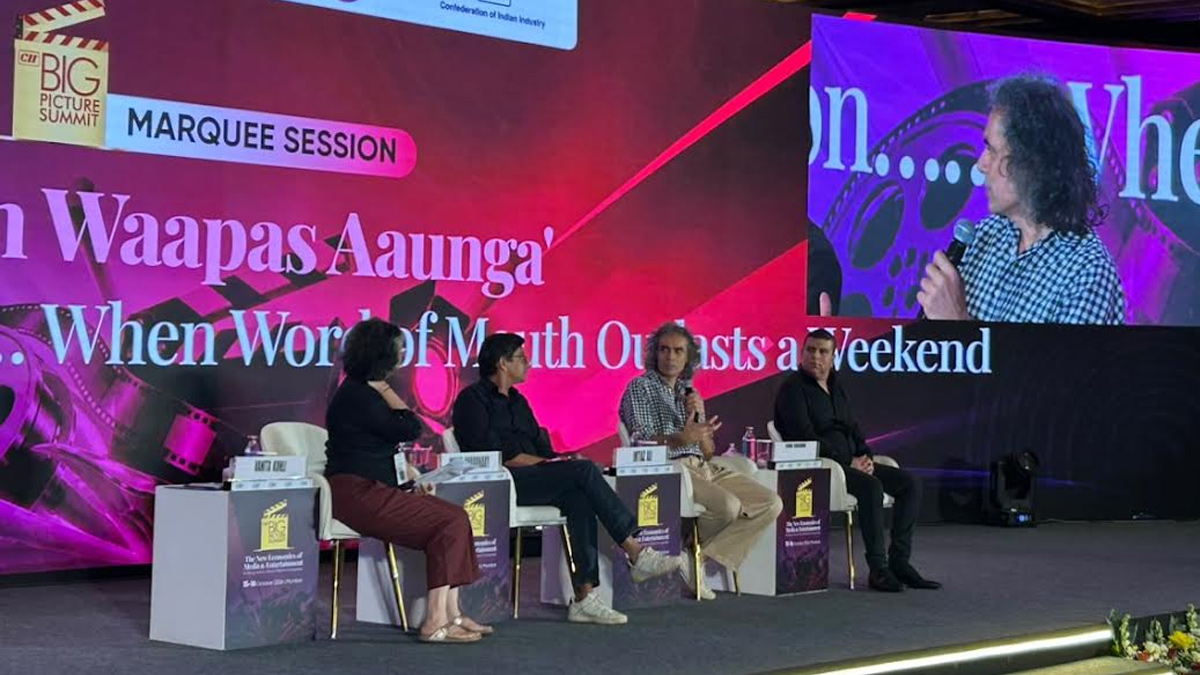
MUMBAI: When the opening numbers failed to tell the full story, word of mouth stepped in to rewrite the ending. The theatrical journey of Main Waapas Aaunga offered a compelling lesson in how audience recommendations can revive a film, challenge conventional box-office predictions and demonstrate the enduring power of emotional storytelling.
The film’s journey and the lessons it offers the wider entertainment industry were discussed at the session, Main Waapas Aaunga: How Word of Mouth Won, When Word of Mouth Outlasts a Weekend, at the CII Big Picture Summit 2026 in Mumbai. Held under the theme The New Economics of Media & Entertainment: Building India’s Future Global Media Companies, the conversation featured filmmaker and producer Imtiaz Ali, Main Waapas Aaunga producer Mohit Chaudhary, Birla Studios CEO Priti Shahani and co-producer Shibasish Sarkar.
At the heart of the discussion was a question confronting filmmakers and studios in an increasingly crowded entertainment market: can a film find its audience beyond the opening weekend, particularly when its appeal lies in emotion, atmosphere and the gradual unfolding of its story rather than an immediate spectacle?
The film’s experience suggested that it can, provided the industry is willing to give audiences the opportunity to discover it.
The conversation began with the creative foundations of Main Waapas Aaunga and the challenge of translating an intimate, deeply personal idea into a story that could resonate with a broad audience.
The film draws on themes of home, identity, memory and belonging, with the Partition providing an important historical and emotional backdrop. Home emerged not merely as a geographical location, but as an idea shaped by people, relationships, experiences and memories. Such themes can be intensely personal, yet they also offer a common emotional language through which audiences from different backgrounds can connect.
The development of the story was linked to the experiences and conversations surrounding the making of Amar Singh Chamkila. Work in Punjab brought exposure to personal accounts of Partition and its lasting impact on families and communities. These encounters helped deepen the creative exploration of displacement, identity and the meaning of home.
The process also highlighted how filmmaking ideas often take shape organically. Rather than following a rigid development formula, a story can grow through conversations, the exchange of ideas and the enthusiasm of people who recognise its potential. An initial concept gradually gains substance as creative collaborators begin to understand the vision and find common ground in its emotional core.
This early alignment between the creative and production sides can be especially important for films built around nuanced storytelling. A producer’s role extends beyond financing and logistical execution to supporting the director’s broader vision, understanding its requirements and helping translate it into a film without losing sight of practical considerations.
The commercial journey of Main Waapas Aaunga became the central case study of the session. Despite the work invested in the film and its promotion, the theatrical opening was significantly weaker than expected. By conventional trade calculations, the initial performance pointed towards a disappointing lifetime box-office outcome.
The experience exposed the limitations of treating first-day collections as a reliable predictor of a film’s eventual performance. Opening figures are important, particularly for expensive productions and films led by established stars, but they do not always capture the time audiences need to discover a story or respond to its emotional appeal.
In this case, audience reactions began to tell a different story from the opening-day numbers. Viewers who watched the film responded strongly to it, with recommendations and personal conversations helping generate interest beyond the initial audience.
The momentum gathered over successive days, with the film recording growth rather than following the steep decline often associated with a weak opening. Its second weekend eventually surpassed the entire first week, providing exhibitors and programmers with a reason to continue backing its theatrical run. The film went on to establish a profitable box-office performance.
The turnaround illustrated the difference between immediate visibility and sustained audience engagement. A film may not attract a large crowd at the outset, yet its ability to move those who watch it can create a chain reaction that brings additional viewers into theatres.
The discussion also highlighted the competitive conditions surrounding the release. A crowded theatrical calendar, with major films arriving in quick succession, left less room for a slow-building title to establish itself. Under such circumstances, an underwhelming opening can quickly become a commercial verdict, even when the response among those who have watched the film suggests that it has more room to grow.
One of the key lessons concerned the limits of digital marketing and the danger of mistaking activity on screens for genuine awareness among audiences.
Digital campaigns can create a reassuring picture of reach through impressions, engagement and other performance indicators. However, algorithms often direct content towards people whose interests and behaviour suggest they are already likely to respond. This can create a feedback loop in which a campaign appears to be performing well within a familiar audience while failing to reach potential viewers beyond it.
The film’s promotional experience raised questions about this gap between digital visibility and broader public awareness. Even in cities with strong media exposure, sections of the potential audience had limited awareness of the film, despite the activity taking place online.
The response was to take the film directly to viewers. Screenings and audience interactions became an important part of the campaign, continuing through the theatrical run until the film’s arrival on Netflix around two months after its release.
The outreach covered more than 100 screenings across 12 cities and reached approximately 15,000 people in theatres. More than 70 per cent of the audience encountered through these efforts was young, challenging the assumption that the film’s subject matter or measured pace would necessarily make it less appealing to younger viewers.
These interactions offered more than an opportunity to promote the film. They provided direct exposure to audience reactions, conversations and interpretations that are difficult to capture through digital engagement metrics alone.
The approach also encouraged a reassessment of conventional promotional tools, including city tours, outdoor advertising and in-person screenings. Rather than treating these methods as outdated, the discussion pointed to the need to reconsider how and when they can be used alongside digital campaigns.
The audience outreach also revealed the importance of the theatrical experience itself. Viewers frequently remained in theatre foyers and corridors after screenings, discussing the film and sharing personal memories and experiences.
These conversations extended the film beyond its narrative, allowing people to connect through their responses to what they had watched. Emotional reactions became a form of social engagement, with viewers carrying the experience into their own networks and encouraging others to see the film.
In this context, word of mouth was more than a marketing outcome. It became a process through which audiences helped communicate the film’s appeal to people who might otherwise have overlooked it.
The experience also underlined the value of direct interaction between filmmakers and audiences. Attending screenings offered an opportunity to understand who was watching, what resonated with them and how different groups interpreted the story. Such first-hand observations can provide a richer understanding of audience behaviour than relying exclusively on campaign reports or assumptions about target demographics.
The challenge for the industry is to recognise that audience discovery does not always follow a predictable timetable. Some films find their following immediately, while others need several days or weeks to generate interest. Exhibitors and programmers therefore play an important role in allowing a film’s trajectory to develop, particularly when audience response and collections begin to strengthen after the opening weekend.
The panel also explored how promotional material can shape expectations before audiences enter a theatre. Posters, trailers and campaign imagery serve as an initial introduction to a film, but they can sometimes emphasise familiar star power at the expense of the story’s emotional character.
Marketing decisions are frequently influenced by perceptions of which actor has the greatest commercial appeal and should receive the most prominent visual treatment. While star recognition can attract attention, it can also create an incomplete impression of a film, particularly when the real appeal lies in relationships, atmosphere or a less conventional narrative.
The broader lesson was the need for closer alignment between a film’s promotional identity and the experience it delivers on screen. The creative appeal that makes a film distinctive should not be lost in the effort to make its marketing immediately recognisable.
This requires a willingness to challenge established promotional templates, learn from audience responses and approach each film according to its own character rather than relying on a standard formula.
Market research remains useful in understanding audience preferences, identifying potential viewers and shaping communication strategies. However, research and performance metrics cannot replace the creative vision at the centre of a film. The task is to use audience insights to communicate that vision more effectively, not to allow data alone to dictate the creative choices.
The discussion also addressed the place of slower-paced films in an entertainment environment dominated by a constant stream of digital content. Audiences now move between short-form videos, films and long-running series, creating pressure on filmmakers to deliver immediate engagement and maintain attention throughout.
Yet a measured pace does not automatically make a film boring, just as relentless activity does not necessarily make it engaging. The challenge is to create an absorbing experience that allows viewers to settle into the world of the story while keeping them emotionally invested.
For a film centred on memory, displacement and belonging, stillness can be an essential storytelling choice. Such stories may need room for moments, relationships and emotions to unfold rather than being driven entirely by plot developments or rapid changes in pace.
The commercial responsibility of filmmaking, however, remains important. Audiences pay to watch a film, and the promise of artistic value cannot substitute for an engaging experience. The creative challenge is to make a film that respects the audience’s time while remaining faithful to its narrative and emotional intent.
Ultimately, Main Waapas Aaunga offered a reminder that a film’s fortunes are not always settled by its first weekend or the performance of its digital campaign. In a market crowded with content and increasingly guided by algorithms, the combination of a resonant story, direct audience engagement and the freedom to build momentum can still make a difference.
The industry’s task is not to abandon opening-weekend numbers or digital marketing, but to recognise their limits. Sometimes, the most effective campaign begins when viewers leave the theatre, carry the story into their own lives and persuade someone else to experience it for themselves.