
Movies
Four Indian filmmakers explore new creative frontiers with AI
Four studios blend AI with traditional filmmaking across mythology, space and history


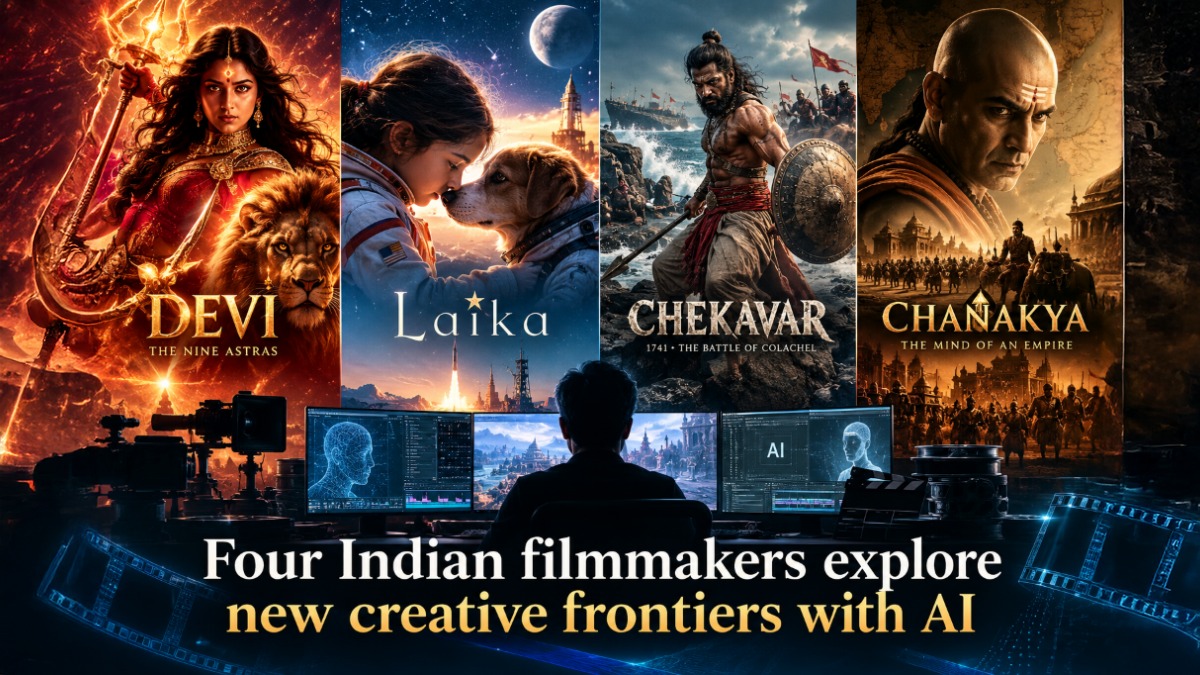
MUMBAI: In the new-age film set, the script may still be human, but the toolbox is getting decidedly more futuristic. The Indian Institute of Creative Technologies (IICT) and YouTube have premiered four AI-enabled short films created under the IICT–YouTube Create with AI programme, bringing together mythology, space, history and ancient India at IICT in Mumbai.
The four films were screened in the order DEVI: The Nine Astras by Kalpanik Films LLP, Laika by Karthik Kult Kreations, Chekavar by Avium Studios in collaboration with Garuda X Media, and CHANAKYA – The Mind of an Empire by Eleventh Door Studio. The showcase brought together filmmakers experimenting with AI while retaining elements of conventional filmmaking, from live performances and cinematography to editing, sound and post-production.
The event was also positioned as a larger attempt to build India’s creative technology ecosystem. Dr Vishwas Deoskar, CEO of IICT, said the institute’s collaboration with YouTube began a year ago and is aimed at helping Indian filmmakers reach audiences at both national and international levels.
“India’s position is such that we have many creators, storytellers, and writers working. There is a lot of talent, but it is not curated,” Deoskar said, pointing to the large number of creators emerging from Tier 2 and Tier 3 cities. He added that the institute’s role was to help turn that raw talent into more polished creative output.
Deoskar summed up the philosophy behind creative education with a line that perhaps fits the AI era particularly well: “In the creative world, it’s not like 1 + 1 = 2; 1 + 1 can also be 11.” For IICT, the combination of imagination, technology, training and infrastructure is intended to make that extra leap possible.
He also outlined IICT’s plans to expand its physical and educational footprint. The Government of Maharashtra has provided 10 acres of land in Film City for a campus, with design and tender processes completed and one State Government approval pending, which Deoskar said was expected in December.
According to Deoskar, IICT is working towards becoming a university and a National Center of Excellence for AVGC-XR and AI. He said the institution aims to provide access to animation, visual effects, video games, comics, extended reality and AI across creative disciplines, backed by the infrastructure required to produce professional-quality work.
The institute’s affordability pitch was another part of the discussion. Deoskar said comparable private animation courses can cost Rs18 lakh or Rs16 lakh, while IICT has developed courses of similar or better quality at Rs3.5 lakh. His argument was that creative technology education needs to be accessible to students from cities such as Bhopal, Udaipur, Yavatmal and Itanagar rather than becoming a privilege limited by course fees.
He added that IICT is already working with 74 companies, including Nvidia, Google, Netflix, Adobe and Microsoft, alongside academic and international collaborations. Eighteen companies are also working with the institute on startup incubation, while discussions with Korean companies are aimed at enabling content production for K-series and other requirements from studios in India.
But it was the four films that put the technology talk to the screen.
Kalpanik Films LLP opened the showcase with DEVI: The Nine Astras, an action-mythology project centred on the divine manifestation of Shakti. Founded and led by Vishal Yoman and Ayushi Anand, the studio used AI to tackle the visual complexity of depicting the nine forms of Goddess Durga.
Yoman said the project grew from a desire to tell stories that had not received enough attention in mainstream filmmaking. “Our country can be called a land of stories, and there are so many stories in our country that are yet to be told,” he said. “Stories flow in the air here.”
For the filmmakers, the challenge was not a shortage of stories but the cost and complexity of bringing some of them to the screen. Anand said filmmakers often spend substantial time and resources on production challenges that are not necessarily their core creative strength.
“With the arrival of AI, if institutes like these come up… such support, where they welcome us with open arms and say, ‘Why don’t you use this? Why don’t you use photogrammetry? Why don’t you use our edit suite?'” Anand said. She argued that such infrastructure could give the next generation of creators access to tools they might otherwise struggle to afford.
DEVI also experimented with what the team described as AI casting. The project features actress Nyra Banerjee as the face of the Goddess across nine forms, with AI technology used to enable the character to appear across the web show’s different manifestations.
Yoman described it as an early experiment in making actors AI-enabled. “We never thought AI casting could also happen, where a real actor or actress is working in 10 films at the same time, appearing in 10 projects without shooting in a single location,” he said.
The project involved research into the Puranas, with NotebookLM used to assist the scripting process. Google Vids and Google Veo were used for cinematic visuals, while Flow Music was used for the title track. The team also emphasised that the human performer remained central to the emotional layer of the project.
Anand said the collaboration demonstrated how traditional performance could sit alongside generated visuals. “People think, how will emotion come through AI? It will come through our actresses and actors,” she said during the screening discussion.
The result was a 30-minute web show comprising nine episodes of three minutes each. The project was made available on YouTube following the showcase.
The second film, Laika, shifted the setting from mythology to space. Created by Karthik Kult Kreations and produced by founder Karthik Sabareesh, the film explores space exploration, sacrifice and the bond between humans and animals.
Sabareesh said the opportunity allowed the team to move away from conventional ideas and experiment with concepts that might otherwise remain on paper.
“We all have ideas, but somewhere we get stopped by not even thinking or writing about those ideas,” he said when discussing the independent filmmaking process. The availability of AI tools, he added, encouraged the team to attempt something less conventional rather than restrict itself to ideas that could easily be produced through traditional methods.
The film’s premise drew on the real-world history of a dog being sent into space, while its visual treatment gave the team room to explore the scale and atmosphere associated with space cinema.
Sabareesh also described the AI opportunity as a way of making complicated production requirements easier to approach. For an independent filmmaker, that distinction matters: the ambition can remain large even when the crew and budget are not.
The film therefore sits at an interesting intersection between technology and emotion. Its space setting creates the visual spectacle, while the relationship between humans and animals gives the story its emotional anchor.
The third film, Chekavar, took the audience back into history. Produced by Avium Studios in collaboration with Garuda X Media and written and directed by Gijo Uthuppu, the fictional story is set against the backdrop of the 1741 Battle of Colachel and draws on local martial traditions.
Uthuppu brought 25 years of filmmaking experience to the project, including work in regional cinema and international productions. He said his transition from conventional filmmaking to AI filmmaking was made possible through the facilities and support provided by IICT, YouTube and Google.
“As I am a traditional filmmaker, I got converted into AI filmmaking,” Uthuppu said. He described the opportunity as unusual because it allowed a traditionally trained filmmaker to approach a traditional story through an entirely different production process.
The scale of the project was one of its biggest challenges. Uthuppu said the team created a 30-minute film in just two months, a timeline that he contrasted with what conventional production would require for a project of similar scale.
“We took only two months to create this kind of scalable movie in 30 minutes,” he said. “For regular movie making, if I needed to create this kind of a movie, it would take a long time.”
Yet Chekavar was not made by simply swapping a camera for a prompt. The team deliberately retained traditional production techniques where they added value. Real Kalaripayattu was filmed with practitioners who knew the martial art, while the footage helped create realism in the AI-assisted production.
“We didn’t 100% avoid traditional filmmaking; we went and shot because we needed realism in our movie,” Uthuppu said. The actor playing the character did not know Kalaripayattu, so the real martial-arts footage became an important part of bringing authenticity to the sequence.
That hybrid approach perhaps captures the larger experiment better than any technical demonstration. AI expanded the scale, but traditional filmmaking supplied the physical reference points, performance knowledge and visual judgement.
The final film, CHANAKYA – The Mind of an Empire, came from Eleventh Door Studio and followed the strategic journey of Chanakya, the architect of the Mauryan Empire. The project was led by the studio’s creative team and presented as more than a finished short film: it was designed as a proof of concept for a much larger production.
Harshit, CEO of 11 Doors Studio, said the 30-minute film was effectively a test run for a proposed feature-length version. “This 30-minute film is actually a proof of concept. Now we have to make a 2-hour movie,” he said.
The team used IICT’s post-production facilities to complete work that would otherwise have been carried out externally. “What we wanted to do outside, we did inside IICT,” Harshit said, pointing to the difference in post-production costs in India.
The film therefore represents another possible use of AI and creative infrastructure: not necessarily replacing conventional filmmaking, but helping filmmakers test the visual and production viability of a much larger project before committing to a full-length production.
Across the four films, one theme kept resurfacing: AI may be changing the mechanics of filmmaking, but it has not removed the need for filmmakers.
Anand said studios need people who understand both traditional creative practices and emerging technology. “They want a blend of both things—like AI and traditional filmmaking, or traditional designing, whatever they are learning,” she said.
That blend is particularly important as the technology moves into more stages of production. Research, writing, casting, visual development, post-production and world-building can all be supported by AI, but decisions about what the audience should feel and why a scene should exist remain creative choices.
IICT’s Deoskar made a similar argument at the institutional level, saying technology and creativity need to move together. “Technology is moving very fast, and creativity has to go in parallel with that. That merger is very necessary,” he said.
The four films consequently offered four different answers to the same question. DEVI used AI to expand mythology, Laika to explore the emotional possibilities of space, Chekavar to recreate historical scale while retaining real martial traditions, and CHANAKYA to test the possibility of expanding a short proof of concept into a two-hour historical epic.
For IICT, however, the films are only the opening act. Deoskar said the institute wants creative labs and studios to be able to use its facilities at minimal cost, develop their work and eventually take it to the global market.
“Our aim itself is to give them wings so they can fly,” he said, describing the broader institutional ambition.
The institute is also looking beyond individual films. With 74 industry partnerships, 18 companies involved in startup incubation and plans for a 10-acre Film City campus, its stated objective is to create a larger knowledge and research ecosystem around creative technology rather than simply provide classrooms or production facilities.
The four films show why that ecosystem could matter. AI can make a battlefield bigger, a mythological universe more elaborate, a space story more visually ambitious and a historical epic easier to prototype. But the technology still needs filmmakers who know what to ask for, what to retain and, perhaps most importantly, what story is worth telling.
In that sense, the most interesting thing about the showcase was not that AI made four films. It was that four filmmaking teams used AI in four very different ways proving that the future of Indian cinema may not be man versus machine, but imagination working with a much bigger toolbox.






