Connect with us

Hindi

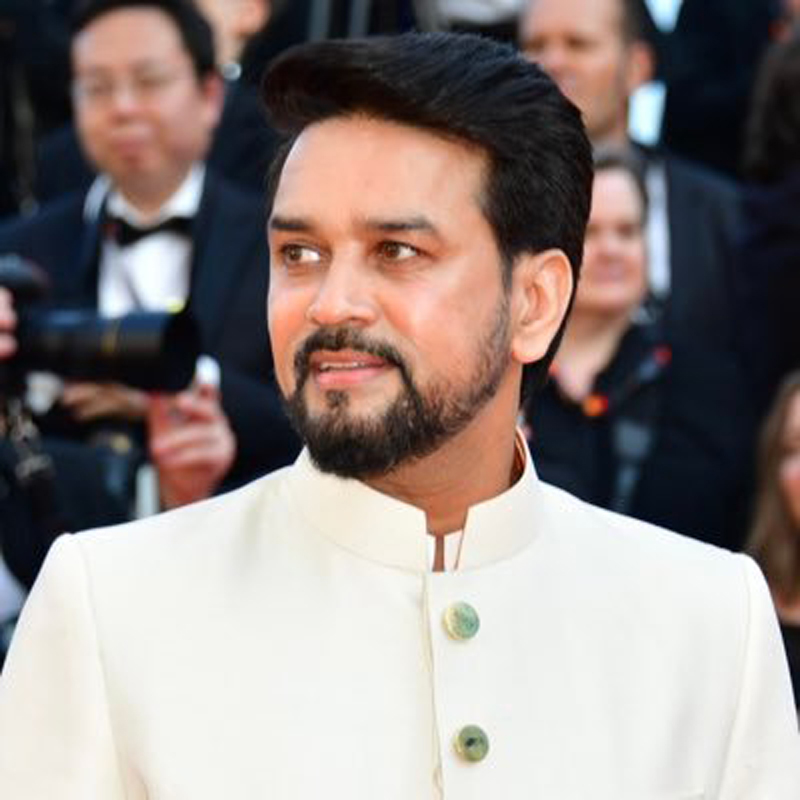
‘Documentary cinema educates, inspires and motivates to bring a change in the society’: Anurag Thakur

Published

on

Mumbai: The 17th edition of the Mumbai International Film Festival for documentary, short fiction and animation films (MIFF-2022) began with an opening ceremony in Mumbai on Sunday.

Speaking via a video message, the Union Minister for Information And Broadcasting Anurag Thakur said, “Documentary cinema creates the most significant impact. It not only educates, inspires and motivates a change in the society but also acts as a tool that transcends cultures and boundaries.”

This edition will offer around 400 films from across the world. Out of these, 102 films will be screened under the competition category-35 in international competition and 67 in a national competition.

Advertisement

The minister also mentioned that MIFF provides a platform where documentary filmmakers from all over the world get to exchange ideas and explore the possibilities of co-productions and marketing of documentary, short and animation films. He added that this opportunity eventually broadens the vision of the film-makers vis-à-vis world cinema.

Speaking in this context, Union Minister of Commerce & Industry, Consumer Affairs & Food & Public Distribution and Textiles,  Piyush Goyal said that those who produce art films, documentary films and animation films are kind of a ‘Start-Up’ seeding new ideas and play the role of messengers in the country.

He said there are multiple avenues like the silver screen, television, OTT, etc, available to spread the message across the world, thus allowing such ‘start-ups’ to become ‘Unicorns’.

Advertisement

Goyal said that Lata Mangeshkar was an inspiration for many artistes and musicians & through art she took India’s history, tradition and heritage to the world. “Let us explore ways as to how we can institutionalise Lata Didi’s role for the country, the city of Mumbai and the Cinema world itself.”

The Minister of State for Information And Broadcasting, Dr L. Murugan in his address spoke about the efforts made to promote Indian Cinema globally. He also pointed out how India has made a greater presence at the Cannes Film Festival and said Shaunak Sen’s film “All That Breathes” made India proud by winning the best documentary award.

The minister said that the government has announced incentives for international filmmakers and co-productions, especially for feature films, animation films, documentary films and web series.  “AVGC sector promotion is happening in a great way. The prime minister (PM) called for Digital India and Startup India and the Indian contingent at Cannes showcased our culture and ethos,” he proudly recalled.

Advertisement

The seven-day festival was organised by the Films Division of the Ministry of Information & Broadcasting and inaugurated by Piyush Goyal.

 

Click to comment

Leave a Reply

Your email address will not be published. Required fields are marked *

Hindi

Remembering Gyan Sahay, the lens behind film, television and advertising

From a puppet rabbit selling poppadums to Hindi cinema, he framed it all.

Published

on

MUMBAI: There are careers, and then there are canvases. Gyan Sahay, the veteran cinematographer, director, and producer who passed away on 10 March 2026 in Mumbai, had one of the latter. Over several decades in the Indian film and television industry, he turned lenses, lights, and the occasional puppet rabbit into something approaching art.

A graduate of the Film and Television Institute of India (FTII) in Pune, Sahay built his reputation as a director of photography across a career that stretched from the early 1970s all the way to the digital age. He was the kind of craftsman who understood that a well-composed shot is not merely a technical achievement but a quiet act of storytelling.

For most Indians of a certain age, however, Sahay will forever be the man behind the rabbit. His direction of the iconic long-running television commercial for Lijjat Papad, featuring its now-legendary puppet bunny, gave the country one of its most cheerfully persistent advertising images. It was the sort of work that sneaks into the national subconscious and takes up permanent residence.

Advertisement

His big-screen credits as cinematographer include Anokhi Pehchan (1972), Pagli (1974), Pas de Deux (1981), and Hum Farishte Nahin (1988). In 1999, he stepped behind a different kind of camera altogether, making his directorial debut with Sar Ankhon Par, a drama that featured Vikas Bhalla and Shruti Ulfat, with a cameo by Shah Rukh Khan for good measure.

On television, Sahay was particularly prized for his command of multi-camera production setups, a skill that made him a go-to technician for large-scale shows and reality programmes. In an industry that has never been especially patient with complexity, he was the calm hand on the rig.

In later life, Sahay turned teacher. He participated regularly in masterclasses and Digi-Talks, often hosted by organisations such as Bharatiya Chitra Sadhna, sharing hard-won wisdom on cinematography, the comedy of timing in a shot, and the sweeping changes brought by the shift from celluloid to digital. He was also said to have been involved in a project concerning a biographical film on Infosys co-founder N.R. Narayana Murthy.

Advertisement

Tributes from the film industry poured in following the news of his passing, with colleagues remembering him as a senior cameraman who served as a rare bridge between two entirely different eras of Indian cinema. That is, perhaps, the finest thing one can say of any craftsman: he kept up, and he brought others along with him.

Continue Reading

Advertisement News18
Advertisement All three Media
Advertisement Whtasapp
Advertisement Year Enders

Indian Television Dot Com Pvt Ltd

Signup for news and special offers!

Copyright © 2026 Indian Television Dot Com PVT LTD

This will close in 10 seconds