
Hindi
Dinesh Vijan and Rajkummar Rao discuss Maddock’s cinema strategy
At FICCI FRAMES 2026, the duo discuss creative freedom, studio building and their new film Prahaar
SEO keyphrase: Dinesh Vijan Rajkummar Rao FICCI FRAMES 2026


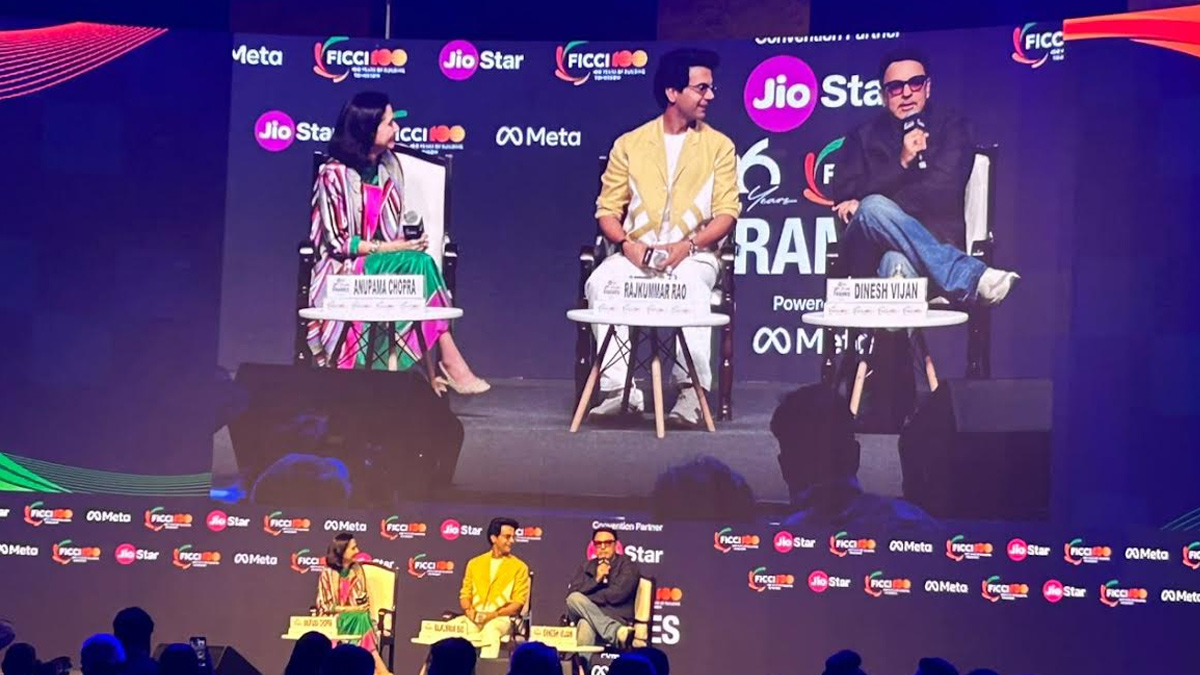
MUMBAI: In an industry where stars often call the shots, Dinesh Vijan believes the real blockbuster begins with the story. At FICCI FRAMES 2026, the Maddock Films founder and actor Rajkummar Rao unpacked the creative partnership behind their films, the business of building a studio and why backing an unconventional idea sometimes requires more conviction than calculation.
The session, titled ‘From Storytellers to Studios: Reshaping the Next Generation of Indian Cinema’, brought the two together in conversation with Anupama Chopra, Editor, The Hollywood Reporter India, RPSG Lifestyle Media. Moving between their collaborations, the changing demands of filmmaking and their upcoming project Prahaar, the discussion offered a look at how Maddock has developed from a production house into a studio without abandoning its emphasis on storytelling.
For Rao, the partnership is built on something that does not always appear in a film’s opening credits: trust. The actor recalled how their association developed through films such as Raabta and Stree, with his performance in Bareilly Ki Barfi helping demonstrate a comic side that audiences and filmmakers had not always associated with him.
Stree subsequently became a turning point for both the actor and the production house. Rao said working with Vijan gave him the confidence that a story would be supported without unnecessary interference, particularly because the producer places considerable faith in his directors and writers.
Vijan, meanwhile, described the relationship as a meeting of creative sensibilities rather than a carefully designed business arrangement. He said Maddock’s content-led films, including Stree, Luka Chuppi, Hindi Medium and Bala, have demonstrated the importance of actors who can inhabit characters rather than rely solely on star power.
The producer revealed that Maddock had taken an unusual pause over the preceding three to four months, choosing not to shoot while the team examined the changing entertainment landscape. The break allowed him to revisit the studio’s journey and consider what had worked, what needed to change and where its creative priorities should lie.
His conclusion was that the company’s identity had been shaped by films that put content before gimmicks. Vijan argued that storytelling-led cinema requires performers capable of making characters convincing, and identified Rao’s ability to deliver humour without overstating it as one reason their collaborations have continued.
That partnership has now extended across seven films, although Vijan suggested the number was never part of a predetermined slate. Rather than setting out to manufacture a long-running actor-producer combination, the two have continued working together when the material and creative circumstances have aligned.
The conversation also examined what changes when an actor works with a studio rather than entering a separate arrangement for every film. Rao, who has also established Campfire Films, said his experience as a producer had given him a clearer understanding of the role played by those financing and supporting a project.
A director and actor may bring a story to life, but its eventual reach depends heavily on the producer’s decisions, he explained. Rao recalled working on films that he believed deserved larger audiences but did not receive the distribution or promotional support needed to achieve that reach.
He credited Vijan with taking an unusually close interest in the journey of a film beyond the shoot, from music and marketing to distribution and release strategy. In his view, that attention can help a strong creative idea find an audience rather than disappear amid the crowded release calendar.
The Stree franchise provided an example. Rao pointed to the promotional role played by Milegi Milegi in the first film and Aayi Nai in Stree 2, arguing that the decision to invest in music and promotion demonstrated the producer’s willingness to push a project even when the commercial outcome was uncertain.
For Vijan, however, no amount of promotional muscle can compensate for choosing the wrong story. He said the most consequential decision at Maddock is determining which film should be made in the first place, with the choice driven more by instinct than by a mathematical formula.
The test, he explained, is whether a story stays with him after he has heard it. If he wakes up the following morning feeling that the film simply has to be made, that conviction becomes the starting point for assembling the director, cast and production team.
Authenticity was another recurring theme. Vijan argued that audiences are surrounded by increasingly artificial experiences and that an original voice rooted in an Indian story can provide a stronger foundation than an elaborate attempt to engineer commercial success.
But authenticity alone is not enough to keep audiences engaged. Vijan said films today need roughly eight to nine moments capable of genuinely surprising viewers, making them forget everything else and feel they are experiencing something they have not encountered before.
The observation reflected the pressure on filmmakers to compete for attention in a market overflowing with content. A compelling premise may bring someone into a cinema, but sustaining that attention requires fresh ideas throughout the film rather than depending on a familiar formula.
The discussion then turned to the economics of creative freedom. Vijan drew a distinction between a production house that must approach a studio for financing and a studio that can control both the money and the filmmaking process.
He recalled that Maddock had spent around 10 years reaching the point where it could make Stree on its own terms. According to Vijan, the project did not attract backing from an outside studio at the time, prompting the company to finance and support it independently.
That decision became an important milestone in Maddock’s development. Having established greater control over its projects, the company subsequently moved towards a studio model, allowing it to make decisions across the production and promotional pipeline.
Vijan said this independence also creates the freedom to spend heavily on a film’s release when the team believes the investment is justified. In the case of the first Stree, he suggested, promotional spending could be pushed to a level comparable with the cost of production because the company controlled the decision.
The approach is not without financial risk. Vijan acknowledged that films do not always work, but said Maddock’s willingness to absorb the consequences of its decisions is part of the reason it sought greater control over financing and production.
Despite the shift in scale, he insisted that Maddock continues to operate with the instincts of a production house. Its growth into a studio, he suggested, has not changed the central question driving the company: whether a story is worth telling.
Asked to define the Maddock identity, Vijan resisted the temptation to reduce it to a particular genre or style. He described the company as a home for Indian storytellers, regardless of their background, provided they have an idea that the studio believes in.
He also outlined an unconventional hierarchy for the filmmaking process. Writers, he said, are the studio’s first stars, directors come next, and actors follow as the performers who bring the material to life.
The distinction between an actor and a star became particularly relevant when the conversation shifted to Rao’s own career. Asked whether he regarded himself as a brand, the actor said his ambition had always been to become a film actor rather than build an identity around commercial labels.
Rao recalled that Anupama Chopra had known him since 2010, a period spanning 16 years, and maintained that his relationship with the craft had remained his primary concern. Labels such as star, superstar or brand, he said, were for other people to assign.
For him, the essential experience remains taking a script, preparing a character and stepping onto a set. He said he does not want decisions about roles to be dictated by whether a project fits a perceived brand image, particularly when the attraction of acting lies in exploring different people and stories.
Vijan expressed a similar discomfort with allowing Maddock to become trapped by its own reputation. He recalled an incident around three to four years earlier when a viewer described a trailer on YouTube as a typical Maddock film.
While his team welcomed the recognition, Vijan said he was concerned that being associated with one kind of cinema could eventually discourage the company from taking risks. Once audiences and executives begin expecting only a particular format, he argued, the temptation is to keep reproducing it.
That concern helps explain the studio’s movement between comedy, horror comedy, drama and more serious subjects. Vijan said the company does not want to be confined to the kinds of films audiences have already seen from it, even when those genres have delivered commercial success.
The conversation provided a natural introduction to Prahaar, the forthcoming film centred on public prosecutor Ujjwal Nikam. Rao and Vijan discussed the project as an example of the kind of material that requires the right combination of story, performer and director rather than a conventional calculation about what appears most commercial on paper.
Vijan said the decision to pursue the film followed a meeting with Nikam that lasted around three hours. He described the prosecutor as a layered individual whose professional journey offered substantial dramatic material, while also drawing attention to the sacrifices made by families supporting people in demanding public roles.
The film’s subject matter includes Nikam’s involvement in cases connected with the 1993 Mumbai blasts and the 26/11 terror attacks. Vijan said the project explores the legal process and the effort involved in establishing evidence and connections through the courts, rather than treating the story solely as a series of dramatic confrontations.
The producer also emphasised that the narrative would examine the personal dimension of Nikam’s career. The demands of pursuing major cases, he suggested, cannot be separated entirely from the impact such work has on the people closest to those involved.
Vijan said the story reached him through Jio, after which his meeting with Nikam strengthened his conviction that it should be developed into a film. He also explained why Rao emerged as the choice for the central role, pointing to the actor’s ability to portray complex material without adding unnecessary theatricality.
Director Avinash was another important part of that decision. Vijan said the filmmaker’s understanding of the setting and his approach to authenticity helped bring the project together, particularly because the team wanted the courtroom and procedural elements to feel grounded.
Rao, meanwhile, acknowledged that biopics are among the more demanding genres for an actor. Although he has been approached for several such projects, he said his involvement in them has developed organically rather than through a deliberate effort to specialise in portraying real people.
Vijan added that Prahaar would be Rao’s only biopic over the next two years, underlining the attention being given to the project. The session also featured the film’s trailer, allowing the discussion to move from the philosophy behind the production to the work itself.
Beyond the individual films, the exchange highlighted a broader question confronting Indian cinema: how does a company grow into a studio without allowing its commercial machinery to overwhelm the stories that made it successful?
For Vijan, the answer lies in keeping the original creative instinct intact even as the financial and operational responsibilities become larger. He argued that choosing a story, finding the right people and supporting the resulting film with conviction remain more important than fitting every project into a predetermined commercial template.
Rao’s perspective brought the discussion back to the actor’s relationship with the material. While a studio can create the conditions for a film to reach audiences, he suggested, the creative process still begins with a performer believing in the character and the story.
The session offered a picture of a changing Hindi film industry in which creative freedom and commercial responsibility are increasingly intertwined. Maddock’s transition from producer to studio may have changed who controls the purse strings, but Vijan and Rao made clear that, for their partnership, the script is still expected to have the final say.






