MAM
What now for TV ratings and TAM


MUMBAI: When the cabinet committee on economic affairs announced that it had approved the Telecom Regulatory of India (TRAI) recommendations on TV ratings guidelines in the first week of 2014 the first question that struck everyone was – what will TAM do now?
The fracas between angry broadcasters and TAM has been brewing for several years and finally came to its boiling point last year when seven TV networks announced that they were clicking on the TAM TV rating unsubscribe button. This put a big question mark over TAM’s very existence but it managed to get out of the corner it was in by hammering out a solution which was acceptable to most subscribers.

As far as the current threat to TAM’s continuance is concerned, the Cabinet’s go ahead to the proposed regulatory framework has now to be notified. When that will happen no one knows, though speculation is that it could be sooner than later. However, what is sure is that TAM will have 30 days from notification date to comply with its guidelines and then seek a licence from the Ministry of Information and Broadcasting (MIB). From all angles it looks like a pressure cooker-like situation that the TV ratings provider has landed itself in.
Broadcasters seem to be the happiest of the lot. NDTV group CEO Vikram Chandra – whose company sued TAM in a New York court two years ago – is cock-a-hoop with delight that the government has affirmed what industry has been voicing since nearly six to seven years: that TAM and the ratings process in India needs to be spruced up.
“The introduction of firm guidelines is a positive step as everything is clear now. It shows that we should never be hesitant to change something that isn’t right,” says Chandra.
Whether TAM will manage to find the capital to ramp up its peoplemeter sample to 20,000 within a month or two is something that is concerning industry. What is also a big question mark is how the MIB will view the WPP group’s 50 per cent equity in TAM (through Kantar Media Research 20 per cent, and Cavendish Square Holdings 30 per cent), as mentioned in the NDTV suit with the supreme court in New York.
“Kantar and Cavendish will have to exit since their parent is WPP. TAM has been worrisome and everyone has realised it. So now it has just two options, either shape up or ship out,” says a senior news broadcaster from the News Broadcasters Association (NBA).
However, a source from the IBF presents another option. “We are a democratic country so the government cannot force things on anybody. TAM has the freedom to go to the court and appeal against the guidelines,” says the source.
If TAM decides to oppose the guidelines and go to court and gets a stay order, then we might see some delays in the roll out of the guidelines. This will allow it to continue to operate until a final decision is given by the court, thus buying it some time. Additionally, the industry-backed Broadcast Audience Research Council (BARC) will also get some time to get its act together with the minimum 20,000 meters.
Media agencies and advertisers aren’t too happy with the way the cabinet has thrust the deadline on TAM.
Says a senior media professional: “In the beginning of cable and satellite TV in India in the nineties, we had TAM and INTAM. The latter could not sustain itself and TAM continued. Then we had TAM and aMap in the mid of the previous decade. aMap too found the going tough without full industry support and folded up. The fact is TAM has started from scratch and survived so many upheavals. It is a sad situation to be destroying something that has been existing and running for so long. ”
However, she is clutching on to a thin sliver of hope that TAM and BARC could co-exist for a while until things smooth out on the ratings front.
“The time given to follow and make all the changes as per the guidelines is impractical,” says Madison World chairman & MD Sam Balsara. “It is obvious that TAM will not be able to handle it all at such a short notice.”
The Indian Society of Advertisers (ISA) chairman Hemant Bakshi says that he is discussing the consequences of the cabinet’s clearance to the new ratings guidelines with major advertisers and other players to gauge the possible impact on their businesses.
One scenario that everyone is dreading is that TAM fails to comply with all the requirements within the time period it is given, and the courts dismiss its appeal, if it makes one. Will it then be forced to cease operations immediately and lead to a ratings-less period for the Indian television business? This is extremely alarming for all concerned.
IPG Mediabrands CEO Shashi Sinha who is also in the technical committee of BARC feels that the management of the new proposed ratings system needs to pull their socks up, and accelerate the rollout of people meters. But even then he says that “we are hoping to be on our feet and start functioning only by September/October.”
That seems a long, long time away, going by how things are moving. Madison’s Balsara is quite clear on the way forward. Says he: “As an industry we need ratings, all the time! Therefore, till BARC comes up, we need an alternate. As an industry we should appeal to the ministry to relax the deadline for the implementation.”
Hence, it is imperative for all concerned – whether it is the MIB led by Manish Tewari, the government, TAM, the ISA, advertising agencies, broadcasters and BARC – to choose their next steps wisely.






Brands
KITKAT India teams up with One Piece for anime-led campaign push
On-pack characters and digital film tap into India’s fast-growing anime wave
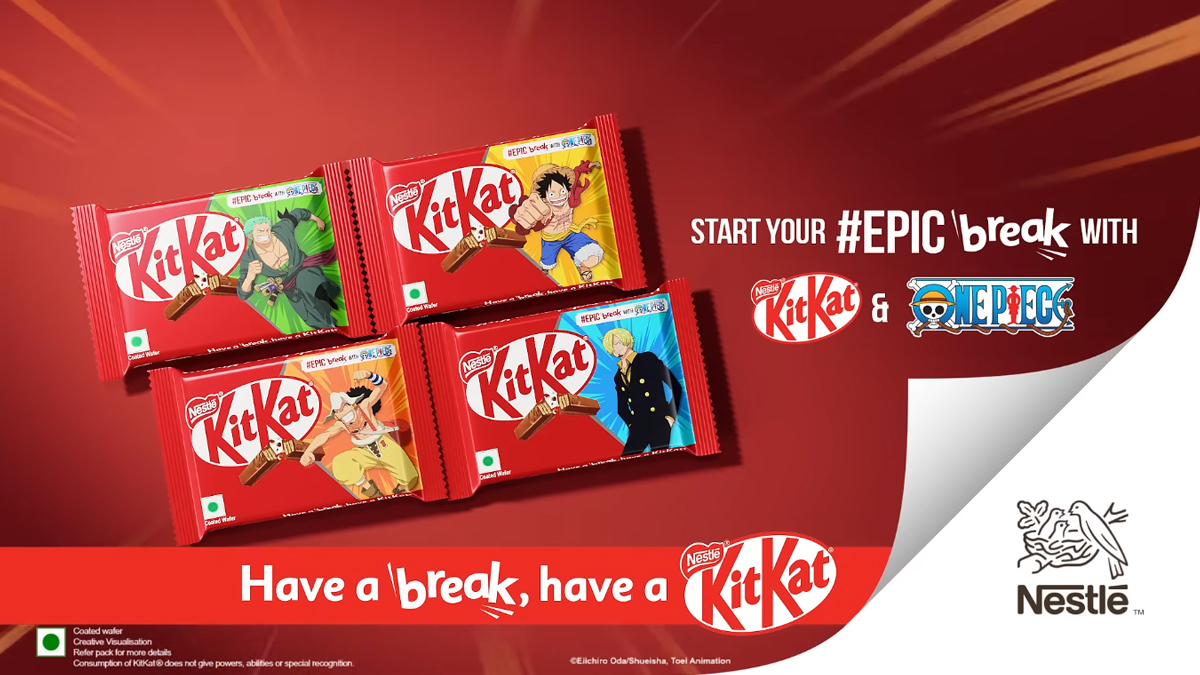
MUMBAI: KITKAT India has joined forces with the globally popular anime One Piece, rolling out a new campaign that brings fan-favourite characters onto its packaging in a bid to connect with India’s rapidly expanding anime audience.
The collaboration sees iconic characters from the series featured on KITKAT packs, adding a playful twist to the brand’s long-standing “take a break” proposition. By blending pop culture with confectionery, the campaign aims to make everyday breaks feel a little more adventurous.
The launch is anchored by a digital-first film released across YouTube and Meta platforms, supported by a broader push spanning outdoor media and interactive social content. The multi-platform rollout reflects a clear attempt to meet younger audiences where they already spend their time.
Nestlé India head confectionery business Gopichandar Jagatheesan said, “Anime is a rapidly growing genre in India, and we are excited to collaborate with one of the most popular shows, One Piece. Having championed breaks for decades, KITKAT now takes them to the next level, making every break more epic with the world of One Piece.”
The move comes at a time when anime is shifting from niche interest to mainstream entertainment in India, with brands increasingly tapping into its cultural currency to stay relevant with younger consumers.
By pairing a globally loved anime with an equally recognisable chocolate brand, KITKAT’s latest outing signals a simple idea with strong appeal. In a crowded market, even a small break can turn into a big moment when it comes with a side of fandom.






