MAM
Visage Lines appoints Siddha Jain as business head-women division

New Delhi: Visage Lines, owner of grooming brand Bombay Shaving Company on Thursday appointed Siddha Jain to lead the company’s women’s beauty and personal care business.
Jain is an IITB and IIMB alumni, and joins the rapidly growing premium grooming company from Bain & Co., where she served technology and consumer goods businesses for over five years.
The company also elevated chief business officer Deepak Gupta to chief operating officer. Gupta joined Visage Lines in January 2019 to lead the brick and mortar business and has risen the ranks rapidly. In his new role, he will lead expansion of the group into multiple strategic businesses across categories.

Visage Lines’ founder and CEO, Shantanu Deshpande said, “We are thrilled to have Siddha join our leadership team. She brings outstanding business acumen, growth intrinsic, limitless energy and a first-hand understanding of the Indian woman consumer. Siddha has a stellar track record of supporting large businesses across growth strategy, sustainable scaling, transformation and people centricity. As we build a robust leadership to scale a new Bombay Shaving Company, a senior executive of Siddha’s calibre is a massive asset for us. Very excited to have her on this journey”
Bombay Shaving Company started as a men-centric shaving, beard and skincare brand. However, over the last few quarters, it has become a preferred choice for women’s grooming needs too. “The Indian women’s hair removal market stands at Rs 15000 Cr (both products and services) and is projected to grow at 21 per cent year-on-year in the next five years. There is a growing demand for hair-removal solutions in the emerging GenZ and millennial customer base, and this has been fuelling the immense post-pandemic growth of the sector,” said the company.
At Bombay Shaving Company, Siddha will be driving business critical mandates to scale the women’s hair removal business, with a special focus on building equity across digital commerce, modern trade and allied services.
“I strongly believe that the brands of today are not just a machinery for serving products, but forcing tough conversations, bringing confidence in the everyday and equipping women to own their beauty. I am deeply passionate about bringing meaning and purpose to the personal care space for the young, ambitious and bold women of today. I am very excited to work with Shantanu and the entire leadership team to own the women’s hair removal space. I am looking forward to this transformative journey not just for me and our brand, but for the communities we serve who identify as women”, says Siddha Jain on her new role.




MAM
Lego brings Messi, Ronaldo, Mbappé, Vinicius together
Campaign clocks 314 million views ahead of FIFA World Cup 2026 buzz.
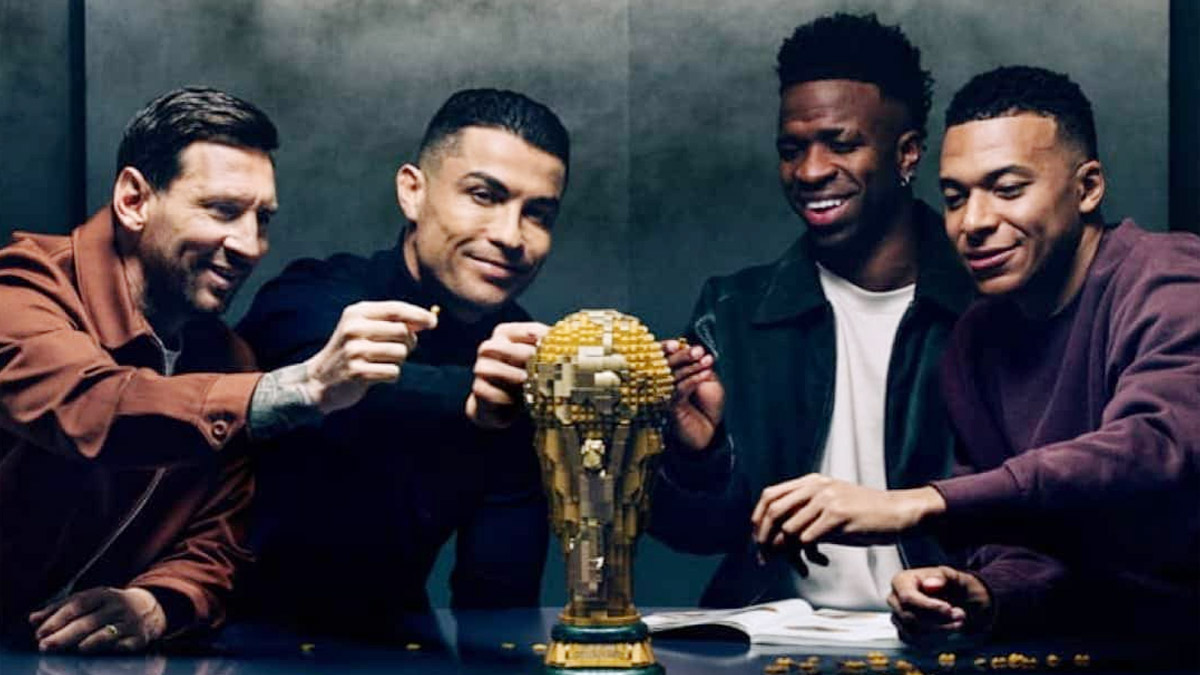
MUMBAI: Four legends, one frame and not a single tackle in sight. Lego has pulled off a crossover few thought possible, uniting Lionel Messi, Cristiano Ronaldo, Kylian Mbappé and Vinícius Júnior in a single campaign ahead of the FIFA World Cup 2026 only this time, they’re building dreams brick by brick.
Titled “Everyone wants a piece”, the campaign features the quartet assembling a Lego version of the World Cup trophy, before placing miniature versions of themselves atop it, a playful nod to football’s ultimate prize. Shared widely across social media, the ad carries a pointed disclaimer: it is not AI-generated, a subtle but telling signal in an era where even reality is often questioned.
The numbers tell their own story. The campaign has already crossed 314 million views on Instagram across the players’ accounts, with fans hailing it as a rare, almost nostalgic moment particularly for the reunion of Messi and Ronaldo, whose last shared campaign ahead of the 2022 World Cup became one of the platform’s most-liked posts.
Beyond the film, Lego is extending the play with exclusive, player-themed sets tied to each of the four stars, part of a broader football-led programme designed to ride the global momentum building towards 2026. The idea, as echoed by the players themselves, leans into the parallels between football and play experimentation, creativity, failure, and triumph.
Messi described the sets as a way to bring on-pitch moments into an imaginative, hands-on world, while Ronaldo called the transformation into a Lego figure a rare honour, blending sport with storytelling. Vinícius, meanwhile, struck a more personal note, recalling childhood moments of building with Lego and framing creativity as a universal language that transcends borders.
The timing is no accident. With the 2026 World Cup set to run from June 11 to July 19 across the United States, Canada and Mexico, and featuring an expanded 48-team format, global anticipation is already building. Argentina, led by Messi, will enter as defending champions, adding another layer of intrigue.
For Lego, the campaign does more than celebrate football, it taps into its mythology. Because when icons become figurines and rivalries turn into play, the beautiful game finds a new kind of pitch. one built, quite literally, by hand.






