MAM
Lego brings Messi, Ronaldo, Mbappé, Vinicius together
Campaign clocks 314 million views ahead of FIFA World Cup 2026 buzz.
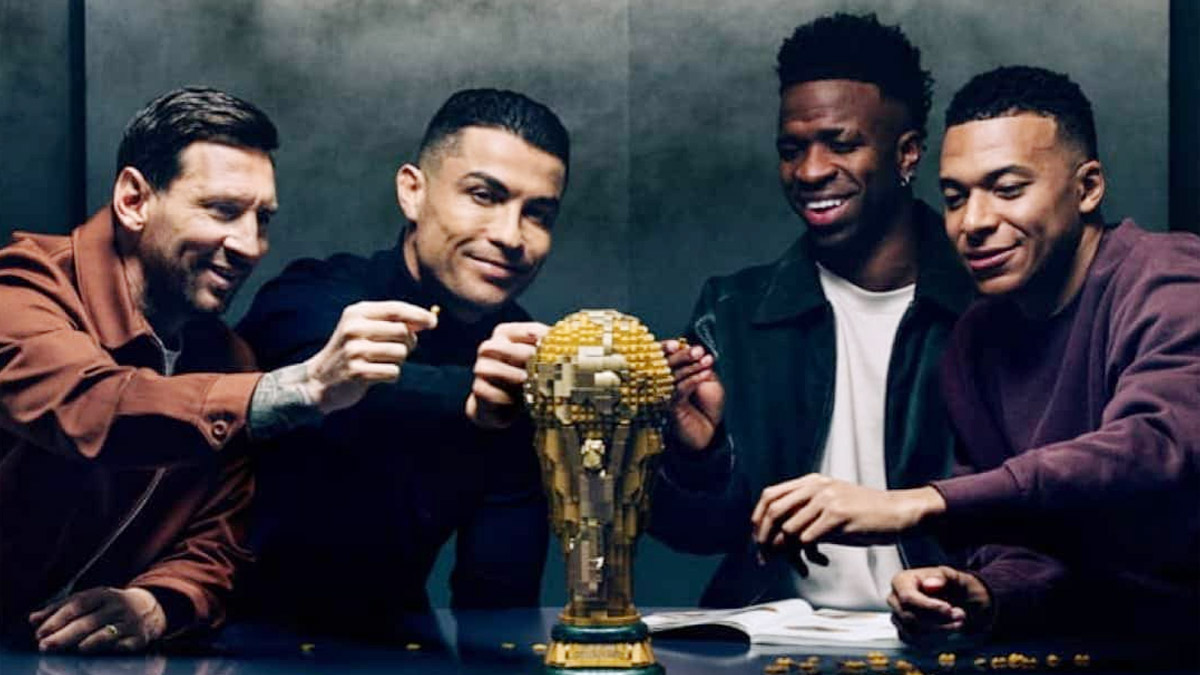
MUMBAI: Four legends, one frame and not a single tackle in sight. Lego has pulled off a crossover few thought possible, uniting Lionel Messi, Cristiano Ronaldo, Kylian Mbappé and Vinícius Júnior in a single campaign ahead of the FIFA World Cup 2026 only this time, they’re building dreams brick by brick.
Titled “Everyone wants a piece”, the campaign features the quartet assembling a Lego version of the World Cup trophy, before placing miniature versions of themselves atop it, a playful nod to football’s ultimate prize. Shared widely across social media, the ad carries a pointed disclaimer: it is not AI-generated, a subtle but telling signal in an era where even reality is often questioned.
The numbers tell their own story. The campaign has already crossed 314 million views on Instagram across the players’ accounts, with fans hailing it as a rare, almost nostalgic moment particularly for the reunion of Messi and Ronaldo, whose last shared campaign ahead of the 2022 World Cup became one of the platform’s most-liked posts.
Beyond the film, Lego is extending the play with exclusive, player-themed sets tied to each of the four stars, part of a broader football-led programme designed to ride the global momentum building towards 2026. The idea, as echoed by the players themselves, leans into the parallels between football and play experimentation, creativity, failure, and triumph.
Messi described the sets as a way to bring on-pitch moments into an imaginative, hands-on world, while Ronaldo called the transformation into a Lego figure a rare honour, blending sport with storytelling. Vinícius, meanwhile, struck a more personal note, recalling childhood moments of building with Lego and framing creativity as a universal language that transcends borders.
The timing is no accident. With the 2026 World Cup set to run from June 11 to July 19 across the United States, Canada and Mexico, and featuring an expanded 48-team format, global anticipation is already building. Argentina, led by Messi, will enter as defending champions, adding another layer of intrigue.
For Lego, the campaign does more than celebrate football, it taps into its mythology. Because when icons become figurines and rivalries turn into play, the beautiful game finds a new kind of pitch. one built, quite literally, by hand.

MAM
Paramount set to acquire Warner Bros. Discovery in $81 billion deal
Shareholders back merger, combined entity could reshape streaming and studios.
MUMBAI: Lights, camera… consolidation, Hollywood’s latest blockbuster might be happening off-screen. Shareholders of Warner Bros. Discovery have voted in favour of selling the company to Paramount in a deal valued at $81 billion rising to nearly $111 billion including debt setting the stage for one of the biggest shake-ups in modern media. The proposed merger, still subject to regulatory approvals, would bring together a vast portfolio spanning HBO Max, CNN, and franchises such as Harry Potter under the same umbrella as Paramount’s own heavyweights, including Top Gun and CBS.
At the heart of the deal is streaming scale. Executives have indicated plans to combine HBO Max and Paramount+ into a single platform, potentially creating a stronger challenger to giants like Netflix and Amazon’s Prime Video. Current market data suggests HBO Max holds around 12 per cent of US on-demand subscriptions, compared to Paramount+’s 3 per cent, together still trailing Netflix’s 19 per cent and Disney’s combined 27 per cent via Disney+ and Hulu.
Paramount CEO David Ellison has signalled that while platforms may merge, HBO’s creative identity will remain intact, stating the brand should “stay HBO” even within a broader ecosystem.
Beyond streaming, the deal would redraw the map for film production. Combining two of Hollywood’s oldest studios Paramount Pictures and Warner Bros., the new entity aims to scale output to over 30 films annually, while maintaining a 45-day theatrical window. Warner Bros. currently commands around 21 per cent of the US box office, compared to Paramount’s 6 per cent, underscoring the strategic weight of the acquisition.
But scale comes with scrutiny. Critics warn that fewer players could mean reduced consumer choice, rising subscription costs, and potential job cuts as the combined company looks to streamline overlapping operations while managing billions in debt.
The news business, too, faces a reset. CNN would join forces at least structurally with Paramount-owned CBS, raising questions about editorial independence and positioning. The merger has already drawn political attention in the United States, particularly given perceived ties between the Ellison family and Donald Trump, though the company maintains that newsroom autonomy will be preserved.
If approved, the deal would mark another milestone in Hollywood’s consolidation wave shrinking the industry’s traditional “big six” studios to a “big four”, with Paramount joining Disney, Universal, and Sony at the top table.
In an industry built on storytelling, this merger may well become its most consequential plot twist yet.