MAM
The good old days weren’t, but people wish they were ; nostalgia rules according to Ipsos survey


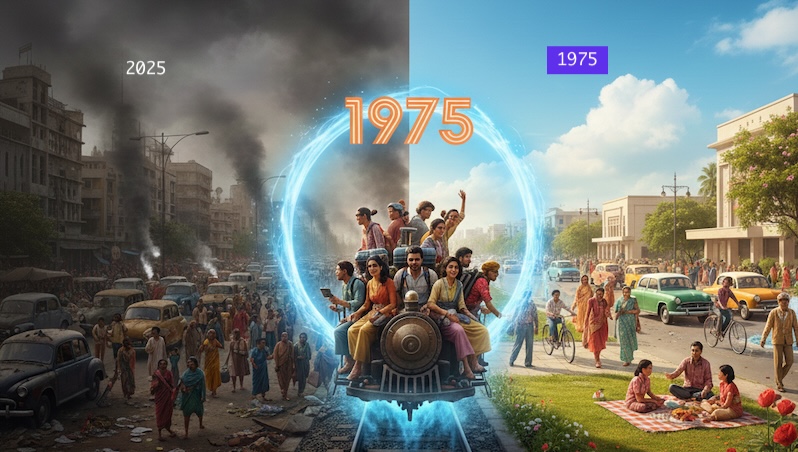
MUMBAI: The past has never looked so rosy. Despite being born decades after disco died, most people across 30 countries would rather have emerged into the world in 1975 than today. By a ratio of nearly two to one, respondents to an Ipsos survey say they’d prefer to have been born 50 years ago—44 per cent versus a mere 24 per cent who favour 2025.
The nostalgia is particularly acute in India, where 44 per cent believe the environment was superior in 1975 and 41 per cent reckon people were happier back then. Never mind that 78 per cent of Indian respondents weren’t even alive to experience the supposed glory days. They’ve inherited a collective memory of simpler times, cleaner air and closer-knit families—passed down like heirlooms through generations.
Recent floods and landslides have sharpened perceptions that India’s environment has deteriorated. Streets, respondents insist, were safer. Healthcare was more accessible. War seemed more distant. Living standards were better, despite India now standing as the world’s fourth-largest economy, poised to overtake Japan for third place by 2030.
The global picture mirrors India’s wistfulness. Across the 30 countries surveyed, 55 per cent say their nation was happier in 1975, compared with just 16 per cent who believe it’s happier now. Environmental degradation troubles people everywhere: in 26 of 30 countries, majorities believe the natural world was in better shape half a century ago, with the global average hitting 61 per cent.
France leads the nostalgia parade, with 57 per cent preferring to have been born in 1975. Belgium and Mexico follow at 53 per cent, whilst Britain and New Zealand tie at 52 per cent. Only South Korea bucks the trend, with more people choosing the present over the past.
Yet the nostalgia rests on shaky foundations. Respondents consistently overestimate life expectancy in 1975 and underestimate how long people live today—even though many can now expect to reach 75 or beyond.
Not everything tilts backwards. A global majority of 55 per cent believe healthcare has improved, reflecting genuine advances in treatment and access. In India, education stands out as an unambiguous win for modernity. Indians overwhelmingly credit today’s job-oriented, skill-based programmes over the theory-laden curricula of yesteryear.
Living standards tell divergent stories depending on geography. In South Korea, 80 per cent believe life is better now; 70 per cent of Singaporeans and 66 per cent of Poles agree. Meanwhile, 59 per cent of the French, 52 per cent of Turks and 52 per cent of Canadians insist things were superior in 1975.
“Despite India being the world’s fourth-largest economy, nostalgia runs deep,” says Ipsos India chief executive Suresh Ramalingam. “Tech-driven lives bring convenience but also emotional distance and higher living costs. Progress drives pride, yet people view the past through a softer, more sentimental lens—where life seemed simpler and happiness easier.”
Ipsos interviewed 23,772 adults across 30 countries between August 22nd and September 5th, 2025. Even Generation Z, the only cohort showing a slight preference for being born in the 2020s, expresses profound uncertainty about both present and future.
The verdict is clear: modernity delivers longer lives, better medicine and expanded educational opportunities. But it cannot compete with the sepia-tinted allure of a past most people never knew—and which, in all likelihood, was nowhere near as golden as memory suggests.