MAM
‘Technology is the future of experiential marketing:’ Vidur Patney

MUMBAI: When talking of marketing campaigns we often come across the term ‘on ground activation.’ While at a rudimentary scale, it’s how a brand markets itself through direct engagement with consumers, its utility and purview is infinitely evolving. The idea is to create a bond between the consumer and the brand beyond ‘buying and selling’ by immersing them in a fun and memorable experience, which evokes emotions within the consumers that they thereafter associate with the brand instead.
From a simple handing out of Red Bull cans at a music concert to Multi Screen Media’s open air bus ‘Bulaava Express,’ which toured the country across 13 cities creating euphoria for the 2014 IPL — the beauty of experiential marketing lies in its flexibility of mode and scale to target the consumers.

While the concept isn’t new to marketers, its rapid evolution over the years armed by technology and digitisation has made it increasingly important to understand experiential marketing from an insider’s perspective.
With that in mind, Indiantelevision.com approached recently appointed Maxus national director – experiential marketing Vidur Patney to shed light on the changing landscape of experiential marketing, and the role it is going to play in the near future.
Purview:
From on ground and van activations through major cities to team building activities from brands at corporate level, experiential marketing plays on a wide range, and the possibilities are endless.
How you use the formula to connect with your consumer, what chord you strike with them in the process is what puts you at an advantage when it comes to this form of marketing. The idea is to wow the consumers with unique interactions and engagements that leave impressions in their minds. Creating vanilla experiences that the consumers can then start associating with the brand is also part of the process.
Though the possibilities are endless, it is getting increasingly challenging to come up with new ways to give consumers that vanilla experience. The only way forward is to use the available digital and technological tools at our disposal. By identifying how the consumers engage with such tools, we come up with concepts that allow us to make the most of it.
Evolution:
The evolution of experiential marketing has happened in three phases. Often considered an old school marketing art, the first hurdle was to get brands and marketers to realise its potential in the current ecosystem. To make them look beyond the generic TVC marketing and acknowledge that today consumers are not content with just knowing a brand through their television sets.
Once that was established, phase two was to explore the various ways in which experiential marketing can be used, and integrated with the headlining campaigns. This was the period we saw an increase in on-ground activities, contests, product launches where consumers could interact with brand ambassadors, etc.
Once that was achieved, we had to think how to expand the reach of experiential marketing, take it from being a space restricted solution, to a trigger that leads to conversations and interactions about a brand on a larger scale. That’s why currently we are concentrating on making way for more and more shareable experiences using the digital platforms.
Role of technology:
There’s no denying the fact that technology is the way forward when it comes to marketing, be it at the concept level or while executing. It has become an integral part of our consumers’ lifestyle. We can not only target consumers better with analytical tools made available to us through technology, but also engage consumers to give them the best of experiential.
Technology is also the differentiator when a brand wants to stand out and grab eyeballs. It is no longer something people are averse to. People are willing to accept technology into their lives and know more. As a result, to customise for them, to garner more participation and deliver a powerful brand message, technology plays a very important role.
The tools could be one on one engagement through technology, giving consumers a virtual experience. Use of technology is important because it is something today’s generation is excited about. If used right, it helps give that wow factor and conveys a much stronger message for the brand. Also, it goes a long way into consumers accepting what you are saying and giving them something memorable.
For example, the recent use of virtual reality (VR) and augmented reality technology can and has opened up new avenues when it comes to experiential marketing. People can now get a first hand interaction with how a brand functions. These are extremely useful tools for automobile and technology related brands where a consumer can see the inner workings of a car or a phone. It has a much bigger impact than simply sharing the specs with a consumer. But its use is endless when it comes to other sectors as well. One may argue that applying virtual and augmented reality in marketing may rack up the cost of marketing for brands but that’s just the initial phase. Just like any other technology, it’s the first investment that costs more, after which one can cash in on them while enjoying more innovations.
Going beyond metros:
Experiential marketing can be a very important marketing tool when it comes to tier II and tier II cities. We have noticed that while on ground activations work in metros, its reach is becoming limited. It only draws in a niche crowd. The urban consumer isn’t easily wowed by simple events, you need to spend more and innovate your engagement concepts to keep their interest. They get easily bored. Consumers in tier II and tier III cities, on the other hand, can still be catered with vanilla experiences by creating simple engaging moments. With brands now looking their way to expand consumer base, use of experiential marketing becomes crucial in those areas.
We recently did an on-ground activation for a movie screening in Indore where hundreds of kids and their parents turned up by simply allowing them to play games on an app we developed for the event. In a metro that would have only interested a niche group, way below hundred.
Experiential marketing in sports:
If there is one section where experiential marketing dominates, it is sports. We all interact with sporting events for a personal connection, be it our passion for the sport, our loyalty to a team or love for a favourite player. That is why brands love to associate with sporting events. It is easier to create those memorable moments, which brands would to be credited for. They want consumers to associate their favourite on ground memories with the brands.
There are numerous possibilities for experiential marketing for any sporting event, be it Indian Premiere League, Indian Super League, Pro Kabaddi League, etc.
A holistic marketing solution:
Experiential marketing and digital marketing forms two important pillars of the core media solution that we provide our clients. Having an experiential marketing arm gives Maxus an added advantage of providing a holistic marketing solution.
It’s a three way communication within Maxus that helps us achieve that. When it comes to digital technology and bringing it on ground, we have Metalworks. Figuring out how that technology can be used to wow and create a memorable experience for the consumer is what we at Experiential Marketing do. When these come together with Maxus’s core media vertical, we are able to give brands the best possible solution to engage with the consumer.
Going only experiential:
So far experiential has worked in collaboration with core media and other arms of marketing. While there are certain brands that can go only experiential as their marketing strategy, it highly depends on the brand’s target audience and the type of campaign. There are some products for which experiential gets the lion’s share of the marketing budget.
While there is no set rule, more and more brands are keeping budgets aside for experiential marketing because it’s the last mile of communication between the brand and a consumer.
Experiential works best when it’s area specific. If a brand launches a product aimed at consumers of a certain area, having a localised approach makes more sense rather than a TVC.






MAM
India’s financial sector spent less on TV ads in 2025 but flooded the internet
Banks, insurers and lenders cut tv ads as digital jumps, LIC and Muthoot lead tv and Axis Bank tops online
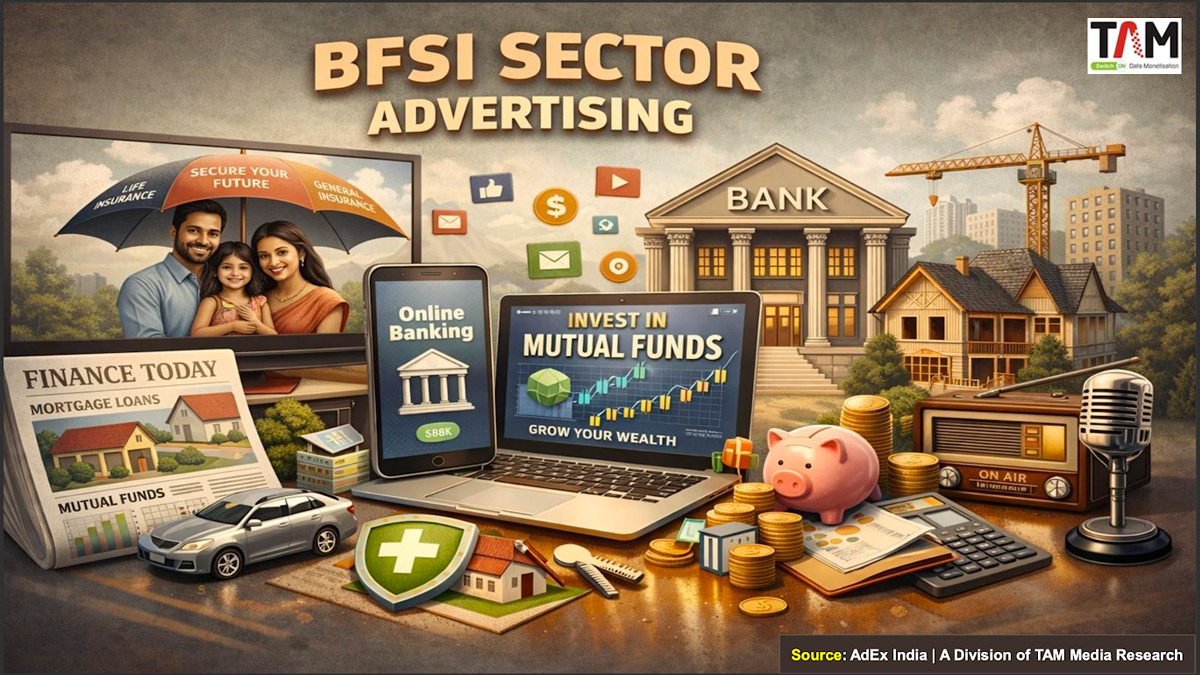
MUMBAI: India’s banking, financial services and insurance sector, one of the most prolific advertisers in the country, delivered a split verdict on media in 2025. It spent less on television, held its nerve in print, turned up the volume on radio and deluged the internet with a ferocity that left every other medium looking pedestrian. The picture that emerges from TAM AdEx’s cross-media report for the BFSI sector is of an industry in transition, still wedded to the news bulletin but increasingly seduced by the algorithm.
Television: a retreat with caveats
TV ad volumes for the BFSI sector fell 16 per cent in 2025 compared with 2024, a sharp reversal after two years of consistent growth that had pushed volumes 16 per cent above 2021 levels by 2023 and a further 7 per cent higher by 2024. Within 2025 itself, the drop was concentrated in the middle of the year: the second and third quarters saw ad volumes slide 35 per cent each against the first quarter, with a partial recovery of 13 per cent in the fourth.
The retreat did not reshuffle the deck. Life insurance retained first place among TV categories with 19 per cent of ad volumes, mortgage loans held second with 16 per cent, and the top ten categories together accounted for 82 per cent of all BFSI television advertising. The dominance of news channels was equally pronounced: news claimed 68 per cent of ad volumes, general entertainment channels a distant 14 per cent and movies 12 per cent. Together, news and GEC captured 82 per cent of the sector’s television spend. News bulletins alone took 48 per cent of programme-genre volumes, with feature films second at 12 per cent. Prime time, between 6pm and 11pm, drew 34 per cent of ad volumes, followed by afternoon at 22 per cent and morning at 20 per cent. A full 82 per cent of all ads ran between 20 and 40 seconds.
Life Insurance Corporation of India was the sector’s biggest TV spender with 11 per cent of ad volumes. Muthoot Financial Enterprises came second with 9 per cent, followed by National Payments Corporation of India at 6 per cent, Tata AIG General Insurance at 5 per cent and State Bank of India at 5 per cent. The top ten advertisers together accounted for 51 per cent of total TV volumes. Three names were new to the top ten in 2025: Tata AIG General Insurance, IIFL Finance and Tata Capital. At brand level, Muthoot Finance Loan Against Gold led with 9 per cent share, Tata AIG Health Insurance entered the top ten for the first time, and the top ten brands together contributed 35 per cent of ad volumes.
Print: the long climb continues
Print told a different story. Ad space for the BFSI sector has grown every year since 2021, rising 16 per cent in 2022, 30 per cent in 2023, 51 per cent in 2024 and 64 per cent in 2025, all measured against a 2021 baseline. Within 2025, ad space was flat in the second quarter but surged 46 per cent in the third and 33 per cent in the fourth compared with the first. Life insurance led print categories with 21 per cent of ad space, followed by mutual funds and banking services and products at 13 per cent each, and corporate financial institutes at 11 per cent. The top ten categories together took 82 per cent of print ad space. LIC led print advertisers with 6 per cent share, and the top ten together covered just 19 per cent of ad space, a reflection of how fragmented print spending remains. Three new entrants joined the top ten in 2025, with Billion Brains Garage Ventures the only exclusive presence not seen in 2024’s list. In the top ten brands, LIC dominated with a 2 per cent share, while Nippon India Mutual Fund rose to third position from fourth in 2024. English accounted for 62 per cent of print ad space, Hindi for 20 per cent. Business and finance publications took 59 per cent of the genre split. The south zone led regional spending with 33 per cent of print ad space, Bangalore topping that zone, while New Delhi and Mumbai were the leading cities nationally.
Radio: louder than ever
Radio ad volumes for the BFSI sector have climbed steadily, rising 12 per cent above 2021 levels in 2023, 36 per cent in 2024 and 45 per cent in 2025. The quarterly pattern within 2025 was volatile: a sharp drop of 43 per cent in the second quarter and 42 per cent in the third, followed by a near-full recovery in the fourth. Life insurance led radio categories with 22 per cent of volumes, banking services and products second at 14 per cent and corporate NBFCs third at 11 per cent. LIC of India held its position as the leading radio advertiser with 20 per cent of ad volumes; the top ten radio advertisers together covered 69 per cent. Muthoot Financial Enterprises led radio brands with 10 per cent share, five of the top ten brands belonged to LIC alone, and SBI Mutual Fund made a remarkable leap to fifth position from 272nd in 2024. Evening and morning time-bands together captured 84 per cent of radio ad volumes, with evenings at 44 per cent and mornings at 40 per cent. Maharashtra was the leading state for radio BFSI advertising with 18 per cent share; Maharashtra, Gujarat and Uttar Pradesh together accounted for 43 per cent.
Digital: the five-times surge
If one number defines the 2025 BFSI advertising story, it is five. Digital ad impressions for the sector multiplied fivefold between 2021 and 2025, having already doubled in 2023 and doubled again in 2024 before the 2025 leap. Within the year, impressions dipped 19 per cent in the second quarter and 12 per cent in the third before recovering 8 per cent above the first quarter by the fourth. Banking services and products led digital categories with 27 per cent of impressions, life insurance and credit cards tied at 19 per cent each, and securities and sharebroking organisations fell from first place in 2024 to fourth in 2025. Axis Bank was the runaway leader among digital advertisers with 12 per cent of impressions, followed by ICICI Bank at 9 per cent, IDFC First Bank at 7 per cent and Kotak Mahindra Bank at 6 per cent. The top ten digital advertisers covered 59 per cent of impressions, and seven of them were new entrants compared with 2024, signalling rapid churn in the digital spending hierarchy. At brand level, Axis Bank led with 9 per cent, ICICI HPCL Super Saver Credit Card vaulted to third place from 921st in 2024, and six of the top ten digital brands were new to the list. Programmatic buying accounted for 91 per cent of all digital BFSI transactions; combined with ad networks, it captured 96 per cent.
The data from TAM AdEx paints the portrait of a sector that still believes in the power of the television news bulletin to sell insurance to the masses, but increasingly knows that the next generation of borrowers, investors and cardholders is scrolling, not watching. The race is now on to reach them before the algorithm serves up someone else’s loan offer first.






