MAM
Tamil Nadu’s retail brands weigh in on television as a marketing medium


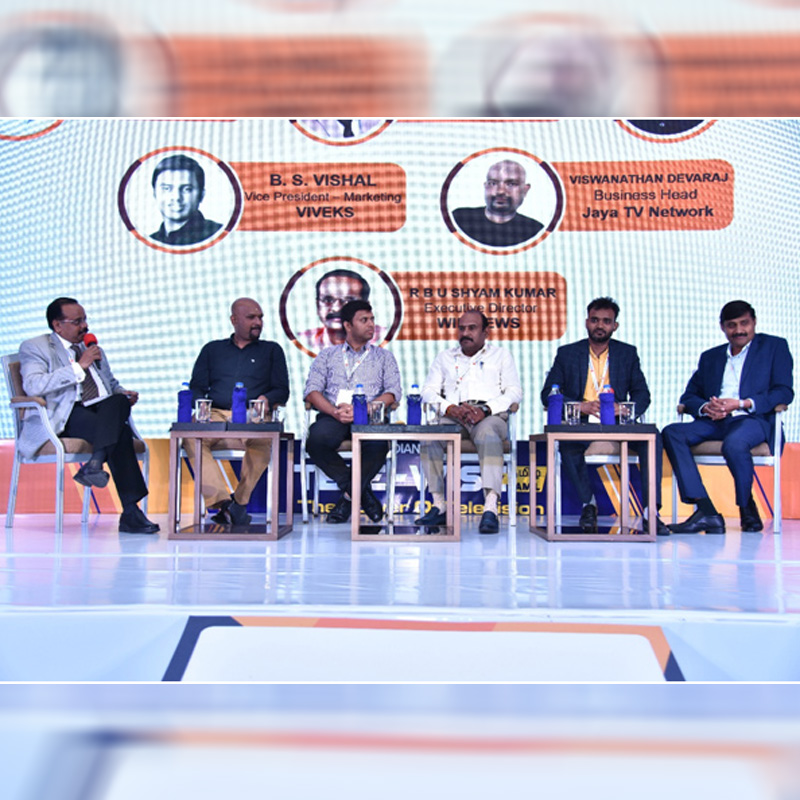
MUMBAI: Tamil GECs should include subtitles in their shows to increase stickiness and drive more brands to advertise on them, was the conclusion of the very insightful ‘Retail Therapy’ session at the recently concluded Tele-Wise Tamil conclave by Indiantelevision.com. The panel was discussing the role of retail advertisers in the Tamil market and how broadcasters can get them to advertise more on television.
Part of the panel were SRM University head of marketing & media Chaitanya Gurijala, Challenge Advertising founder and CEO R. Sakthivel, Kalimark Group joint managing director J. Ramesh, Viveks vice-president marketing B.S. Vishal, and Jaya TV Network business head Viswanathan Devaraj. The session was moderated by Win News executive director, Cornerstone founder president, and Puthiyathalaimurai Group former CEO R.B.U. Shyam Kumar.
The two broadcasters on dais, Devaraj and Kumar, discussed how important subtitling can be in not only driving more viewers to regional channels but also greater advertising revenues. However, they insisted that it has to be evaluated on a cost-benefit model before implementation.
Kumar noted, “I am sure moving hyperlocal, particularly in the GEC segment, will drive a lot of brands because coming from a news channel, I have seen those 4-5 aston bands that we run get a lot of stickiness to our programmes. Even GEC segment can try subtitles as an option to break the ongoing rules and get more traction. Forget about advertising, first of all, it will increase the viewer base to a great extent.”
Devaraj said, “I agree that stickiness to a content increases when there are subtitles on it. In Singapore, if they have a Tamil movie playing, they post subtitles in four different languages, including Tamil language. But when we look at, say Vijay TV, that goes on air in Singapore doesn’t have subtitles in all languages because it is a costly affair.”
To this, Indiantelevision.com founder, CEO, and editor-in-chief Anil Wanvari added that it takes approximately between 12-15 thousand rupees to add subtitles in a half hour episode.
Kumar claimed that if GECs can monetise that additional cost to the production of an episode of a TV show, which he assumed to be close to Rs 1.50 lakh for an half hour run, broadcasters will be equally interested in drawing new audiences.
Devaraj added that this will require a deep analysis based on the cost effectiveness.
The panel also discussed a lot of other interesting topics related to retail advertising in Tamil Nadu market. While Gurijala and Vishal reinstated the fact that print advertising is working for them to a great extent, Sakthivel and Ramesh vouched for the need advertise on TV to increase the user base.
Gurijala said, “I am huge fan of television but for education as a medium, print gives us an edge that we need to survive. There is a belief that parents are looking for education institutes that are more subtle. And subtlety has been the mantra that some of the biggest universities across the globe have followed and are following to build their ads.”
He acknowledged that a few universities like Amity and Lovely Professional are turning the narrative to the other side and investing big in TV but he insisted that advertising on television is only good for getting a sudden spike in the visibility.
Vishal shared that Viveks have been investing in print since the day they started in 1965.
“Back then, the competition was very less and everything that started was on print. Also, I would say that word-of-mouth was a strong medium. I would say, till date, we are known by the trust (that people have in us), and that has given us a strong foothold. I am spending close to 80-85 per cent of my budget on print”
He added, “TVCs are only for a brand recall purpose. But there are national players like Reliance and Croma, who are now spread across Tamil Nadu. For them, I believe, TV TVCs get more leverage than they do for players like us.”
Ramesh shared that television helped his Kalimark Group to a great extent. “When we started in 1916, for the initial few years, we used only paintings to promote our drinks. Later, I am very proud to say, TV helped us greatly in our brand journey. People in Tamil Nadu are very sensitive and they believe what they see. So, TVCs help us in getting their attention. I am spending 75 per cent of my budgets on TV.”
He also shared that the brand initially had a rule that it will not engage with any celebrity to promote its products, but they revoked it with changing times.
Sakthivel also mentioned that TV is the dominating medium in Tamil Nadu. He said, “As an advertising agency that handles a lot of retail clients, I believe that Tamil Nadu is still a television market. To give you an example, 18 years back, my first client was a computer institute who was advertising just on print, spending somewhere around Rs 4-5 lakh rupees for a month-long campaign. We helped him go to television with the same budget, did a TVC with a popular TV star of that time and placed it on 3 GECs. Within 3-4 years, the institute grew from 10 centres to 350 centres.”
He added that while digital is soon catching up with television, advertisers can focus on creating a mix for both the media but only digital will not be able to drive growth.