MAM
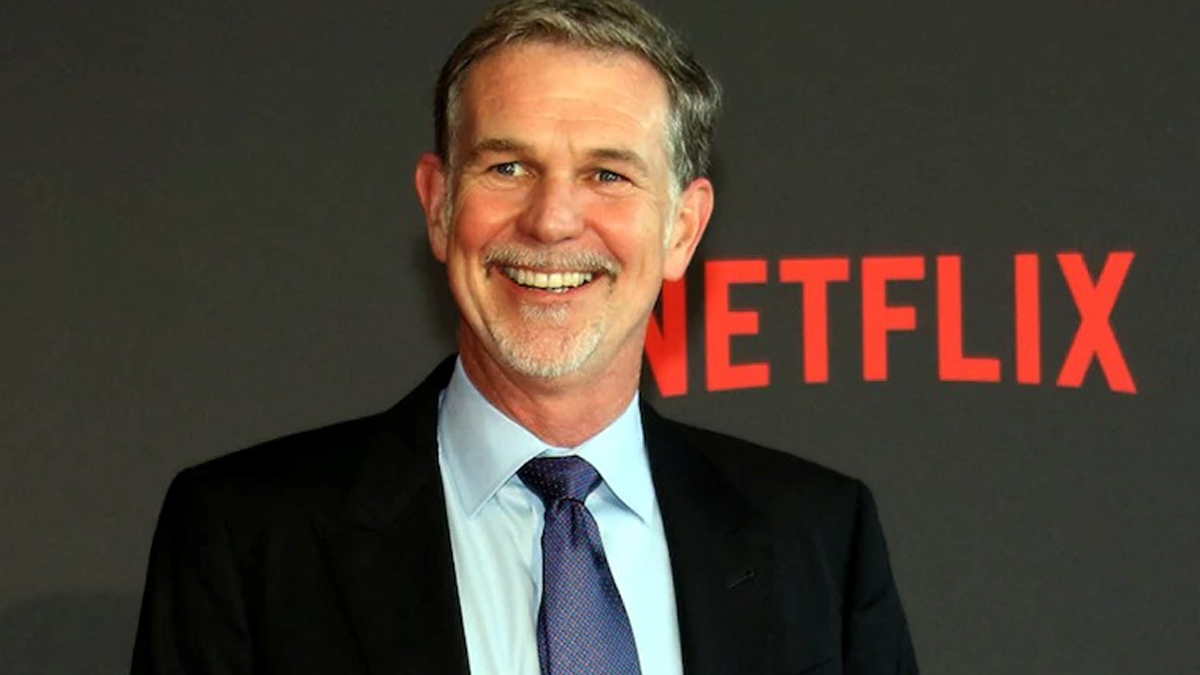
Reed Hastings to exit Netflix board as company posts steady growth
Shares dip 8 per cent as cofounder exits; revenue up 16 per cent to $12.25 billion.
MUMBAI- When the man who taught the world to binge decides to log off, the credits don’t just roll, they reset the script. Reed Hastings is set to step away from Netflix, marking the end of a defining chapter for a company that reshaped global entertainment even as its latest numbers suggest a business finding firmer footing.
Hastings, who co-founded Netflix nearly three decades ago and transformed it from a DVD-by-mail service into a streaming powerhouse, will not stand for re-election at the company’s annual meeting in June. While the company offered little detail on his next move beyond philanthropy and personal pursuits, the symbolic weight of his departure was immediate. Shares fell around 8 per cent following the announcement, underlining how closely Hastings remains tied to investor confidence and the company’s long-term vision.
The exit comes at a moment of recalibration. Netflix has been working to stabilise growth after a period of strategic turbulence, including the loss of a high-profile $72 billion deal involving Warner Bros. Discovery to Paramount Skydance, a setback that raised fresh questions about its ambitions in large-scale content consolidation. Yet, if the deal slipped, the fundamentals appear to be holding.
For the first quarter, Netflix reported revenue growth of 16 per cent to $12.25 billion, slightly ahead of expectations, while earnings per share nearly doubled to $1.23 from 66 cents a year ago. The company reaffirmed its full-year outlook, projecting double-digit revenue growth, expanding margins and strong free cash flow signals aimed squarely at calming post-announcement jitters.
In its shareholder communication, Netflix struck a careful balance between legacy and continuity. Its mission, it reiterated, remains unchanged: to serve a global audience with diverse storytelling across languages and cultures. The message was clear—while a founder may exit, the playbook stays in motion.
At the same time, the company is quietly redrawing that playbook. Netflix is leaning into newer formats such as video podcasts and live programming, including events like the World Baseball Classic in Japan, reflecting a broader industry shift where streaming, television and live experiences increasingly overlap. Advertising, once an afterthought in its subscription-first model, is now moving centre stage, with the company projecting ad revenues of $3 billion in 2026 roughly double current levels.
Still, some questions linger in the wings. Chief among them is how Netflix plans to deploy the $2.8 billion termination fee from the collapsed Warner Bros deal. With competition for premium content intensifying, capital allocation decisions in the coming quarters could prove as consequential as the leadership transition itself.
For now, Netflix finds itself in a familiar paradox: a company built on disruption navigating continuity. Hastings may be stepping off the stage, but the show by design goes on.

Brands
Wipro hires 7,500 freshers, withholds FY27 hiring outlook
Profit rises to Rs 3,522 crore, Rs 15,000 crore buyback announced.
MUMBAI- Hiring may be on, but visibility is off, Wipro is adding talent even as it pauses the crystal ball. The company hired 7,500 freshers in FY26 but stopped short of offering any hiring outlook for FY27, underscoring the uncertainty gripping the IT services sector as it pivots towards an AI-led operating model.
The disclosure came alongside its fourth-quarter earnings, where management flagged volatile demand conditions and refrained from committing to future workforce expansion. Chief human resources officer Saurabh Govil noted that over 3,000 of the total hires were onboarded in the March quarter alone, signalling continued intake despite a lack of clarity on deployment pipelines.
This divergence active hiring without forward guidance reflects a broader industry pattern where talent acquisition continues even as deal conversions remain uneven and client spending cycles stretch. Wipro expects its IT services revenue for the June quarter to range between a decline of 2 per cent and flat growth sequentially in constant currency terms, reinforcing near-term caution.
Chief executive officer Srini Pallia pointed to artificial intelligence as both a disruptor and an opportunity. He said evolving client priorities are pushing the company towards outcome-driven engagements, with Wipro increasingly focusing on a services-as-software model through its AI Native Business and Platforms unit. The shift marks a structural change from traditional headcount-led growth to AI-enabled delivery frameworks.
The company has already committed over $1 billion to its AI ecosystem, with investors closely watching how these investments translate into revenue. For now, the numbers present a mixed picture. Net profit rose sequentially to Rs 3,522 crore, while revenue grew 3 per cent to Rs 24,236 crore. However, core IT services performance remained under pressure, with full-year revenue declining 0.3 per cent in dollar terms and 1.6 per cent in constant currency.
Large deal bookings offered a counterpoint, rising 45.4 per cent year-on-year to $7.8 billion, highlighting a widening gap between deal wins and actual revenue realisation. On a quarterly basis, IT services revenue slipped 1.2 per cent sequentially, signalling continued softness in execution.
Margins, however, told a more optimistic story. Operating margins expanded to 17.3 per cent in the fourth quarter, up from 14.8 per cent in the previous quarter, reflecting improved cost discipline. That said, the company cautioned that upcoming wage hikes and the ramp-up of large deals could exert pressure going forward.
Attrition stood at 13.8 per cent in the March quarter, indicating stabilisation after periods of elevated churn. Alongside its earnings, Wipro also announced a Rs 15,000 crore share buyback, reinforcing its focus on shareholder returns, with a payout ratio of 88 per cent over the past three years.
Taken together, the numbers capture a company in transition investing in AI, maintaining hiring momentum, but navigating a demand environment where growth is uneven and visibility remains limited.