MAM
Radico Khaitan launches World’s First Single Malt Whisky finished in Indian Wine Casks – Rampur Asava


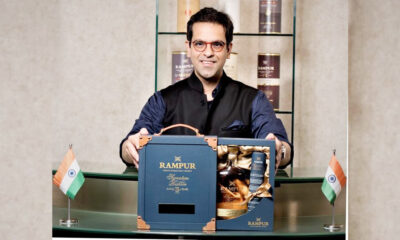
Radico Khaitan – the largest manufacturer of Indian Made Foreign Liquor (IMFL) in India – has added yet another feather to its cap with the recent launch of a unique and exciting new expression ‘Rampur Asava Indian Single Malt Whisky’ at The Whisky Show 2020 in the United Kingdom. In a first, a single malt matured in American Bourbon Barrels has been carefully finished in Indian Cabernet Sauvignon casks, at one of Asia’s largest distilleries i.e. Rampur, UP. Currently launched in the UK and the US, Rampur Asava – a non-chill filtered and bottled at 45% ABV resulting in a ground-breaking expression with perfect balance – is set to be made available in a few other markets for whisky connoisseurs soon.
With the exclusive combination of Rampur’s unique distillation and maturation process, this single malt has successfully taken traditional Indian heritage and rooted it in contemporary culture. This luxury whisky, produced at a distillery located in the foothills of the Himalayas, is the perfect amalgamation of tradition and innovation through the use of Indian Cabernet Sauvignon casks. The unique distillery location exposes the whiskies to polar opposite climate conditions throughout the year, with the flavour of the famous Indian Summer giving Rampur Single Malts an added dimension as well as depth.
“We are very proud of our Indian heritage and Rampur Asava is another step in bringing the unique whiskies of India to the world. We are confident the exotic and unique Indian flavours will delight your palate,” said Mr. Abhishek Khaitan, Managing Director, Radico Khaitan.
Rampur Asava is an electrifying addition to Rampur’s Indian Single Malt Whisky range, which currently boasts of Rampur Select, Rampur Double Cask, limited edition Rampur Sherry PX and the ultra-exclusive Rampur Signature Reserve.
Sanjeev Banga, President, International Business of Radico, said: “We are always striving to make each Rampur expression of the highest quality and exciting for malt whisky drinkers. The diverse weather conditions at the distillery have enabled us to be creative and experiment with our single malts. We are delighted with the results as there is an impeccable balance of taste in this finely perfected golden nectar that lingers on your taste buds.”
Tasting Notes:
Appearance: Dark mahogany
Nose: Typical tropical fruity note of Rampur with added notes of apricot, blackberry, black currant, dark cherry & plum followed with a faint hint of tobacco and spices.
Palate: Velvety, Manuka honey sweetness highlighted by spicy oak, vanilla and balanced with dryness from Indian red wine.
Finish: Medium to long finish which gently lingers on the palate
Initial launch in UK and USA. More markets to follow.
Instagram: @rampursinglemalt
Facebook: @rampursinglemalt
www.rampursinglemalt.com
Notes to Editors:
Rampur Asava Indian Single Malt Whisky is owned by Radico Khaitan – the largest Indian beverage alcohol company and one of the oldest whisky distillers in India – established in 1943. The company has been distilling malt whiskies for over 27 years with a reputation for quality and innovation.
Three of Radico Khaitan’s distilleries are based in Uttar Pradesh in the foothills of the Himalayas, where all of Rampur’s Whiskies are distilled, matured and bottled. Rampur is named after the princely Indian state known for its rich heritage and royal traditions.
Radico Khaitan are also the producers of award winning Jaisalmer Indian Craft Gin, which is triple-distilled in traditional copper pot stills and hand-crafted with a recipe that combines the ancient knowledge of herbs and spices, vibrant juniper berries and hand-picked botanicals from all four corners of India. With seven of the 11 botanicals coming from India, Jaisalmer Indian Craft Gin is ‘the whole of Indian in one bottle’.
For trade enquiries please contact: exports@radico.co.in